
Quick answer: The best AI content detectors right now are Pangram for accuracy, GPTZero for teachers and students, and Originality.ai for publishers and SEO teams. Pangram beat GPTZero, Copyleaks and Turnitin in a 2026 university study, especially on edited AI text. Still, no detector is reliable enough to prove who wrote something on its own.
AI detectors are everywhere now. Teachers run essays through them, editors screen freelance drafts, and plenty of writers check their own work just so a human-written piece doesn’t get labeled “90% AI.” The catch is that a score like “92% AI” doesn’t mean there’s a 92% chance a machine wrote it. Different tools score text differently, and two good detectors can disagree about the same paragraph. Here’s how the main tools compare on price and features, what independent research says about their accuracy, and what to do when a detector gets it wrong.
In this article 9 sections
Best AI Content Detectors Compared
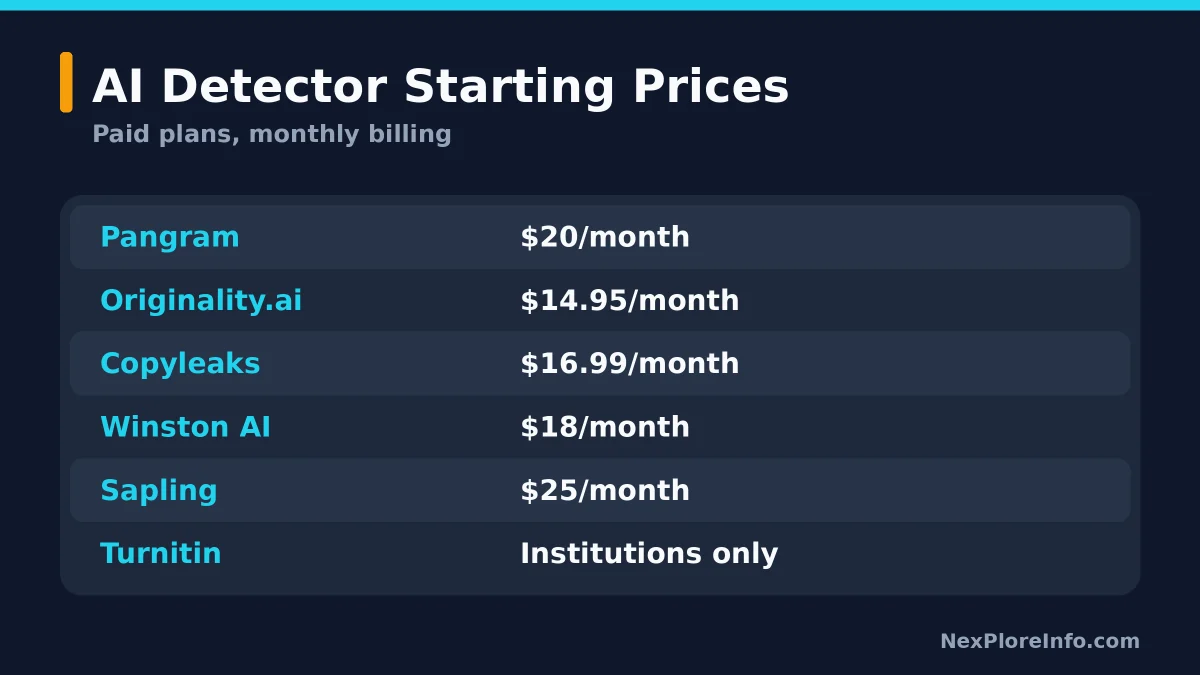
Pangram, GPTZero and Originality.ai lead for most people, while Copyleaks, Winston AI, Turnitin and Sapling each fit a narrower job. Prices below are starting prices from each company’s own pricing page as of October 25, 2026.
| Detector | Best for | Free option | Starting paid price | Standout feature |
|---|---|---|---|---|
| Pangram | Accuracy, universities | 7-day trial | $20/month | Top result in a 2026 independent study |
| GPTZero | Teachers and students | Free plan with limits | Paid plans on gptzero.me | Writing Replay shows how a doc was written |
| Originality.ai | Publishers, SEO teams | 10,000 words, one time | $14.95/month ($12.95 billed yearly) | AI, plagiarism and fact checks together |
| Copyleaks | Multilingual and business use | Not listed | $16.99/month ($13.99 billed yearly) | 30+ languages, API and LMS tools |
| Winston AI | Editorial reports | 2,000 credits for 14 days | $18/month ($10 billed yearly) | Highlight map and shareable reports |
| Turnitin | Schools and universities | Through your institution | Institution pricing only | Built into academic workflows |
| Sapling | Quick second opinion | 2,000 characters per check | $25/month ($12 billed yearly) | Fast, simple sentence-level check |
Which AI Detector Should You Use? Our Picks by Need
Pick a detector by what you’re checking. Accuracy matters most for high-stakes decisions, while workflow features matter more if you’re screening lots of content every week.
1. Pangram: best overall for accuracy
Pangram has the strongest outside evidence behind it. In a study published in the International Journal for Educational Integrity, researchers at Vrije Universiteit Brussel tested Pangram, GPTZero, Copyleaks and Turnitin on 160 documents of known origin. All four correctly identified fully human writing, but Pangram did best on mixed human-AI text and on AI text that had been “humanized” to dodge detection. The other three tended to underestimate AI content. Pangram’s Individual plan costs $20 a month with 300,000 words, a 7-day free trial and Google Docs and Gmail add-ons.
2. GPTZero: best for teachers and students
GPTZero is the name most people know, and its interface is easy to read, with sentence highlighting and plagiarism checks. The feature worth knowing about is Writing Replay, which shows how a Google Doc was built over time. As detection gets harder, proof of the writing process is often more useful than a guess about the finished text. In the Brussels study GPTZero underestimated AI content, so treat its scores as a signal, not a ruling. It has a free plan with word limits and paid tiers for heavier use.
3. Originality.ai: best for publishers and SEO
Originality.ai is built for content teams rather than classrooms. Along with AI detection, you get plagiarism checks, readability scores, a fact checker and team management. The free tier gives you 10,000 words once, and Pro costs $14.95 a month for 200,000 words, or $12.95 a month billed yearly. One credit covers 100 words for an AI-only scan, and an AI plus plagiarism scan uses two.
4. Copyleaks: best for multilingual teams
Copyleaks says its detector supports more than 30 languages, which makes it a good fit for international publishers and companies. It also offers an API and learning management system integrations. The Personal plan is $16.99 a month for up to 25,000 words, or $13.99 a month billed yearly. Education and enterprise pricing needs a sales quote.
5. Winston AI: best for shareable reports
Winston AI shows a prediction map that highlights the passages that look machine-written, which makes it easier to discuss a result with a writer. It also includes plagiarism checks, PDF reports and a WordPress plugin. The free trial gives you 2,000 credits for 14 days. Essential starts at $18 a month for 100,000 credits, or $10 a month billed yearly.
6. Turnitin: best inside schools
Turnitin’s AI writing report lives inside the tools many schools already use, so teachers don’t need a separate service. You can’t buy it as an individual, though. Turnitin reports a false positive rate of about 1.3% for native English writers and 1.4% for English language learners on documents over 300 words, and it says it found no significant bias against non-native speakers.
7. Sapling: best quick second opinion
Sapling is the lightweight option. Paste text in and you get a probability score with sentence-level detail in seconds. The free version checks up to 2,000 characters at a time, and Pro raises that to 100,000 characters for $25 a month, or $12 a month billed yearly. It’s handy for a fast second check, not a full workflow.
How Accurate Are AI Detectors?
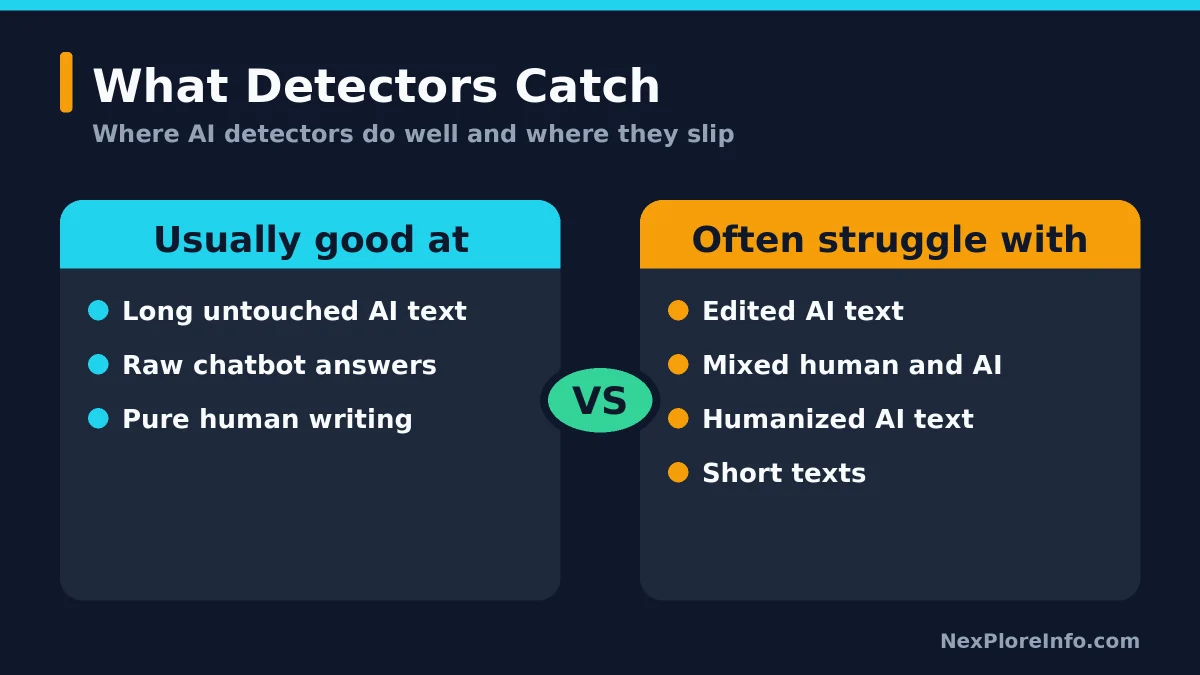
AI detectors are fairly good at spotting long, untouched AI text and much weaker on edited or mixed writing. That gap is the main thing to understand before trusting any score.
Most vendors advertise accuracy close to 99%, and those numbers can be real under their own test conditions. But a benchmark built on raw chatbot answers is very different from a human article with three AI-polished paragraphs. Academic essays behave differently from product pages, and English behaves differently from other languages. Detectors also get updated, so a study from six months ago may not match today’s results.
The Brussels study shows the pattern clearly. Every tool handled pure human writing well and false positives were rare, but three of the four struggled once AI text was edited or humanized. The authors concluded that detectors “should not be used as sole evidence in high-stakes decision-making.” When the same team scanned 1,163 recent master’s theses with Pangram, it flagged 45.5% of them, mostly at low to moderate levels of AI-associated writing.
Can AI Detectors Give False Positives?
Yes. Any detector can label human writing as AI, and that’s the most damaging mistake it can make when grades or jobs are on the line.
A widely cited 2023 Stanford study, “GPT detectors are biased against non-native English writers”, ran 91 TOEFL essays through seven detectors. On average, 61.3% of those human-written essays were flagged as AI. Simple, predictable phrasing, which is common for people writing in a second language, looked “machine-like” to the tools.
The picture is more mixed now. Turnitin reports similar false positive rates for native and non-native writers on longer documents, and the Brussels study found false positives were rare on human text. But short texts, formulaic writing and heavily edited documents still trip detectors up. The safe takeaway is simple: a score alone isn’t strong enough evidence for a serious accusation.
How Do AI Content Detectors Work?
AI detectors don’t contact ChatGPT, Claude or Gemini to ask who wrote something. They analyze patterns in the text itself.
Two terms come up a lot. Perplexity measures how predictable the next word is, and AI text has historically been more predictable than human writing. Burstiness measures variation, since people naturally mix short and long sentences and odd word choices. Modern detectors go further, using classifiers trained on huge sets of human and AI writing that weigh hundreds of signals at once.
The trouble is that the line keeps blurring. AI models write more like people every year, and people use AI for grammar fixes, outlines and rewrites. If you want the basics on how these models generate text, our guides to what ChatGPT is and why AI hallucinates are a good start.
What to Do When an AI Detector Flags Human Writing
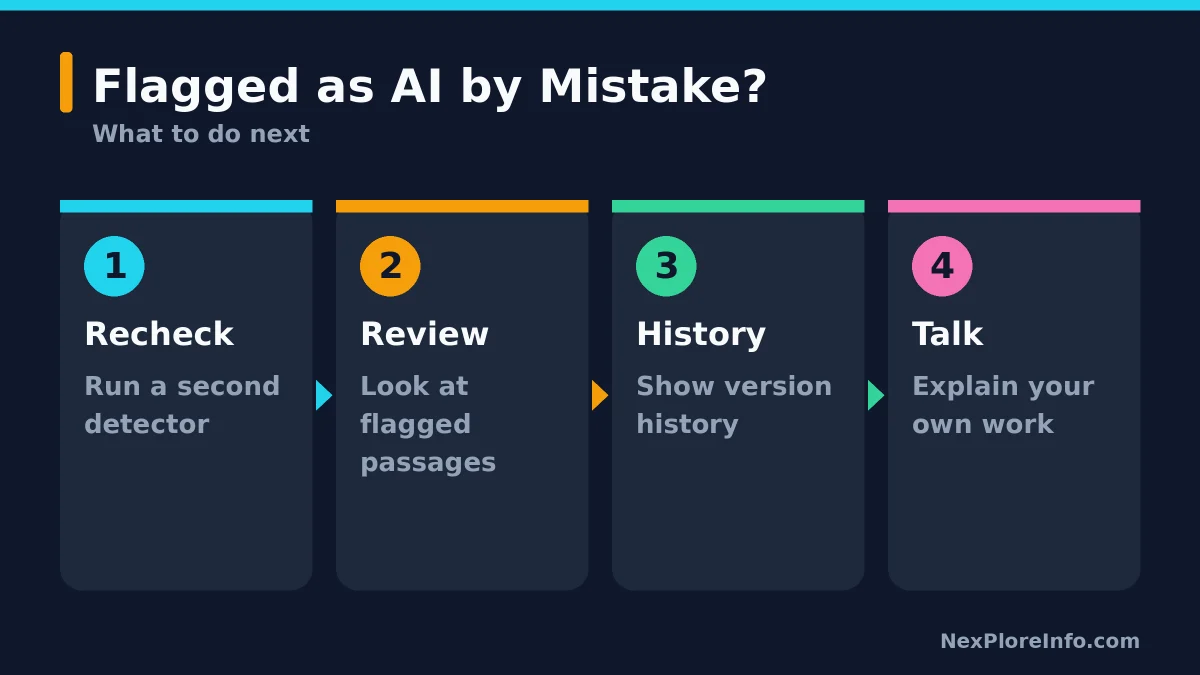
Don’t panic, and don’t rely on the score alone. Gather evidence about how the text was written instead.
- Run a second detector. If two tools disagree, the first score was a weak signal.
- Check the highlighted passages. Short, formulaic sections like definitions or lists often trigger false flags.
- Show the writing history. Google Docs version history or GPTZero’s Writing Replay can show drafts, edits and timing.
- Share notes and sources. Research notes, outlines and saved links back up human authorship.
- Talk it through. A writer who can explain and revise their own work in person is the clearest evidence of all.
For schools, clear rules about when AI help is allowed tend to work better than trying to catch it after the fact. Our AI tools for students and teachers guide covers ways to use AI openly in class.
Should Website Owners Worry About AI Content?
Not about detector scores. Google has said it rewards helpful, high-quality content however it’s produced, and it targets content made mainly to manipulate rankings, as explained in Google Search Central’s guidance on AI content.
So the useful questions for editors are the old ones. Are the facts right? Are real sources cited? Does the piece add experience or analysis? Does it answer the reader’s question better than what’s already ranking? A 0% AI score doesn’t make a thin article good, and AI help with an outline doesn’t make a great one bad. If you use AI for drafts, our how to write AI prompts guide helps you get better first drafts to edit.
Can you trust a 0% AI score?
Not completely. A 0% score only means the tool didn’t find enough AI-like patterns under its current model. It doesn’t prove no AI was used, just as an 80% score doesn’t prove a person didn’t write it.
Verdict
AI detectors are better than they were in the early ChatGPT days, and the best ones are useful for screening large amounts of text and pointing you to passages worth a closer look. Pangram has the strongest independent evidence, GPTZero is the easiest everyday tool with the best writing-history feature, and Originality.ai fits publishers who also need plagiarism and fact checks.
But better isn’t the same as certain. Treat any score as the start of a check, not the end of one. Read the text, look at the sources and writing history, and ask questions before making any decision that affects someone’s grade or job.
FAQs
What is the best AI detector right now?
There’s no single best AI detector for every kind of text. Pangram performed best in a 2026 study in the International Journal for Educational Integrity, especially on mixed and humanized AI writing, while GPTZero, Copyleaks and Turnitin tended to underestimate AI content in that test.
Is there a free AI detector that works?
Yes, several have free options. GPTZero has a free plan, Originality.ai gives 10,000 free words once, Sapling checks up to 2,000 characters for free, and Winston AI offers a 14-day trial. Free tiers work best on longer, unedited text.
Can AI detectors detect ChatGPT, Claude and Gemini?
Major detectors say they’re trained on output from leading models, including ChatGPT, Claude and Gemini. Accuracy still drops when the text has been edited, paraphrased or mixed with human writing.
Can AI detectors be wrong about human writing?
Yes. Human text can be flagged as AI, especially short or formulaic writing. A 2023 Stanford study found seven detectors flagged 61.3% of human-written TOEFL essays as AI on average, so a score should never be the only evidence.
Should teachers use AI detectors to accuse students of cheating?
A detector score shouldn’t be the sole proof. Researchers behind the 2026 Brussels study warned against using detectors as sole evidence in high-stakes decisions. Writing history, drafts and a conversation with the student give far better evidence.
Is AI detection the same as plagiarism checking?
No. Plagiarism checkers look for text that matches existing sources. AI detectors estimate whether writing has patterns typical of machine text. An AI-written article can be fully original, and a human-written one can still be plagiarized.


Leave a Comment