

Sam Altman’s RAM comment started as one sentence on a podcast, and a few hours later half the PC world was angry at him. The OpenAI boss suggested that the RAM sitting inside your computer is a poor use of the world’s limited memory supply. Gamers, developers and people who run AI models at home heard something very different: “your RAM should be in my data center.”
So what did he really say, and should you care? If you have ever run an AI model on your own laptop with Ollama, or wondered why AI is pushing up the price of phones and memory chips, this story is really about you. Here is the full picture, minus the memes.
In this article 11 sections
- Quick Answer
- Sam Altman’s RAM Comment at a Glance
- What Did Sam Altman Say About RAM?
- Why Did the RAM Comment Make People So Angry?
- Did Sam Altman Take It Back?
- Is the 5% RAM Figure Actually True?
- Why Is RAM So Expensive Right Now?
- Local AI vs Cloud AI: Who Is Right?
- How Much RAM Do You Need to Run AI Locally?
- What This Means for You If You’re Buying a PC
- FAQs About Sam Altman’s RAM Comment
Quick Answer
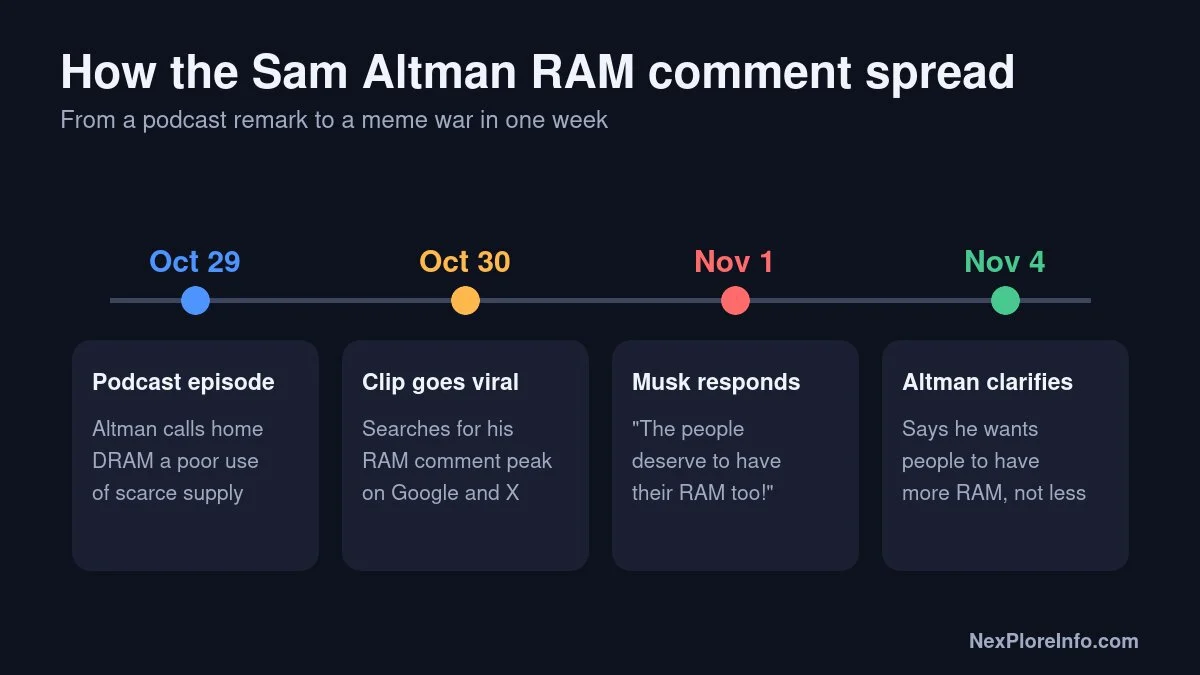
On the Cheeky Pint podcast with Stripe co-founder John Collison, released October 29, Sam Altman said it is “quite terrible,” from a global allocation point of view, for everyone to keep scarce DRAM in their own computers when, by his estimate, it is used about 5% of the time. He was talking about local AI inference, meaning running AI models on your own PC, during a wider chat about the memory shortage. After the backlash, he said on X that he wants people to have as much RAM as they like, and that the real fix is building more memory.
Sam Altman’s RAM Comment at a Glance
| Question | Short answer |
|---|---|
| Where did he say it? | Cheeky Pint, Stripe’s podcast hosted by John Collison |
| When did the episode come out? | October 29; the clip went viral the next evening |
| What was the topic? | Local AI inference and the global DRAM shortage |
| Key phrase | “Quite terrible” for scarce DRAM to sit in home PCs used about 5% of the time |
| Did he say people shouldn’t own RAM? | No. He argued about efficiency, not ownership |
| Biggest reaction | Elon Musk’s November 1 post: “The people deserve to have their RAM too!” |
| His follow-up | Said he wants the world to have tons of memory and called for more production |
| Why it hit a nerve | RAM prices have climbed more than 500% in about a year |
What Did Sam Altman Say About RAM?
The conversation was not about your gaming rig at first. Collison and Altman were talking about why chip and memory supply has not kept up with AI demand. Altman’s view is that memory makers have been burned by boom and bust cycles for decades, so they are slow to build new factories even when demand is huge.
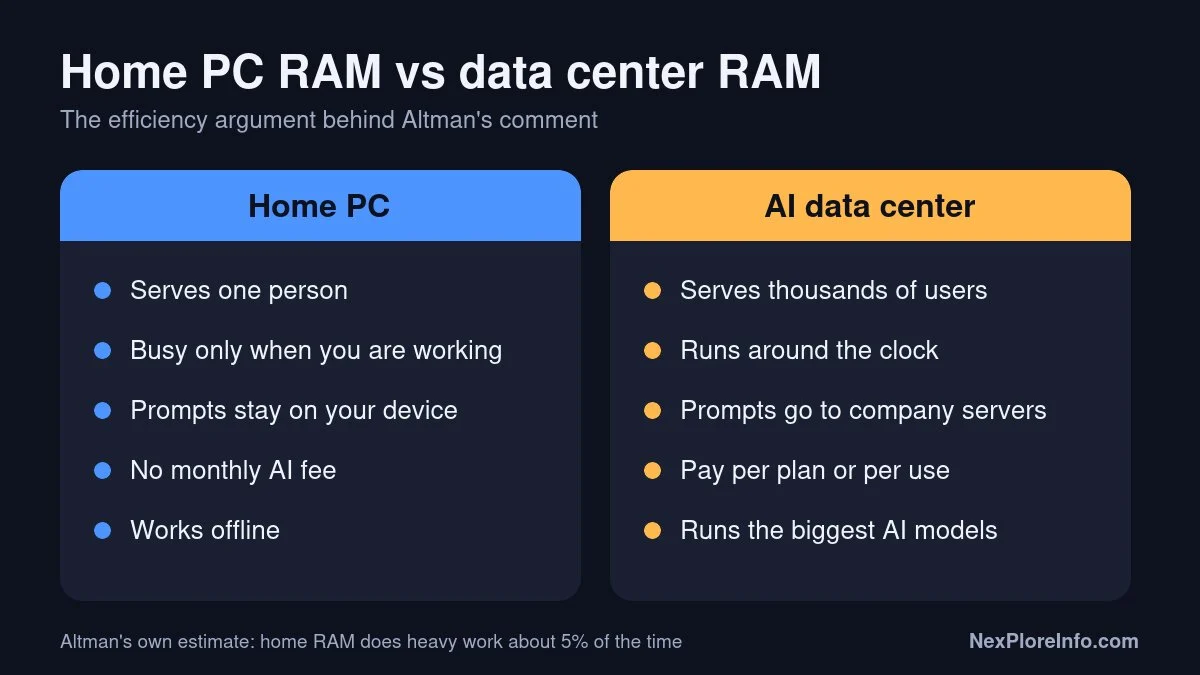
Then the subject turned to local inference. A lot of people argue that open-source models running on home computers could take pressure off data centers. Altman disagreed. According to Engadget’s report on the interview, he said that from a “global allocation perspective” it is terrible for everyone to hold a chunk of the world’s DRAM in a computer that uses it a tiny fraction of the time. His point: in a supply-constrained world, you want memory working around the clock in the cloud.
Read it slowly and the logic is simple. A server in a data center serves many users, all day and all night. Your laptop’s 16GB or 32GB mostly waits for you to open a browser tab. From a pure spreadsheet view of the world’s memory, that looks wasteful.
The trouble is that people don’t buy computers to be efficient on a global spreadsheet. They buy them to work, play, edit videos and, more and more, to run AI privately.
Why Did the RAM Comment Make People So Angry?
Timing, mostly. The clip spread on X with a caption that made it sound like Altman wanted to take memory away from ordinary people. That framing was harsher than what he said, but it landed during the worst memory squeeze the PC market has seen in years.
There is also the question of who was saying it. Back in October 2025, Samsung and SK hynix signed letters of intent to supply OpenAI’s Stargate project, and both companies said its demand could reach 900,000 DRAM wafers a month. As Tom’s Hardware worked out at the time, that could be close to 40% of global DRAM output. So when the head of the company buying that much memory calls home RAM a bad allocation, it sounds less like an economics lesson and more like a sales pitch.
Elon Musk saw the opening. On November 1 he posted a meme from the film Inglourious Basterds about “withholding DRAM from the cloud,” with the line “The people deserve to have their RAM too!” That post pulled in millions of views and turned the debate into a full meme war.
Did Sam Altman Take It Back?
Sort of. He didn’t delete anything, but he pushed back hard on how people read it. In replies on X he said he actually wants the world to have tons of memory and people to put as much as they want in their computers. In another reply on November 4 he wrote, in his usual lowercase style, that he wants you to have “so much ram” and that the answer is to build more.
He also leaned into the joke. After a user suggested it, he briefly changed his X display name to “Ram Altman.” It was a smart move. A pun does more to cool down an internet fight than a long clarification thread ever could.
Still, the clarification and the original quote can both be true. He wants more memory built overall. He also thinks memory used for AI work belongs in data centers where it runs nonstop. Those two ideas sit together fine in his head. They just don’t sit well with people paying record prices for a RAM kit.
Is the 5% RAM Figure Actually True?
Nobody really knows, and that matters. The 5% number is Altman’s own estimate. He did not share a study behind it, and no independent data has backed it up so far.
It also depends on what you call “used.” Your operating system keeps RAM busy the whole time the computer is on. Windows and macOS cache files and apps in spare memory so things open faster. In that sense, RAM is almost never idle. What Altman probably means is that your memory isn’t doing heavy, useful work most hours of the day, especially overnight or while you’re away.
There is a real idea underneath it. Data centers pool resources, so one server can share memory across many customers and stay busy. That is genuinely efficient. But efficiency is not the only thing people value. Privacy, offline access, no subscription fees and full control over your own data are reasons people choose local AI in the first place.
Why Is RAM So Expensive Right Now?
Because AI companies are buying memory faster than factories can make it. Chipmakers have shifted a big part of their production toward server memory and HBM, the stacked high-bandwidth memory used in AI accelerators. That leaves less ordinary DRAM for laptops, desktops and phones. PC builders have started calling it the RAM crisis, and some online even call it “RAMageddon.”
The numbers are rough. In mid-October, Tom’s Hardware found the cheapest 32GB DDR5-6000 kit at $449.97 in the USA, and said RAM prices had climbed more than 500% in about a year. And the pressure isn’t over. TrendForce forecasts conventional DRAM contract prices will rise another 10% to 15% in the fourth quarter, with PC makers still buying aggressively because they think supply will stay tight into 2027.
| Memory price snapshot | Figure | Source and date |
|---|---|---|
| Cheapest 32GB DDR5-6000 kit (USA retail) | $449.97 | AED 1,653 (converted) | Tom’s Hardware, October 14 |
| RAM price change over about a year | Up more than 500% | Tom’s Hardware, October 14 |
| Conventional DRAM contract prices, Q4 | Up 10% to 15% vs Q3 | TrendForce forecast, September 30 |
| Total DRAM including HBM, Q4 | Up 15% to 20% vs Q3 | TrendForce forecast, September 30 |
The AED figure is a straight conversion at 3.6725 AED per USD, not a UAE shelf price. Store prices in the UAE move with stock and import costs, so expect some gap between the two.
Local AI vs Cloud AI: Who Is Right?
Honestly, both sides have a point, and the right answer depends on what you use AI for.
The case for the cloud is scale. Big models like the ones behind ChatGPT need far more memory than any home PC has. Running them in shared data centers means one expensive machine serves thousands of people. If you want to understand how those facilities work, our guide on how AI data centers work and how much power they use covers it in plain language.
The case for local AI is control. Your prompts never leave your machine. You don’t pay per month. It works on a plane. And for many everyday jobs, like summarizing documents, drafting emails or helping with code, a small open model on a decent laptop does the job well.
The fair middle ground looks like this:
- Use cloud AI for heavy, cutting-edge tasks that need the biggest models.
- Use local AI for private documents, offline work and routine tasks.
- Don’t buy huge amounts of RAM “just in case” during a shortage. Buy what your actual workload needs.
How Much RAM Do You Need to Run AI Locally?
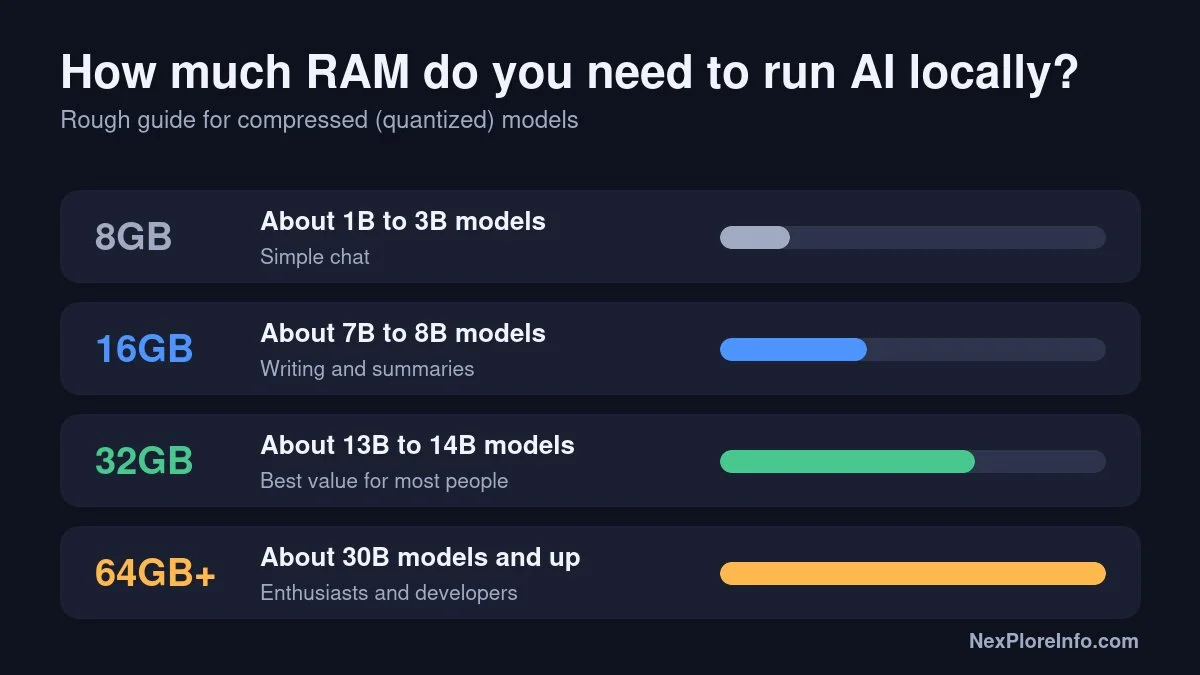
This is the practical question hiding inside the whole drama. The rough rule: the bigger the model, the more memory it needs. Most people run “quantized” models, which are compressed versions that use far less memory with a small hit to quality.
| System RAM | What it can comfortably run | Good for |
|---|---|---|
| 8GB | Very small models (about 1B to 3B parameters) | Simple chat, quick text tasks |
| 16GB | Small models (about 7B to 8B, compressed) | Writing help, summaries, basic coding |
| 32GB | Mid-size models (about 13B to 14B, compressed) | Better reasoning, longer documents |
| 64GB and up | Larger models (about 30B and above, compressed) | Enthusiasts and developers |
These are general guidelines, not hard limits. A graphics card with its own video memory changes the math, and Apple’s M-series Macs share one pool of memory between the processor and graphics, which helps a lot with local AI. For most people, 32GB is the sweet spot right now: enough for useful local models without paying shortage prices for 64GB.
What This Means for You If You’re Buying a PC
Altman’s words won’t change what your computer can do. There is no new rule, no policy and no limit on running AI at home. What does affect you is the shortage behind his comment.
- If your PC works fine, wait. Upgrading RAM at today’s prices only makes sense if you’re running out of memory every day.
- Buy laptops with enough RAM from day one. Many thin laptops have soldered memory you can’t upgrade later, so 16GB is the floor and 32GB is smarter for AI use.
- Check DDR4 if your platform supports it. Older-generation memory has generally stayed cheaper per gigabyte than DDR5.
- Try local AI before you spend. Run a small model on what you already own and see if it covers your needs.
If there’s one takeaway here, it’s that AI now competes with regular buyers for the same physical chips. You feel it in RAM kits first, then in laptop price tags, and eventually in what your next phone costs. If you’re curious about the other hidden costs of AI, check out how much electricity one ChatGPT question actually uses.
FAQs About Sam Altman’s RAM Comment
Did Sam Altman say people shouldn’t own RAM?
No. He said that, in a global shortage, it is inefficient for lots of DRAM to sit in home computers that rarely use it fully. He never proposed taking RAM away from anyone, and he later said he wants people to have as much as they want.
What podcast was Sam Altman on when he talked about RAM?
He was on Cheeky Pint, the podcast hosted by Stripe co-founder John Collison. The episode came out on October 29, and the RAM clip went viral on X the following evening.
What did Elon Musk say about Sam Altman and RAM?
On November 1, Musk posted a meme on X with the caption “The people deserve to have their RAM too!” mocking the idea that home PCs are wasting memory.
Why did Sam Altman change his name to Ram Altman?
After an X user suggested it, he briefly switched his display name to “Ram Altman” as a pun, turning the criticism into a joke.
Why is RAM so expensive right now?
AI data centers are buying huge amounts of memory, and chipmakers are shifting production toward server memory and HBM. That leaves less DRAM for consumer PCs and phones, which pushes retail prices up.
Will RAM prices go down soon?
Not soon, based on current forecasts. TrendForce sees DRAM contract prices still rising in the fourth quarter and notes that PC makers think supply will stay tight into 2027.
Is running AI locally bad for the RAM shortage?
Not in any way you should feel guilty about. Home users make up a small part of memory demand compared with AI data centers. Running a model on hardware you already own adds nothing to the shortage.





Leave a Comment