
What are AI hallucinations? They are answers from a chatbot that sound confident and fluent but are false, invented or unsupported. If you have ever asked ChatGPT, Claude or Gemini for a source and received a link that does not exist, you have seen one. This guide is for everyday users who use AI for study, work or content and want to know why it happens, how to spot it and what to do about it.
By the end you will have a plain-language explanation, real documented examples, a seven-step checklist and prompts that lower the risk of made-up answers.
In this article 12 sections
- What Is an AI Hallucination?
- Why Do AI Chatbots Hallucinate?
- AI Hallucination vs Outdated Information vs a Simple Mistake
- AI Hallucination Examples That Really Happened
- Types of AI Hallucinations to Watch For
- How to Spot AI Hallucinations: A 7-Step Checklist
- How to Stop ChatGPT, Claude and Gemini From Hallucinating
- Can Web Search Stop AI Hallucinations?
- Can AI Hallucinations Be Fixed?
- Do AI Hallucinations Matter for AI Agents?
- How AI Hallucinations Differ From Bias
- Frequently Asked Questions
What Is an AI Hallucination?
OpenAI defines hallucinations as “plausible but false statements generated by language models.” IBM describes them as outputs that seem credible but are false, irrelevant or invented, and says they can be reduced but not fully eliminated.
In short: a hallucination does not require intent. The model generates a plausible response from learned patterns, and sometimes that response contains false, invented or unsupported information.
Why Do AI Chatbots Hallucinate?
There is no single cause. The main reasons documented by AI labs and technology companies are below.
1. Models predict words, not facts
A language model learns by predicting the next word across huge amounts of text. OpenAI explains that regular patterns such as spelling improve with scale, but arbitrary low-frequency facts, like a private person’s birthday, cannot be worked out from patterns alone, so errors appear.
2. Training rewards guessing
OpenAI argues that standard training and testing reward guessing over admitting uncertainty, much like a multiple-choice exam with no penalty for wrong answers. In the figures OpenAI cites from the GPT-5 system card on the SimpleQA test, o4-mini scored slightly higher accuracy (24% vs 22%) than gpt-5-thinking-mini but had a far higher error rate (75% vs 26%), because the other model declined to answer more often.
3. The “I know this name” signal misfires
Anthropic’s interpretability research found that Claude’s default behavior is to decline when it lacks information. When a “known entity” signal switches on for a name the model only vaguely recognizes, it suppresses that default and the model can produce a plausible but untrue answer.
4. Flawed data and weak grounding
Google Cloud notes that incomplete or biased training data and a lack of grounding in real-world facts can lead to outputs that look right but are wrong, including links to web pages that do not exist.
AI Hallucination vs Outdated Information vs a Simple Mistake
Not every wrong AI answer is a hallucination. The cause matters:
- Hallucination: the model invents or states unsupported information, such as a fake study, quotation or URL.
- Outdated information: the answer may once have been correct but no longer reflects the latest price, policy, product or event.
- Reasoning mistake: the model has the right facts but makes an error in logic, arithmetic or interpretation.
- Prompt or context error: the model misunderstands the instruction or loses access to an earlier detail in a long conversation.
That last case is why context management matters. Our guide to what a context window in AI is explains how active context, token limits and long chats can affect what a model can reliably use.
AI Hallucination Examples That Really Happened
These cases are documented by court records and reputable outlets, not invented for effect.
- Fake court cases (2023): In Mata v. Avianca, lawyers filed a brief with cases found through ChatGPT that did not exist. On June 22, 2023, a federal judge in the Southern District of New York fined the attorneys and their firm $5,000 | AED 18,375 after they kept defending the fake opinions.
- Glue on pizza: IBM cites a Google AI Overview that suggested adding nontoxic glue to pizza sauce, drawing on a 2013 joke post on Reddit, as reported by the BBC.
- Invented links and sources: Google Cloud lists fabricated web page links as a common form of hallucination.
Types of AI Hallucinations to Watch For
| Type | What it looks like | Typical risk |
|---|---|---|
| Invented facts | Wrong dates, statistics or biographies stated with confidence | Misinformation in homework, posts and reports |
| Fake sources | Book titles, studies, quotes or URLs that do not exist | Credibility loss, legal trouble |
| Added details | A summary that includes points missing from the original text | Misleading summaries |
| Unsupported conclusions | A response draws a claim that the cited evidence does not support | Misleading reports and decisions |
How to Spot AI Hallucinations: A 7-Step Checklist
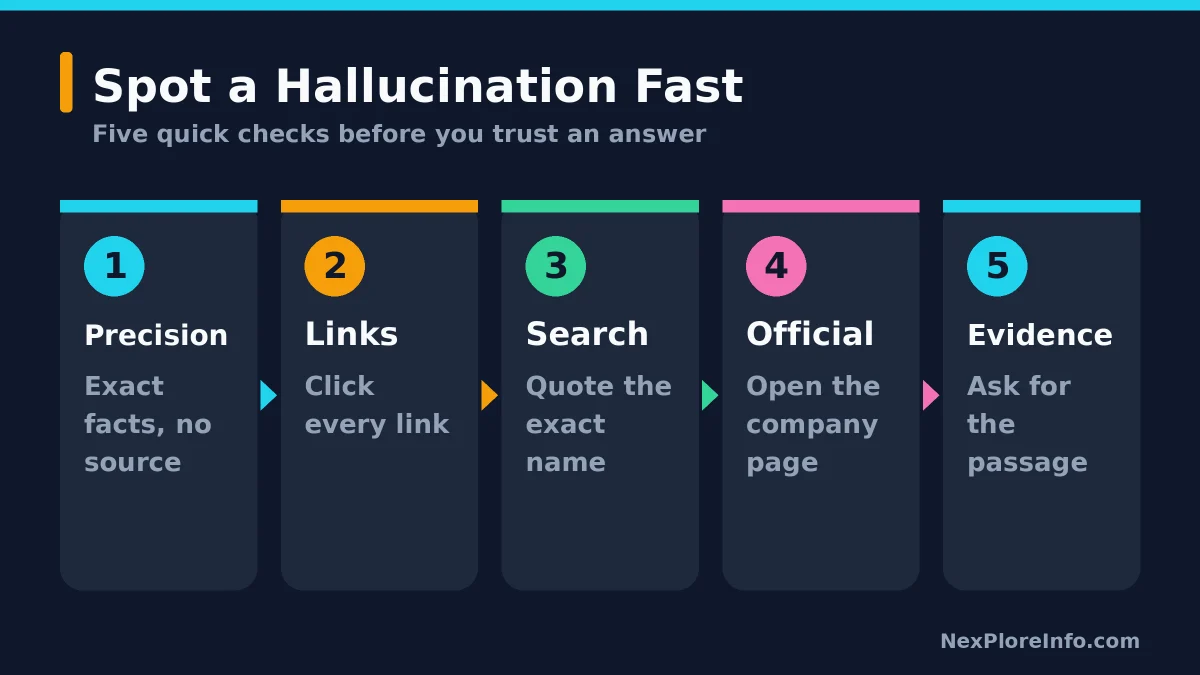
To fact-check an AI-generated answer, identify its key factual claims, open the original sources, and confirm that each source actually supports the statement. The following seven checks help catch invented citations, outdated facts and unsupported details before you trust, publish or submit the answer.
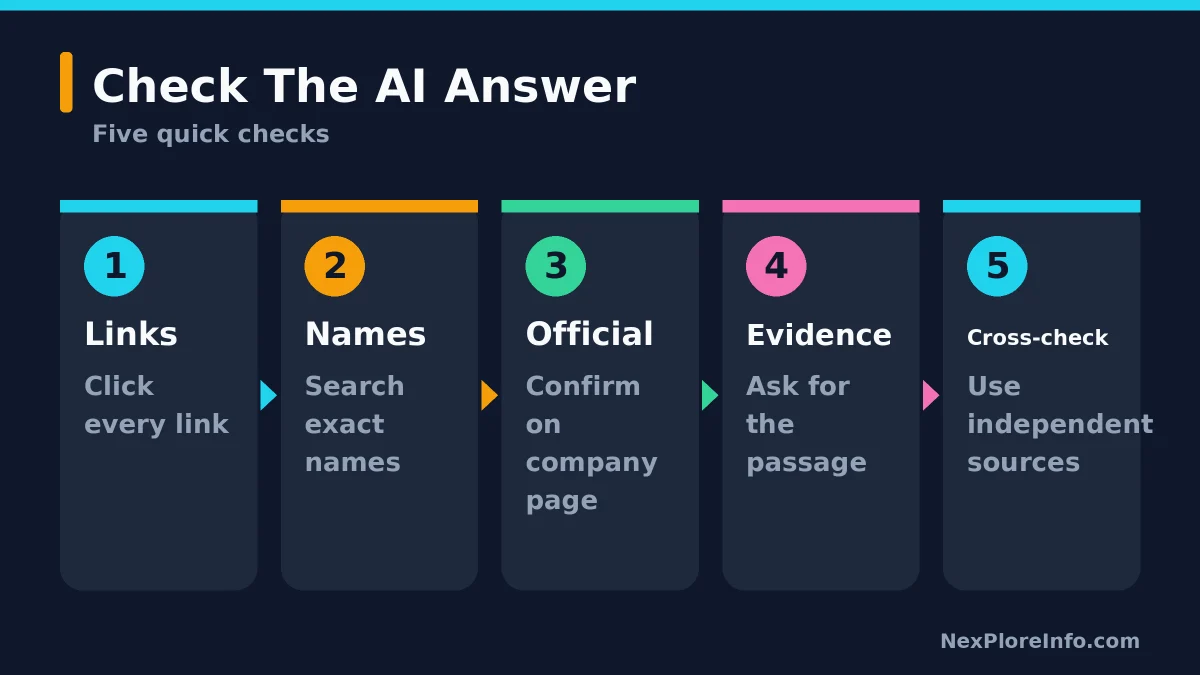
- Look for precision without a source. Exact numbers, dates and quotes with no link deserve a check.
- Click every link. If the page is missing or does not say what the chatbot claims, treat the claim as unverified.
- Search the exact name. Search for the person, study or case title in quotation marks. No results is a red flag.
- Confirm with an official page. For prices, rules and product features, open the company’s own page.
- Check for inconsistent answers. Asking again can reveal uncertainty, but matching answers can also be wrong. Verify factual claims against independent primary sources.
- Ask for the evidence. Request the source and the exact passage, then check that passage yourself.
- Cross-check independently. Use an official source, original research or a reputable database. A second chatbot can repeat the same mistake. AI content detectors estimate whether text may be AI-generated; they do not reliably check whether its claims are true.
How to Stop ChatGPT, Claude and Gemini From Hallucinating
You cannot switch hallucinations off, but you can lower the odds. IBM lists structured prompting, retrieval-augmented generation (RAG) and human checks among its prevention methods.
Use web search and sources
Turn on web search or source-grounded mode when you need current facts. This can reduce hallucinations because the model has fresh evidence to work from, but it does not guarantee accuracy. An AI can still misread a source, cite the wrong passage, combine sources incorrectly or draw an unsupported conclusion.
In Gemini, when sources are available a Sources button appears with the links behind a response, and if there is no button, Gemini did not provide links for that answer.
Give the model the material
Retrieval-augmented generation (RAG) helps AI answer using relevant information retrieved from external sources, such as document libraries, websites or databases. The retrieved passages provide context beyond the model’s training knowledge, but they do not guarantee accuracy. The model may still use irrelevant evidence or misinterpret a passage. Source-grounded tools such as NotebookLM can help users work with supplied documents. Check every important claim against its cited source.
Write prompts that allow “I don’t know”
IBM recommends guardrails such as telling the model to say so when it is unsure. Here is a prompt you can adapt:
Answer only from the text I paste below. If the answer is not in the text, reply “Not in the source.” Quote the sentence you used for each claim.
For more on structuring requests, see our guide on writing AI prompts with a clear formula.
Add a human check for high-stakes work
IBM advises human approval for outputs such as legal, medical or regulatory content. The 2023 court case shows why. A person must own the final answer.
Can Web Search Stop AI Hallucinations?
No. Web search can lower the risk of factual hallucinations, especially for recent information, but it cannot make every answer automatically correct. A model can still misunderstand a page, overlook context, cite an irrelevant source or produce a conclusion that the source does not support.
The safest workflow is to use web-connected AI as a research assistant, then open the cited source and verify the exact claim yourself. For prices, laws, product specifications, health information and other high-stakes facts, prefer the original official source rather than a secondary summary.
Can AI Hallucinations Be Fixed?
They can be reduced, not erased. OpenAI says newer models hallucinate less on many evaluations, but false or unsupported answers still occur. The practical goal is therefore to reduce confident guessing, improve grounding and make uncertainty more explicit rather than assuming any model is error-free.
Do AI Hallucinations Matter for AI Agents?
Yes. An assistant that takes actions can repeat a wrong fact across many steps. Read what an AI agent is and the risks involved, and keep a person approving any action that costs money or sends messages. Students should also see our AI tools guide for students and teachers for safe study habits.
How AI Hallucinations Differ From Bias
An AI hallucination involves false, invented or unsupported claims. A reasoning error is an incorrect inference or calculation, even when the underlying facts are available. Bias is a systematic skew in how information is selected or presented. These problems can overlap. Verify cited evidence to catch hallucinations, check calculations and logic for reasoning mistakes, and examine perspectives and omissions for bias.
Frequently Asked Questions
What are AI hallucinations in simple words?
They are confident-sounding answers from an AI that are false or invented, such as a fake book title or a case that never existed.
Why do AI chatbots make things up?
Chatbots predict likely words from patterns in training data. Training that rewards guessing, rare facts and weak grounding all push them toward a fluent answer instead of “I don’t know.”
Do AI chatbots lie?
No, lying needs intent. A hallucination is a false output from a system built to predict text, but the effect on the reader can be the same, so verify.
How do I know if ChatGPT is hallucinating?
Check sources, click links, search exact names and compare with an official page. Unsupported precision is the biggest warning sign.
Which AI hallucinates the least?
No chatbot is consistently the most accurate across every task. Hallucination rates depend on the specific model version, evaluation method, subject and whether the assistant has access to reliable sources. Compare models using task-specific evidence rather than a single overall score.
Can I use AI for school or work safely?
AI can help with brainstorming, drafts and explanations, provided you verify important facts, cite original sources, follow your institution’s or employer’s rules, and keep a person responsible for the finished work.
How can I prevent AI hallucinations?
Ask the chatbot to use trustworthy sources, give it relevant source material, allow it to say when information is missing, and independently verify dates, quotations, statistics and citations. Retrieval and web search can reduce unsupported answers but do not guarantee correctness.
Does web search make ChatGPT’s answers accurate?
Not automatically. Search can provide current evidence, but a chatbot may misunderstand a page or cite material that does not support its claim. Open cited pages and check each important statement against the original source.
For more AI explainers and tutorials, browse the AI section on NexPloreInfo.




Leave a Comment