

Smart glasses finally look like regular glasses. You can now buy a pair that takes photos, answers questions or floats a small screen in front of your eye, and prices start well under 0. (Want a full headset instead? See our Meta Quest 3 vs Quest 3S comparison.)
Quick answer: For most people, Ray-Ban Meta glasses are the best smart glasses, with the Gen 2 starting at $379. The cheapest way in is Meta Adventurer at $249, and Meta Ray-Ban Display adds a screen for $799. If you mostly want to watch movies, look at Xreal 1S.
In this article 10 sections
- Best Smart Glasses at a Glance
- What Are Smart Glasses?
- What Can Smart Glasses Do?
- How Do Smart Glasses Work?
- How Much Do Smart Glasses Cost in the USA and UAE?
- Best Smart Glasses by Type
- Camera Glasses or Display Glasses: Which Should You Buy?
- Are Smart Glasses Worth It?
- Things to Know Before You Buy Smart Glasses
- FAQs
Best Smart Glasses at a Glance
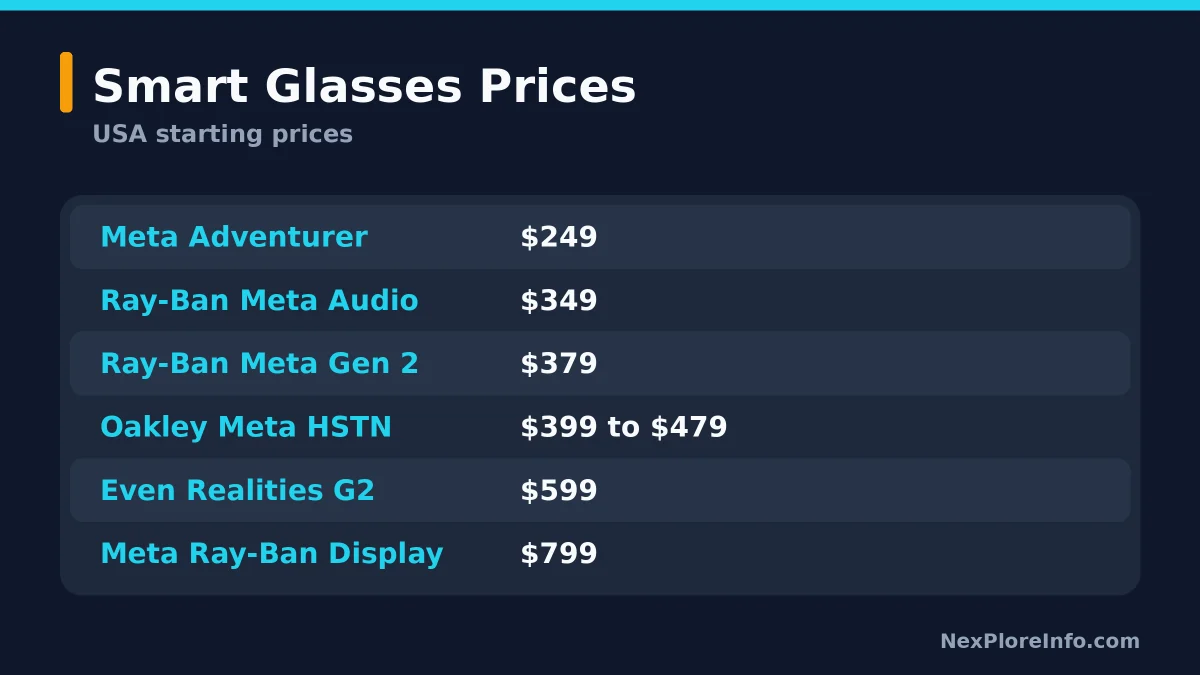
Seven pairs cover almost every need right now. The prices below are USA starting prices as of November 5, 2026. Your pick really comes down to one question: do you want a camera, a display, or neither?
| Model | Type | Price in the USA | Best for |
|---|---|---|---|
| Meta Adventurer | Camera and AI | From $249 | Lowest price |
| Ray-Ban Meta Audio | Audio and AI, no camera | From $349 | Music and calls |
| Ray-Ban Meta Gen 2 | Camera and AI | From $379 | Everyday wear |
| Oakley Meta HSTN | Camera and AI | $399 to $479 | Sport and sun |
| Xreal 1S | Cabled display glasses | $449 (June sale price) | Movies and gaming |
| Even Realities G2 | In-lens display, no camera | From $599 | Text readouts, strong prescriptions |
| Meta Ray-Ban Display | In-lens display with wristband | $799 | Glanceable info |
Meta, Oakley and Engadget’s launch coverage back the Meta and Oakley prices. The Xreal and Even Realities prices come from The Gadgeteer’s June 2026 buying list, so check the maker’s store before you pay.
What Are Smart Glasses?
Smart glasses are regular-looking glasses with a small computer built into the frame. Depending on the model, that means a camera, microphones, speakers, a tiny display, or a mix, all linked to your phone.
They fall into three groups. Camera and AI glasses, like Ray-Ban Meta and Meta Adventurer, record what you see and answer voice questions. Display glasses, like Even G2 and Meta Ray-Ban Display, show short bits of text on the lens. Cabled display glasses, like Xreal 1S, act as a private movie screen for your phone or laptop.
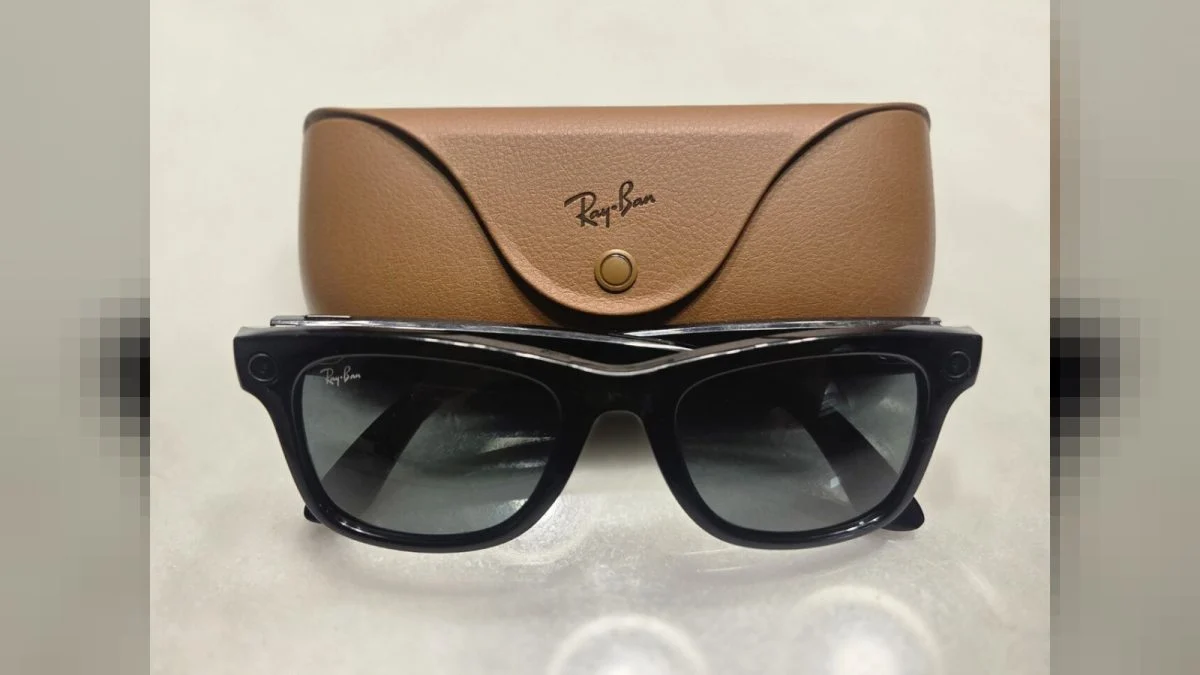
If you’re wondering what smart glasses look like, that’s the whole idea: a pair of Wayfarers or a sport wrap that just happens to have a computer inside. The first-generation Ray-Ban Meta in the photo above is a shiny black frame you’d never clock as tech.
What Can Smart Glasses Do?
Mostly the small jobs you’d normally pull your phone out for. What you get depends on which group you buy from.
Camera glasses take photos and video hands-free. Meta says the Adventurer comes with built-in Meta AI and 3K video, and the Gen 2 Ray-Ban Meta also records 3K video. You can ask the AI a question out loud, take a call, or play music through small speakers near your ears.
Display glasses add a layer of text. The Even Realities G2 uses a Micro LED display, 640 by 350 pixels with a 27.5 degree field of view, and has no camera at all. Meta Ray-Ban Display has a 20 degree field of view display, according to The Gadgeteer, and you control it with a wristband that reads small hand movements.
Xreal 1S is a different animal. It has a 1200p Sony micro-OLED display running at 120Hz with a peak brightness of 700 nits, according to Xreal, and it’s built for watching video rather than glancing at notifications.
How Do Smart Glasses Work?
A chip, microphones and speakers sit in the arms of the frame, and a wireless link to a phone app does the rest. The AI replies come back through the speakers or, on display models, as text on a lens.
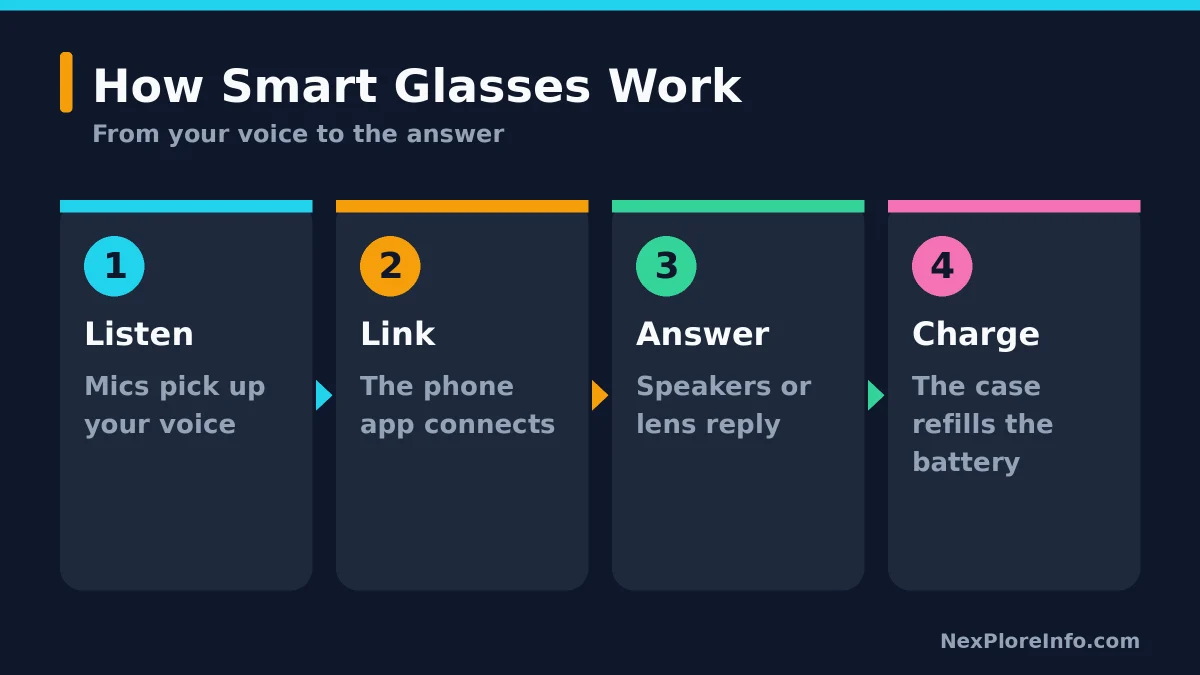
Camera glasses pair with a companion app on your phone, which is where photos and videos land. Charging usually happens in a small case, which is why you’ll see two battery numbers on most spec sheets: one for the glasses, one for the case. The Even G2, for example, lasts up to two days on the glasses, and its case holds enough power for seven full charges, according to Even Realities.
How Much Do Smart Glasses Cost in the USA and UAE?
Smart glasses cost from $249 for Meta Adventurer to $799 for Meta Ray-Ban Display, and Meta-brand glasses start at AED 1,160 in the UAE.
In the USA, Meta lists Adventurer from $249 and Ray-Ban Meta Gen 2 from $379. Engadget’s Meta Connect 2026 roundup puts Ray-Ban Meta Gen 3 at $449, with Ray-Ban Meta Audio at $349 and Meta Ray-Ban Display at $799. Oakley lists the Meta HSTN between $399 and $479 depending on colour.
Prices work differently in the Gulf. According to Gulf News, Meta Glasses went on sale there on September 24, 2026, from $316 | AED 1,160, and Ray-Ban Meta Gen 3 starts at AED 1,960. DigiFlow lists Meta Store UAE, Sunglass Hut, Dubai Optical, Sharaf DG, Noon and Amazon.ae as sellers, and says Meta Ray-Ban Display isn’t sold in the Gulf yet. Buy from an authorised seller so the warranty is valid locally.
Best Smart Glasses by Type
Here’s how each pair fits, starting with the all-rounder most people should look at first. It’s the easiest place to start.
Ray-Ban Meta: The Best All-Rounder
Ray-Ban Meta is the easiest recommendation because it looks like normal eyewear and does the most. Meta’s Gen 2 page lists it from $379. The Gen 2 launched in September 2025 with roughly double the battery of the original, and Meta’s own announcement highlights better video capture. Auganix puts the battery at up to 8 hours with 3K video.
Gen 3 followed. Engadget reports it went on sale on September 23, 2026 from $449, with a 12MP camera, 3K video, nine hours of use and a six-microphone array that Meta says cuts more than 90 percent of background noise. If battery and call quality matter to you, that extra $70 is worth thinking about. If not, the Gen 2 is the better value.
Meta Adventurer: The Cheapest Way In
At $249, Meta Adventurer is the lowest-priced pair here. Meta’s product page shows four colours, a rectangle frame with three-way adjustable nose pads, built-in Meta AI and 3K video. Engadget says it reached shelves on October 23, 2026 and comes with a plug-in case. It’s a sensible first pair if you want to find out whether you’ll use the camera at all.
Oakley Meta HSTN: Best for Sport and Sun
Oakley’s Meta HSTN is the sporty option, and Oakley’s product page shows $399 to $479 depending on the colour. There’s an option to add prescription lenses at checkout. It costs more than the Ray-Ban frames, so it only makes sense if you want the wrap-around look outdoors.
Ray-Ban Meta Audio: Music and Calls Without a Camera
Not everyone wants a camera on their face. Engadget says Ray-Ban Meta Audio starts at $349, weighs 43 grams, runs up to 12 hours on a charge with up to 48 hours from the case, and supports prescription lenses. Shipping began on October 13, 2026. It suits people who mostly want calls, music and an assistant.
Meta Ray-Ban Display: The Screen You Can Actually Read
Meta Ray-Ban Display costs $799 and includes the Neural Band wristband, which Meta describes as an EMG controller. It’s the only pair here that puts an in-lens display together with a camera viewfinder. The Gadgeteer suggests checking prescription support before ordering, since it’s a first-generation design. For readers in the Gulf, it’s the one to wait on, because it hasn’t launched locally.
Even Realities G2: Display Without a Camera
Even Realities skips the camera entirely on the G2. The company’s page lists a 36 gram frame, a camera-free design, up to two days of battery and custom lenses from -12.00 to +12.00. That prescription range is the widest on this list. The Gadgeteer lists it from $599.
Xreal 1S: Best for Movies and Gaming
Xreal 1S is a personal screen, not an everyday pair. Xreal’s page lists a 1200p Sony micro-OLED display, 120Hz refresh and 700 nits peak brightness in an 82 gram frame. The Gadgeteer found it at $449 on sale from $529 in June. Xreal also offers prescription inserts fitted by an optician, though not every model supports them.
Camera Glasses or Display Glasses: Which Should You Buy?
Camera glasses are the safer buy for most people, and display glasses are for people with a specific use in mind.
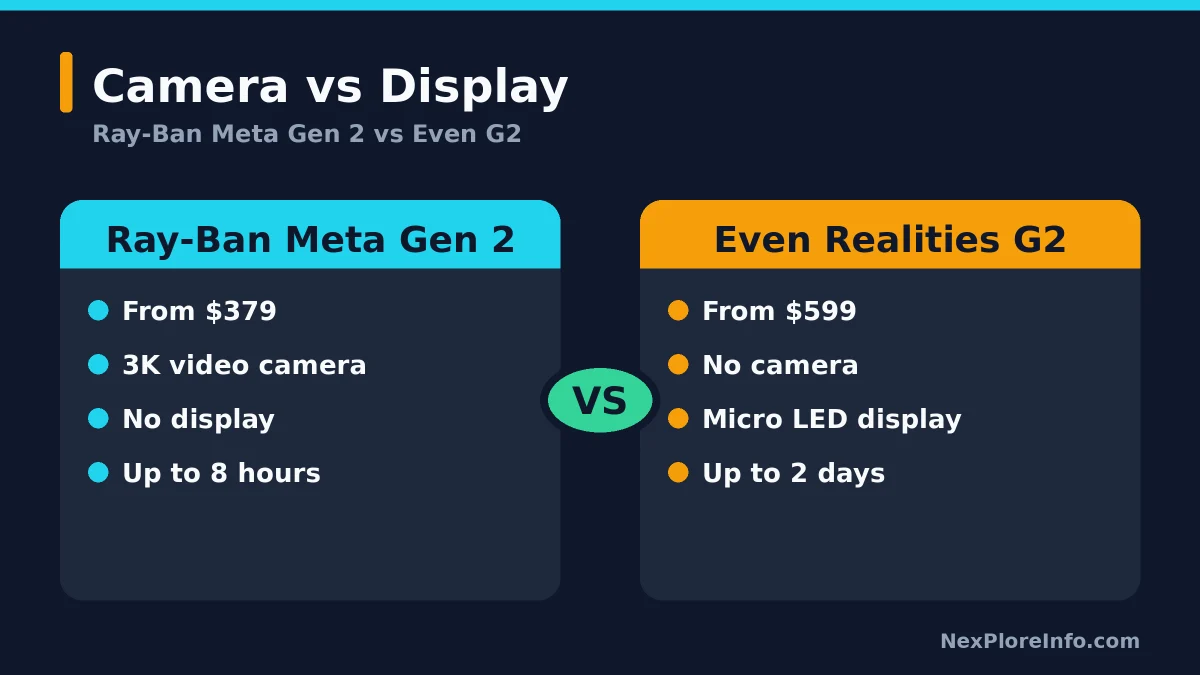
A camera pair costs less, runs for hours on a charge and looks like normal eyewear. A display pair costs $599 to $799, shows information without a phone, and gives you a very small window to look at. The G2’s field of view is 27.5 degrees, so it’s closer to a floating notification strip than a screen. If your top priority is photos and AI answers, buy camera glasses. If you want navigation or text in your line of sight, buy display glasses.
Mixed-reality headsets are a different category. If you’re deciding between glasses and a headset, our Steam Frame price and specs guide covers that side.
Are Smart Glasses Worth It?
Smart glasses are worth it if you’ll use the hands-free camera or voice assistant every day. If you just like gadgets, a $249 pair is a low-risk way to find out.
They suit commuters who want calls and music without earbuds, parents who want to catch a moment without reaching for a phone, travellers who want a hands-free camera, and anyone who already wears glasses and wants something extra. They’re a poor fit if you need long battery life from a display or if you’d rather keep your phone in your hand anyway.
Meta’s push into AI goes beyond glasses. Our Meta Muse availability guide covers where its AI agent is and isn’t available.
Things to Know Before You Buy Smart Glasses
Check a few things before you pay. Prescription support varies by pair: the Even G2 handles -12.00 to +12.00, Ray-Ban Meta Audio supports prescription lenses, Oakley offers a prescription option, and The Gadgeteer says to verify it on Meta Ray-Ban Display. Battery numbers are for the glasses alone, so plan around the case. And ask before you record people, since a camera on your face is more noticeable to others than you might think.
Finally, make sure you’re buying from an authorised seller. Prices shift, and several of the numbers above come from launch coverage, so confirm the current price on the maker’s page. For a sound-first alternative that isn’t glasses, see our AirPods Pro 3 vs Sony WF-1000XM6 comparison.
FAQs
Can smart glasses be prescription?
Yes, on most of them. Even Realities G2 supports custom lenses from -12.00 to +12.00, Ray-Ban Meta Audio supports prescription lenses, and Oakley Meta HSTN has an option to add prescription lenses. Check each maker’s page for the exact range before ordering.
Where can I buy smart glasses in the UAE?
Meta Glasses and Ray-Ban Meta are sold through Meta Store UAE, Sunglass Hut, Dubai Optical, Sharaf DG, Noon and Amazon.ae, according to DigiFlow. Meta Ray-Ban Display isn’t sold there yet. Buy from an authorised seller so the warranty applies locally.
Has Apple released smart glasses?
No. Apple has not launched smart glasses, so none are on sale, and this guide only covers models you can buy today. When Apple does launch a pair, we’ll add it.
What are Meta smart glasses?
Meta smart glasses are camera and AI glasses made with partners like Ray-Ban and Oakley. They record photos and 3K video, play audio through built-in speakers and answer questions through Meta AI. The lineup runs from Meta Adventurer at $249 to Meta Ray-Ban Display at $799.
Do smart glasses need a phone?
Yes, for setup and for most features. Camera glasses pair with a companion app on your phone, and cabled display glasses like Xreal 1S connect to a phone or laptop. Check the maker’s page for any pair that claims to work on its own.
How long does the battery last?
It depends on the type. Ray-Ban Meta Gen 2 is listed at up to 8 hours, Gen 3 at nine hours of use, Ray-Ban Meta Audio at up to 12 hours and Even G2 at up to two days. Cases extend that further.
Image credits: Photo: CCadio, Wikimedia Commons, CC BY 4.0.





Leave a Comment