
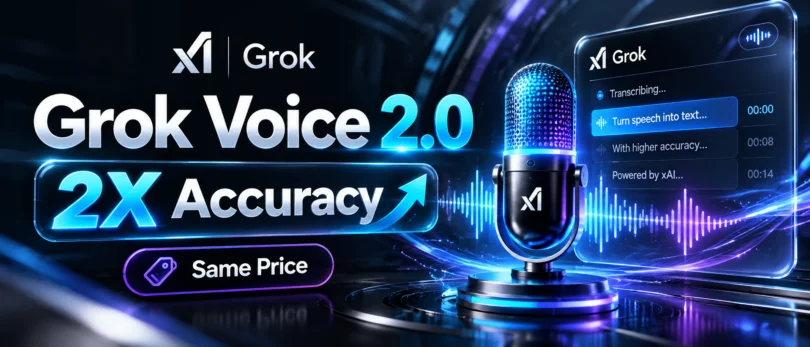
Grok Voice Transcribe 2.0 is xAI’s current speech-to-text model for batch and real-time transcription, with diarization, timestamps and keyterm prompting included. It’s built for phone calls, meetings, podcasts, videos and voice-agent workflows rather than as a standalone consumer transcription app.
xAI says the new model ranks first for accuracy among 32 streaming speech-to-text systems tracked on the Artificial Analysis streaming leaderboard, with the biggest gains showing up in noisy, real-world audio and multilingual conversations. The model is already rolling out through xAI’s Speech-to-Text API, and it also powers voice features inside Grok and in Tesla vehicles. Here is what actually changed, what it costs, and who can use it today.
In this article 16 sections
- What’s New?
- Previous Version vs New Version
- Features
- Availability
- Price and Plan Requirements
- Current Language Support and API Limits
- What Does Grok Voice Transcribe 2.0 Cost in Practice?
- Batch vs Streaming: Which Mode Should You Use?
- How Users Can Access It
- Supported Audio and Language Coverage
- Privacy and Enterprise Deployment
- Limitations
- Competitor Comparison
- Who Is Grok Voice Transcribe 2.0 Best For?
- What This Means
- Quick FAQs
What’s New?
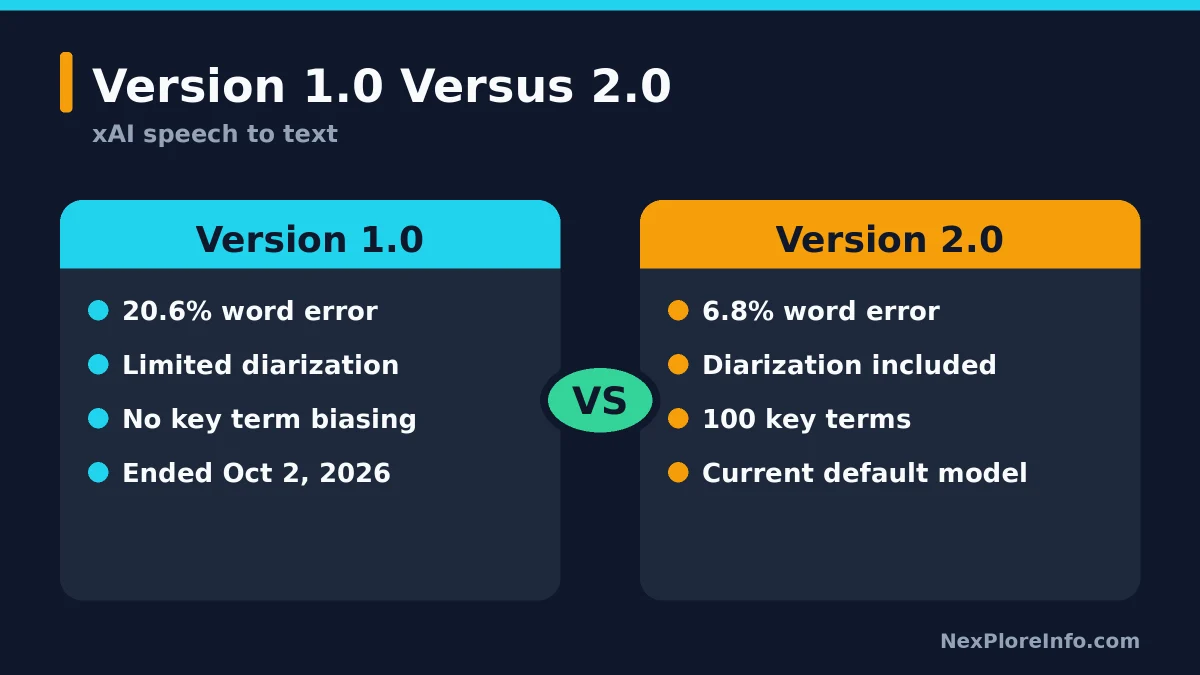
According to xAI’s official announcement, Grok Voice Transcribe 2.0 was trained to handle the kind of audio that trips up older transcription models: phone-line calls, overlapping speakers, heavy accents, and spoken credentials like account numbers or confirmation codes. xAI reports the model is “twice as accurate” as Voice Transcribe 1.0 at the same price, and that on short multilingual phrases, word error rate dropped from 20.6 percent to 6.8 percent.
The model also gained automatic language detection with the ability to switch languages mid-recording, which matters for creators who mix languages in a single video or livestream, a common pattern for AI tutorial content aimed at global audiences.
Previous Version vs New Version
| Detail | Voice Transcribe 1.0 | Voice Transcribe 2.0 |
|---|---|---|
| Multilingual word error rate (short phrases) | 20.6% | 6.8% |
| Speaker diarization | Limited | Included at no extra cost |
| Multichannel audio | Limited | Up to 2 channels in current xAI documentation |
| Key term biasing | Not available | Up to 100 terms per request |
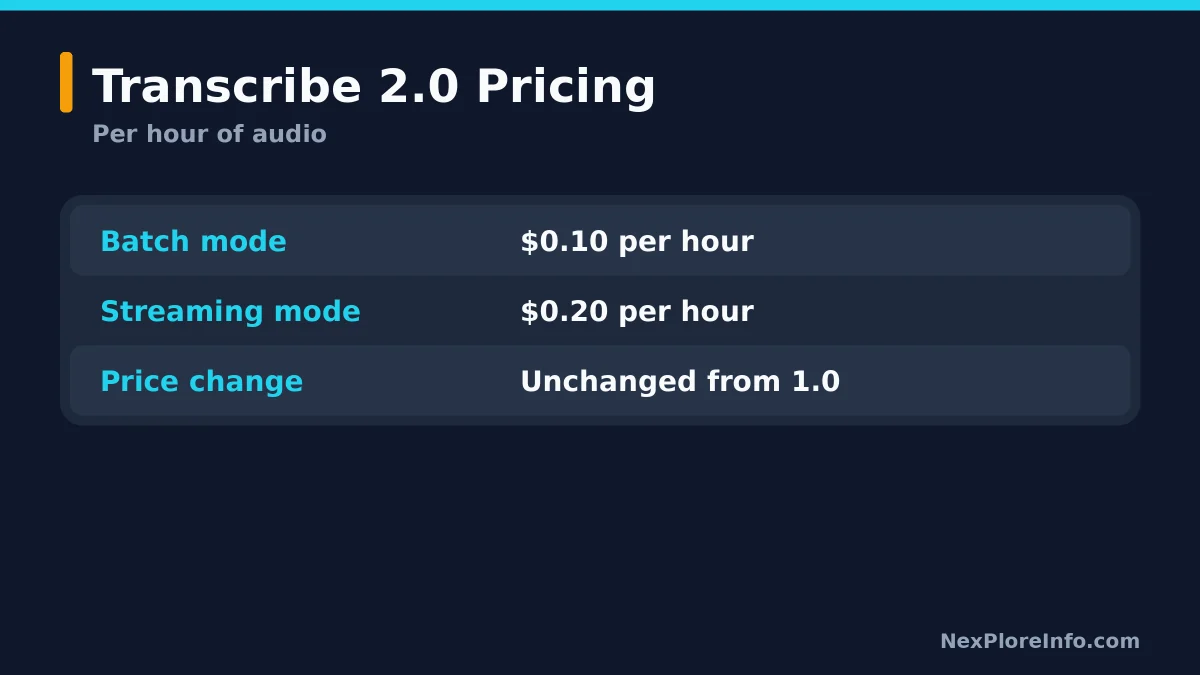
| Pricing (batch / streaming) | $0.10 / $0.20 per hour | $0.10 / $0.20 per hour (unchanged) |
| Status | End of life since October 2, 2026 | Current default model |
Features
Beyond the accuracy claims, xAI’s release notes and independent coverage from Unite.AI point to a fuller feature set built for both creators and developers:
- Batch and real-time streaming transcription through the Speech-to-Text API
- Word-level timestamps with confidence scores
- Speaker diarization included at no extra cost
- Multichannel transcription for up to 2 audio channels in current xAI documentation
- Key term biasing, so names, brands, or technical terms get transcribed correctly
- Automatic text formatting for numbers, dates, currencies, and emails
- Filler word removal and smart turn detection, aimed at voice agents
- Support for a dozen audio formats and files up to 500 MB
Availability
xAI charges $0.10 | AED 0.37 per hour for REST batch transcription and $0.20 | AED 0.73 per hour for streaming.
Grok Voice Transcribe 2.0 is available now through xAI’s Speech-to-Text API and is the current default model. xAI’s October release notes say Grok Voice Transcribe 1.0 reached end of life on October 2, 2026, and requests to the old slug are now routed to version 2.0 at the same price. xAI still positions this mainly as developer and enterprise infrastructure rather than a standalone consumer transcription app.
Atlassian’s Loom, which transcribes every video uploaded to the platform, is one of the named early adopters. Atlassian’s Sanchan Saxena was quoted in xAI’s announcement saying the pairing of Grok’s transcription with coding tools “closes the loop from context to code,” a sign xAI is positioning this as developer and workflow infrastructure rather than a consumer product.
Price and Plan Requirements
xAI’s current Speech-to-Text pricing remains straightforward:
- Batch transcription: $0.10 per hour of audio
- Streaming transcription: $0.20 per hour of audio
Diarization, timestamps, and key term detection are bundled in at no additional cost, so teams that were paying extra for those add-ons elsewhere may see a real savings, not just an accuracy bump.
Current Language Support and API Limits
xAI’s current Speech-to-Text documentation lists support for 38+ languages with automatic language detection. The API supports common formats including WAV, MP3, WebM, OGG and M4A. For developers, the published limits are 10 requests per second for REST, 10 requests per second for streaming, and up to 100 concurrent streaming sessions per team.
Current multichannel support is up to two channels, while speaker diarization can separate multiple speakers in a conversation. Keyterm prompting helps bias recognition toward product names, people, brands and technical vocabulary.
What Does Grok Voice Transcribe 2.0 Cost in Practice?
At $0.10 per hour for batch transcription, a 60-minute podcast costs about $0.10 to transcribe through REST. Ten hours of recorded interviews would cost about $1. Streaming the same amount of live audio costs twice as much: one hour is about $0.20, while ten hours is about $2.
Those figures cover xAI’s transcription charge itself. Storage, application hosting, data transfer or any third-party front-end service can add separate costs depending on how the API is used.
Batch vs Streaming: Which Mode Should You Use?
Use the REST batch endpoint when the audio already exists as a file and low latency is not important. Podcasts, interviews, recorded meetings, customer-support archives and uploaded videos are good examples. Batch is also the cheaper option at $0.10 per hour.
Use streaming when text needs to appear while someone is still speaking. Live captions, voice agents, call-center assistants and real-time meeting tools are the clearest use cases. Streaming costs $0.20 per hour and supports interim results so an application can display partial text before the final transcript is ready.
| Use case | Best mode | Why |
|---|---|---|
| Podcast transcript | Batch | Lowest cost and no need for instant text |
| Recorded interview | Batch | File can be processed after recording |
| Live captions | Streaming | Text must appear in real time |
| Voice agent | Streaming | Low-latency turn detection is required |
| Meeting archive | Batch | Cheaper for completed recordings |
How Users Can Access It
Access runs through xAI’s developer platform and requires an API key, so this is not a one-click consumer tool. Developers can use REST for file-based batch jobs or the streaming endpoint for low-latency transcription. Version 2.0 is now the default, and the older 1.0 model has reached end of life.
Supported Audio and Language Coverage
xAI’s current documentation lists common input formats including WAV, MP3, WebM, OGG and M4A, along with automatic language detection across more than 38 languages. The public Speech-to-Text page also highlights English, Spanish, French, German, Japanese, Portuguese, Italian, Korean, Hindi, Arabic, Dutch and Turkish among its supported languages.
For multilingual recordings, automatic detection can reduce the need to configure a language in advance. Even so, specialist vocabulary, names and product terms can still benefit from keyterm prompting, especially in technical interviews, medical or legal discussions, and branded content.
Privacy and Enterprise Deployment
xAI markets its Voice API for enterprise deployments as well as individual developers. The company says enterprise customers can use controls such as zero data retention, SOC 2 Type II compliance, GDPR/DPA support, custom rate limits, SSO and audit logging. It also advertises HIPAA-eligible deployments with a business associate agreement for supported healthcare use cases.
Those controls matter because transcription often involves sensitive audio. Teams handling customer calls, healthcare conversations, employee meetings or private interviews should check retention, regional processing and compliance requirements before sending recordings to any third-party speech-to-text provider.
Limitations
xAI’s “twice as accurate” claim comes from its own production evaluations across four internal audio sets. Separately, xAI points to the public Artificial Analysis streaming leaderboard, where Grok Voice Transcribe 2.0 ranks first for accuracy among 32 streaming models. Those results are useful reference points, but performance can still vary by accent, domain vocabulary, channel quality and background noise.
It is also worth noting this is an API product first. Casual users who just want to transcribe a single video or voice memo will still need a front-end app, browser extension, or existing tool (Loom, for example) that has integrated the Grok API, rather than a dedicated Grok transcription app of their own.
Competitor Comparison
xAI compares Grok Voice Transcribe 2.0 with competing speech-to-text systems including ElevenLabs, Deepgram, Google, Microsoft and OpenAI. Its own published evaluations favor Grok on several production audio sets, while the separate Artificial Analysis streaming leaderboard also places Grok Voice Transcribe 2.0 first for accuracy. Buyers should still compare language support, latency, integrations, privacy requirements and price for their own workload rather than assuming one benchmark decides every use case.
Who Is Grok Voice Transcribe 2.0 Best For?
The model makes the most sense for developers and businesses that want low-cost transcription inside an existing application. Its pricing is especially attractive for high-volume batch workloads, while the streaming endpoint is aimed at live products such as call assistants, captions and voice agents.
- Podcasters and video teams: low-cost transcripts, captions and searchable archives.
- Customer-support platforms: diarized call transcripts and searchable conversation history.
- Voice-agent developers: streaming transcription and smart turn detection.
- Meeting and productivity apps: speaker separation, timestamps and multilingual support.
- Technical teams: keyterm prompting for names, brands and specialist vocabulary.
It is less convenient for someone who simply wants to drag a voice memo into a consumer app and receive a transcript. For that use case, a dedicated transcription application may still be easier than working directly with an API.
What This Means
For AI content creators specifically, the practical upside is cheaper, more accurate auto-captions and multi-speaker transcripts for interviews, tutorials, and reaction videos, especially in mixed-language content. For businesses, bundling diarization and timestamps into the base price removes a cost line that competitors often charge for separately. The bigger picture is that xAI is quietly building out an audio and voice stack (transcription, voice agents, a no-code voice agent builder announced at the same event) rather than only competing on chatbot features, which puts more pressure on Whisper, ElevenLabs, and Deepgram in the transcription market specifically. It is also a reminder that AI infrastructure decisions, not just flashy consumer apps, increasingly shape the AI business tools that companies build on top of them.
Quick FAQs
Is Grok Voice Transcribe 2.0 free? No. It is billed per hour of audio processed, at $0.10 per hour for batch jobs and $0.20 per hour for real-time streaming.
Can I use it without coding? Not directly. It is an API product, so most people will access it through an app or platform (like Loom) that has already integrated it, rather than through a standalone Grok transcription app.
Will my existing Grok transcription integration change automatically? According to xAI, existing API integrations upgrade to version 2.0 automatically, and the older model stays available on request until it is fully phased out.
How does it compare to Whisper or ElevenLabs Scribe? xAI’s own internal tests show it ahead of Whisper Large v3, ElevenLabs Scribe v2, and Deepgram Nova-3, but these are company-reported results, not independent benchmarks, so it is worth testing your own audio before switching.
For more on how AI tools are evolving across chatbots, image, and video generation, keep checking NexPloreInfo’s tech coverage, where we track pricing and feature changes as they happen. We will update this piece as xAI shares independent benchmark results or expands transcription features to more consumer-facing apps.





Leave a Comment