
DeepSeek released an updated checkpoint, DeepSeek-V4.1-Flash-1017, on October 17, 2026. It is available through the same deepseek-flash model name with unchanged pricing, and DeepSeek says it delivers stronger benchmark scores, faster task completion and shorter outputs. DeepSeek also opened its in-house Search and Fetch APIs to outside developers. Both changes are covered in the new section below.
DeepSeek V4.1 Flash is now live on the DeepSeek API under the model name deepseek-flash. It combines native image understanding, a 1 million-token context window, up to 384K output tokens and substantially lower API pricing than DeepSeek V4 Pro.
DeepSeek says V4.1 Flash beats V4 Pro on several coding and agent benchmarks while using a more efficient architecture. That does not mean it wins every test. V4 Pro still leads on some difficult reasoning benchmarks, and DeepSeek has decided to keep the Pro API available after initially planning to route it into Flash.
In this article 14 sections
- DeepSeek V4.1 Flash at a Glance
- DeepSeek V4.1-Flash-1017: What Changed on October 17
- When Was DeepSeek V4.1 Flash Released?
- What Is New in DeepSeek V4.1 Flash?
- DeepSeek V4.1 Flash Benchmarks vs V4 Pro
- DeepSeek API Pricing: V4.1 Flash Input, Output and Cache Costs
- Is DeepSeek V4 Pro Being Discontinued?
- DeepSeek V4.1 Flash Context Window and Output Limit
- Does DeepSeek V4.1 Flash Support Images?
- How to Get a DeepSeek API Key and Use V4.1 Flash
- Who Should Use DeepSeek V4.1 Flash?
- DeepSeek vs ChatGPT: Is V4.1 Flash Better for Developers?
- Why DeepSeek V4.1 Flash Matters
- Frequently Asked Questions
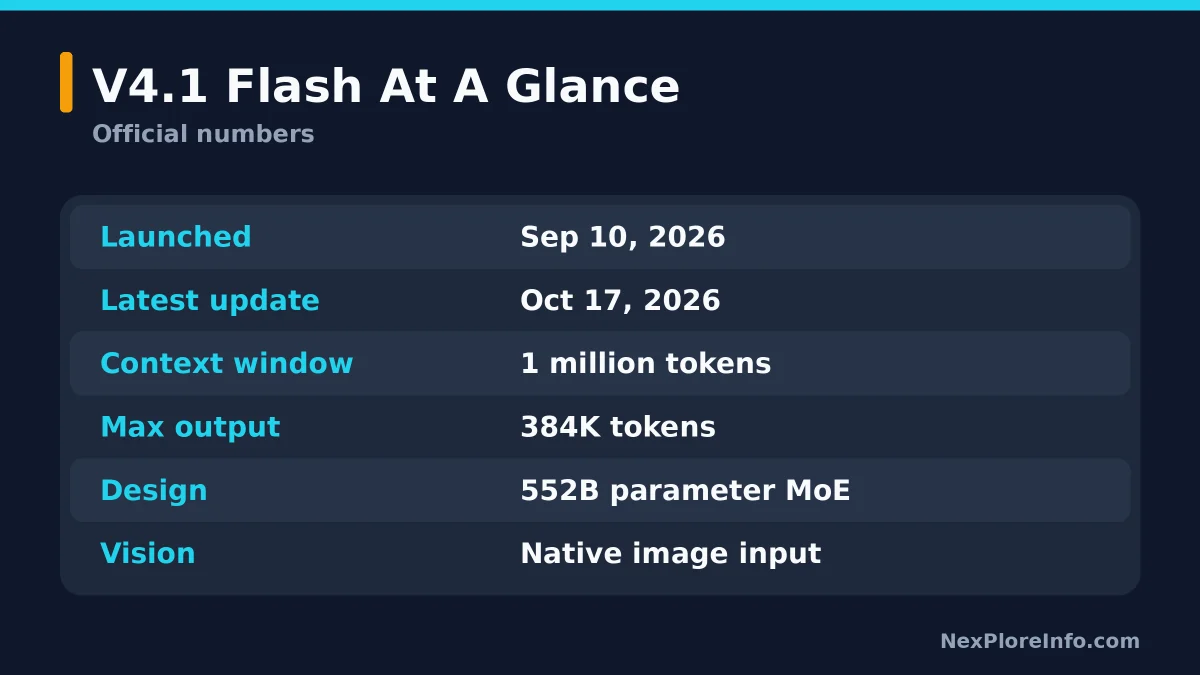
DeepSeek V4.1 Flash at a Glance
| Launch date | September 10, 2026 |
| Latest update | V4.1-Flash-1017, released October 17, 2026 |
| API model name | deepseek-flash |
| Architecture | 552B-parameter MoE, Causal Encoder-Decoder |
| Active parameters | 8B for input, 16B for output |
| Context length | 1 million tokens |
| Maximum output | 384K tokens |
| Vision support | Yes, native multimodal image understanding |
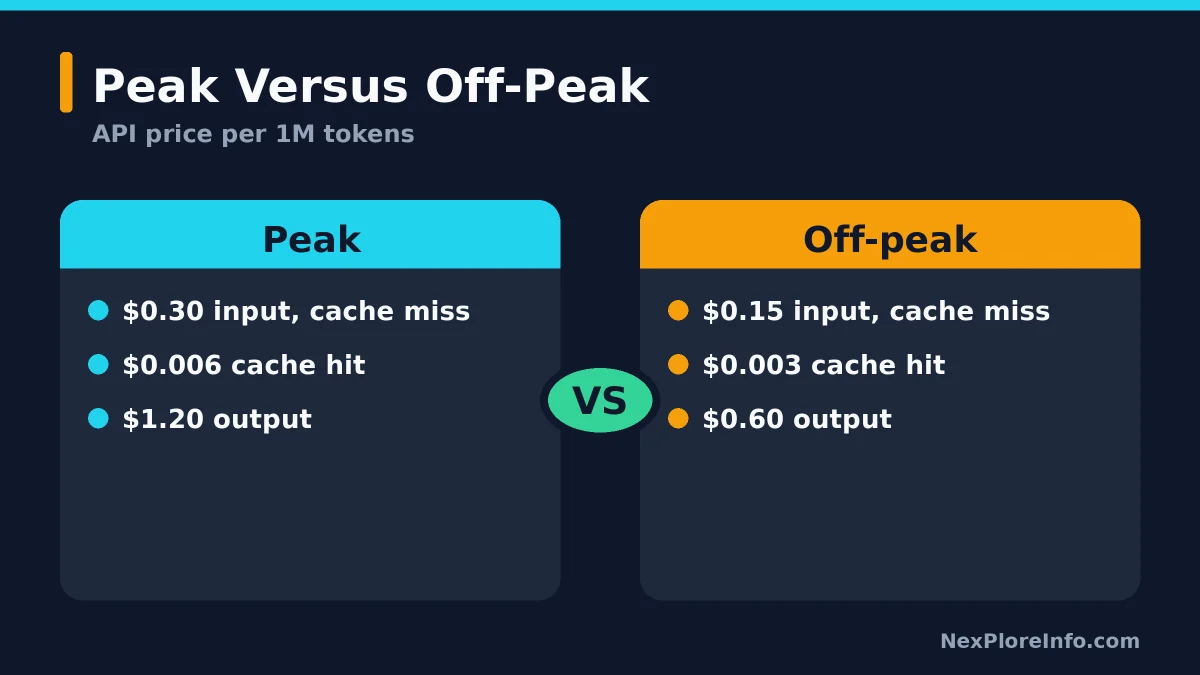
| Peak API price | $0.30 input cache miss, $0.006 cache hit, $1.20 output per 1M tokens |
| Off-peak API price | $0.15 input cache miss, $0.003 cache hit, $0.60 output per 1M tokens |
DeepSeek V4.1-Flash-1017: What Changed on October 17
According to the DeepSeek API change log, V4.1-Flash-1017 is an updated checkpoint of V4.1 Flash, not a new architecture. Developers keep using deepseek-flash, so existing integrations need no code changes, and the web and app versions of DeepSeek were updated at the same time. DeepSeek says task runtime and output length are both lower, which reduces cost per task even though per-token prices are unchanged. It recommends DeepSeek Harness 0.2.1-rc.1 or later.
The headline number is DeepSWE v1.1, where the score rose from 74.2 to 77.0. On the text-only HLE subset (without tools), the score rose from 39.1 to 42.6. DeepSeek also published new results on several benchmarks:
| Benchmark | V4.1-Flash-1017 |
|---|---|
| DeepSWE v1.1 | 77.0 (up from 74.2) |
| HLE, text-only, no tools | 42.6 (up from 39.1) |
| NL2Repo-Bench | 68.2 |
| Apex Bench v1.1 | 72.1 |
| Automation-Bench v1.0.6 | 60.5 |
| Terminal-Bench 4.0 | 42.3 |
| Agents’ Last Exam | 35.4 |
| ProgramBench | 29.1 |
| BabyVision (with tools) | 92.5 |
| Chartography (with tools) | 83.0 |
These are DeepSeek-reported results and independent reproduction is still pending, as Tbreak notes in its coverage. Treat them as a guide, and remember that even strong models can still produce AI hallucinations. Open weights for the update are listed on Hugging Face and ModelScope.
New: DeepSeek Search and Fetch API
Alongside the model update, DeepSeek opened the in-house search engine that powers its own web and app search. The Search API and Fetch API each cost $0.75 | AED 2.75 per 1,000 successful requests. Server-side tool calls made through DeepSeek Harness, Claude Code or Codex are free until per-request billing starts at 00:00 Beijing time on November 1, 2026 (16:00 UTC on October 31). Details are on the DeepSeek pricing page.
When Was DeepSeek V4.1 Flash Released?
DeepSeek V4.1 Flash was officially released on September 10, 2026. It replaced the previous V4 Flash and V4 Flash Vision Exp models. DeepSeek says requests using the older model names deepseek-v4-flash and deepseek-v4-flash-vision-exp are temporarily routed to V4.1 Flash for compatibility.
The official model name for new API integrations is deepseek-flash. DeepSeek also supports OpenAI-compatible and Anthropic-compatible API formats, making it easier for developers to migrate existing applications.
What Is New in DeepSeek V4.1 Flash?
V4.1 Flash is the smallest model in DeepSeek’s new architecture family, but “smallest” is relative. It is a 552-billion-parameter mixture-of-experts model built around a new Causal Encoder-Decoder architecture. Only 8 billion parameters are active while processing input and 16 billion are active while generating output, which helps DeepSeek reduce inference cost while keeping a very large total model capacity.
Another major change is the KV cache. DeepSeek says V4.1 Flash needs only one-quarter of the HBM and one-eighth of the SSD storage required by the previous generation. That matters for long conversations, coding agents and tool-heavy workflows because repeated context can become a large part of inference cost.
V4.1 Flash also adds native visual understanding. Developers can send images to the model without switching to a separate experimental vision model.
DeepSeek V4.1 Flash Benchmarks vs V4 Pro
DeepSeek’s own benchmark results from the original September 10 release show the strongest V4.1 Flash gains in coding, terminal use and agentic workloads. For the newer October 17 scores, see the V4.1-Flash-1017 section above.
| Benchmark | V4.1 Flash | V4 Pro | Better result |
|---|---|---|---|
| DeepSWE v1.1 | 74.2 | 62.7 | V4.1 Flash |
| Terminal-Bench 2.1 | 90.6 | 87.9 | V4.1 Flash |
| Codeforces rating | 3,471 | 3,348 | V4.1 Flash |
| GPQA Diamond | 90.9 | 92.4 | V4 Pro |
| HLE text-only subset | 39.1 | 42.7 | V4 Pro |
The results suggest V4.1 Flash is particularly competitive for software engineering and agent workflows, but the comparison is not a clean sweep. V4 Pro retains an advantage on some difficult knowledge and reasoning tests. Developers should therefore benchmark both models on their own workloads rather than treating one public score as a universal ranking.
DeepSeek API Pricing: V4.1 Flash Input, Output and Cache Costs
DeepSeek uses peak and off-peak pricing. Off-peak rates are half the peak rates. According to DeepSeek’s current official pricing page, V4.1 Flash costs:
| Token type | Off-peak | Peak | Approx. AED peak |
|---|---|---|---|
| 1M input tokens, cache hit | $0.003 | $0.006 | AED 0.02 |
| 1M input tokens, cache miss | $0.15 | $0.30 | AED 1.10 |
| 1M output tokens | $0.60 | $1.20 | AED 4.41 |
For comparison, DeepSeek currently lists V4 Pro at up to $1.32 per million cache-miss input tokens and $3.96 per million output tokens during peak hours. That makes V4.1 Flash substantially cheaper for high-volume applications, especially coding agents, customer-support systems and long-context automation.
Peak hours are currently 01:00 to 04:00 UTC and 06:00 to 10:00 UTC, Monday through Friday. Prices can change, so developers should verify the official DeepSeek pricing page before budgeting a production workload.
Is DeepSeek V4 Pro Being Discontinued?
No, not at the moment. DeepSeek originally said that after September 14, 2026, requests to deepseek-v4-pro would be routed to V4.1 Flash until a future V4.1 Pro release.
DeepSeek later changed that plan. Its official API change log now states that, in response to user demand, the company will continue providing DeepSeek V4 Pro API service after September 14 with its existing billing method. DeepSeek says it will issue another notice if that changes.
DeepSeek V4.1 Flash Context Window and Output Limit
DeepSeek V4.1 Flash supports a 1 million-token context window and a maximum output of 384K tokens. Those limits make it suitable for large codebases, long technical documents, multi-step agent sessions and workflows that require large amounts of conversation history. If you are new to the term, our explainer on what a context window is in AI covers how tokens work.
The model supports JSON output, tool calls, the Responses API, Anthropic-compatible API access, chat prefix completion and fill-in-the-middle completion in non-thinking mode.
Does DeepSeek V4.1 Flash Support Images?
Yes. V4.1 Flash includes native multimodal visual understanding. The older experimental V4 Flash Vision model has been retired because image understanding is now built into V4.1 Flash itself.
How to Get a DeepSeek API Key and Use V4.1 Flash
To use DeepSeek V4.1 Flash in your own application, create an account through DeepSeek’s developer platform, generate a DeepSeek API key, and use the deepseek-flash model identifier. The API supports an OpenAI-compatible interface with the base URL https://api.deepseek.com. Store API keys in a secure environment variable or secrets manager, not in browser-side code or a public repository. Review the official API quick start and pricing information before deploying.
Who Should Use DeepSeek V4.1 Flash?
V4.1 Flash is particularly attractive for developers who need a low-cost model for:
- Coding agents and repository analysis
- Terminal and command-line automation
- Long-context document analysis
- Tool-using AI agents
- High-volume chat applications
- Image-plus-text workflows
- Applications that benefit from OpenAI- or Anthropic-compatible APIs
If your application depends heavily on difficult scientific reasoning or the specific tasks where V4 Pro still benchmarks higher, test both models before migrating. Benchmark results are useful indicators, but production reliability, latency, hallucination rate and tool-use behavior matter more than a single leaderboard score.
DeepSeek vs ChatGPT: Is V4.1 Flash Better for Developers?
Searches such as DeepSeek vs ChatGPT and ChatGPT vs DeepSeek often compare different products: DeepSeek V4.1 Flash is an API model, while ChatGPT is an assistant application with its own plan features and usage limits. For developers, compare task-specific coding results, latency, API pricing, context handling, model reliability and tool integrations rather than declaring one universally better. For the consumer assistant, see our What is ChatGPT? guide.
Why DeepSeek V4.1 Flash Matters
The important story is not simply that DeepSeek launched another model. V4.1 Flash combines a very large 1M-token context window, native vision, strong coding benchmarks and aggressive API pricing in one model. That increases pricing pressure across the broader AI API market and gives developers another option for agentic software without immediately paying frontier-model prices.
If you are comparing developer-focused AI systems, see our guide to the best AI coding tools in 2026. You can also follow how frontier models compare in our GPT-6 Astra vs Claude Fable 5.1 comparison, or read our guide to what Claude AI is and how it works.
Frequently Asked Questions
Is DeepSeek better than ChatGPT for coding?
It depends on the programming task, model, tools and budget. DeepSeek reports strong V4.1-Flash-1017 scores for coding agents, but those figures alone do not establish a universal winner over ChatGPT. Run the same representative tasks on both services and compare correctness, cost, time and human review needs.
Do I need a DeepSeek API key to use V4.1 Flash?
For direct developer API access, yes. Create a key through DeepSeek’s developer platform and use the deepseek-flash model name. The regular DeepSeek website or app is a separate way to use the assistant without configuring an API key.
When was DeepSeek V4.1 Flash released?
DeepSeek officially released V4.1 Flash on September 10, 2026.
What is DeepSeek V4.1-Flash-1017?
It is an updated V4.1 Flash checkpoint released on October 17, 2026. It uses the same deepseek-flash model name and the same pricing, with higher DeepSeek-reported scores (77.0 on DeepSWE v1.1), faster task completion and shorter outputs.
What is the DeepSeek V4.1 Flash API model name?
Use deepseek-flash. Older V4 Flash model names are temporarily routed to the new V4.1 Flash model for compatibility.
How much does DeepSeek V4.1 Flash cost?
At peak rates, DeepSeek currently charges $0.30 per million cache-miss input tokens, $0.006 per million cache-hit input tokens and $1.20 per million output tokens. Off-peak rates are half those amounts.
Is DeepSeek V4.1 Flash better than V4 Pro?
It is better on several DeepSeek-reported coding and agent benchmarks, including DeepSWE (77.0 after the October 17 update, versus 62.7 for V4 Pro), Terminal-Bench 2.1 and Codeforces. V4 Pro still leads on some difficult reasoning benchmarks such as GPQA Diamond and the text-only HLE subset.
Does DeepSeek V4.1 Flash support images?
Yes. Native multimodal image understanding is included in V4.1 Flash.
What is the DeepSeek V4.1 Flash context window?
The model supports a 1 million-token context window and up to 384K output tokens.
Is DeepSeek V4 Pro still available?
Yes. DeepSeek initially planned to route V4 Pro requests to V4.1 Flash after September 14, 2026, but later decided to keep V4 Pro API service available because of user demand.
Sources and Verification
This article uses DeepSeek’s official V4.1 Flash release announcement, the October 17 API change log entry for V4.1-Flash-1017 and current Models & Pricing documentation. Benchmark figures are DeepSeek-reported results and should not be treated as independent performance guarantees.
Official sources: DeepSeek V4.1 Flash announcement, DeepSeek API change log, and DeepSeek API pricing.





Leave a Comment