

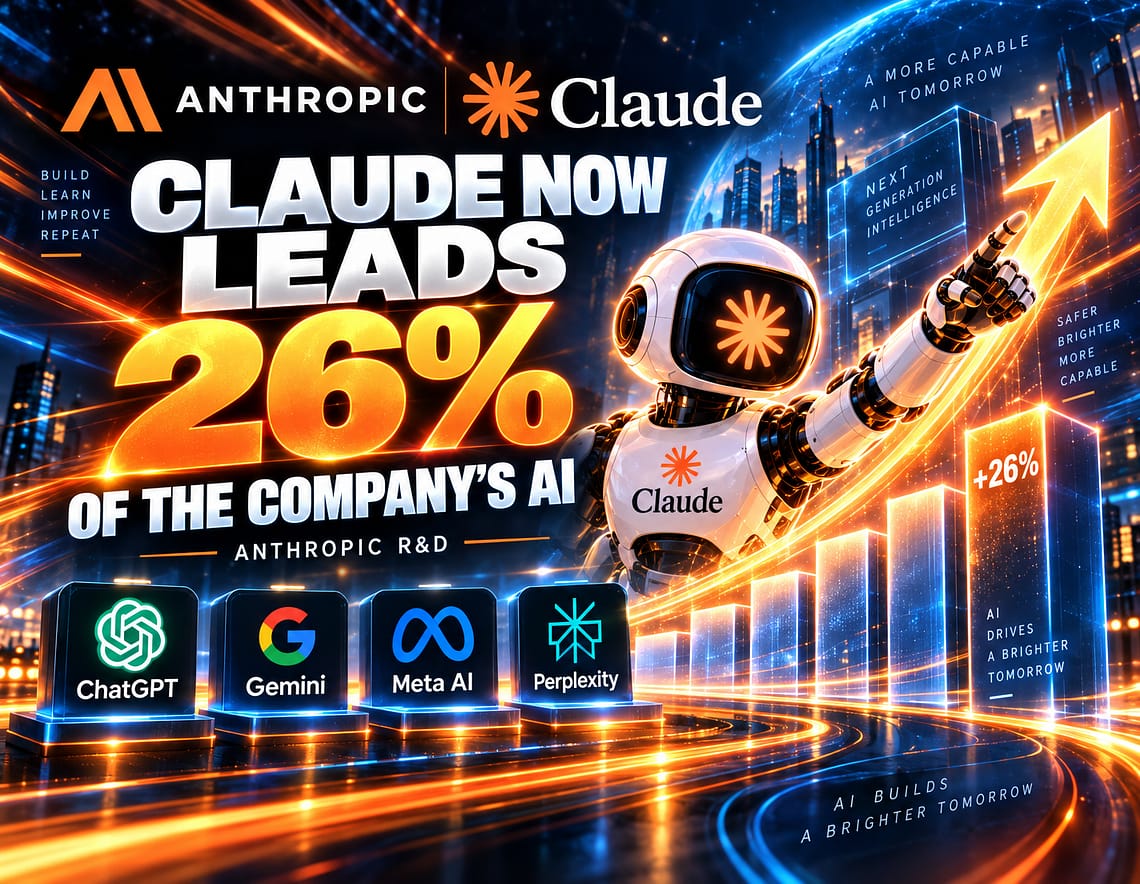
Anthropic revealed this week that its own AI model, Claude, now leads 26% of the company’s research and development work end to end, and collaborates in some form on roughly 90% of all R&D tasks internally. The company shared the numbers in a self-published report called “When AI Builds Itself”, and the story was picked up by wire services and dozens of national and regional outlets on September 17 and 18, 2026. It matters because Anthropic is one of the first major AI labs to attach hard percentages to a trend usually described only in vague terms, that AI is starting to help build the next generation of AI. Anyone who uses Claude for coding, writing, or research, and anyone simply trying to understand where AI development is actually headed, gets a clearer, numbers-based look at what is really happening inside one of the industry’s biggest labs, along with Anthropic’s own admission of where the claims fall short.
Quick Summary
Anthropic says Claude now leads 26% of its research and development work, up from close to zero in February 2026. Roughly 90% of staff R&D work now involves Claude in some capacity, and more than 30,000 Claude-based agents were running research and engineering tasks at once as of August 2026. Anthropic also says over 80% of the code merged into its own production systems is Claude-written, though the company is careful to say that figure overstates true productivity gains. The report frames all of this as meaningful progress toward, but not arrival at, “recursive self-improvement,” where AI systems design their own successors with minimal human input.
What Happened?
Anthropic published a detailed internal report describing how much of its own operations Claude now handles, particularly inside its research and engineering teams. The company says the shift has been fast. In February 2026, Claude led essentially none of Anthropic’s R&D work. By August 2026, that figure had climbed to 26%, with Claude completing most of a given task end to end from a single high-level prompt while a human stays in a supervisory role.
Anthropic also disclosed that its task completion “time horizon,” a measure of how long a task an AI model can complete unsupervised, has been doubling roughly every four months recently, faster than the seven-month doubling period the company cited previously. As one example, Anthropic said Claude Opus 3 could reliably handle around four minutes of human-equivalent work in March 2024, Claude Sonnet 3.7 handled about 90 minutes in March 2025, and by March 2026 a newer Claude model was managing roughly 12 hours of work in a single supervised run.
What’s New?
The genuinely new element here is not that Claude writes code or helps with research, that has been true for a while, it is that Anthropic is now willing to publish specific internal numbers about it. The report discloses that over 80% of production code merged at Anthropic as of May 2026 was authored by Claude, and that engineers are shipping roughly 8 times more code per quarter than their 2021 to 2025 baseline.
It also describes a research experiment in which Claude based agents recovered 97% of a target performance gap on an optimization problem within a week, compared with 23% recovered by human researchers working the same problem over the same period. Anthropic frames this as evidence that AI is meaningfully accelerating its own development cycle, while stopping short of saying full recursive self-improvement, where AI needs no human guidance at all, has arrived.
Who Gets Access?
This is an internal Anthropic operations disclosure, not a new consumer product or feature, so there is nothing new for everyday Claude users to download or subscribe to. The relevant “access” here is Anthropic’s own research and engineering staff, who are using Claude based agents as part of their daily workflow, plus, going forward, external third party evaluators that Anthropic says it plans to give internal access comparable to an employee’s, specifically to monitor this kind of AI assisted self development for safety issues.
Pricing and Plans
There is no new pricing or plan change tied to this announcement. It does not affect Claude Free, Pro, Max, Team, or Enterprise plans, and it is not related to API pricing. For related recent Claude product news, see Claude’s recent Chat and Cowork merger. Readers looking for current Claude subscription pricing should check Anthropic’s official pricing page directly, since plan pricing and limits can change independently of research announcements like this one.
Why It Matters
This report matters for two different reasons depending on who is reading it. For builders and creators who already rely on Claude, it is a signal that the tool itself is likely to keep improving quickly, since Anthropic is explicitly using AI to speed up its own model development cycle. For everyone else, it is one of the clearest concrete data points yet in the broader “AI building AI” conversation, a topic that is frequently discussed in sweeping, hard to verify terms. Anthropic putting real percentages and dates behind the claim, even a self reported and imperfect one, gives readers something more concrete to reason about than another round of unqualified hype. The disclosure also lands just weeks after reports that Anthropic could pursue an IPO at a roughly $2 trillion valuation, adding business context to why the company may want to show hard evidence of its research velocity.
Competitor Context
Anthropic is not alone in making these kinds of claims. Around the same period, OpenAI said its own AI agents are now doing the work equivalent of roughly three researchers each on certain internal tasks, a separate claim about internal automation rather than a like for like comparison. Google DeepMind and Meta’s Superintelligence Labs have both discussed internal AI assisted research acceleration in less quantified terms. What sets Anthropic’s disclosure apart for now is the level of detail, specific percentages, dated milestones, and named caveats, rather than a single headline statistic. For more on where OpenAI says its own models stand, see our coverage of the GPT-6 Astra launch.
| Company | Type of claim | Level of detail disclosed |
|---|---|---|
| Anthropic | 26% of R&D led by Claude, 90% collaboration rate | High, dated percentages and named caveats |
| OpenAI | AI agents doing the work of about 3 researchers each | Moderate, headline figure with less methodology detail |
| Google DeepMind | General statements on AI assisted research acceleration | Low, largely qualitative |
| Meta Superintelligence Labs | Progress updates on research reorganization and new models | Low to moderate, no comparable self-audit published |
Limitations
Anthropic’s own report is unusually candid about where the numbers fall short, and readers should weigh those caveats carefully. The company says its 8x code output figure is “almost certainly an overstatement of the true productivity gain,” because lines of code measure quantity, not quality. It also acknowledges that Claude authored code quality was noticeably worse than human written code as recently as late 2025 and has only reached rough parity now.
The research experiment showing a 97% recovered performance gap did not transfer cleanly to production scale models, and humans still chose the research problem and built the scoring system used to judge Claude’s performance. Anthropic also says a meaningful judgment gap remains, its models still lag humans at deciding which research directions are worth pursuing in the first place, even if they can execute a chosen direction quickly. None of this is fully autonomous either, Anthropic states that oversight measures remain in place specifically to catch AI misbehavior in this expanded, largely unsupervised, agent workforce. For a more skeptical take on where this trend could lead, see our earlier coverage of an Anthropic researcher’s resignation over AI safety concerns.
What Happens Next?
The announcement lands in the middle of a live industry argument about how fast AI development should move. Anthropic CEO Dario Amodei has publicly argued for a verifiable, industry wide slowdown and greater transparency around frontier AI progress, and Anthropic says it is now building third party verification mechanisms as part of that push, including giving outside evaluators access comparable to an Anthropic employee’s. Other prominent industry figures have pushed back on the idea that a slowdown is necessary, arguing companies can self regulate responsibly. Expect this specific debate, and Anthropic’s own follow up disclosures on Claude’s R&D role, to keep surfacing as new Claude models are released over the coming months, since Anthropic has now committed to sharing these kinds of internal metrics publicly rather than only in private.
FAQs
Is Claude actually building itself with no human involvement?
No. Anthropic is explicit that humans remain in a supervisory role throughout, and that models still lag well behind humans at choosing which research directions are worth pursuing. “Leading” a task means executing most of it end to end from a prompt, not deciding independently what to build next.
What does “recursive self-improvement” mean?
It refers to a scenario where an AI system substantially designs, builds, and improves its own successor with little to no human guidance. Anthropic’s report says the company is seeing meaningful acceleration in that direction but has not reached that point.
Does this change what Claude can do for regular users today?
Not directly. This is an internal operations disclosure about how Anthropic builds its own models, not a new consumer feature or capability.
Why is Anthropic sharing numbers that make its own claims look shakier?
The company frames the disclosure, including its caveats about overstated productivity figures, as part of a broader push for transparency and third party verification of frontier AI progress, tied to its public call for a verifiable industry slowdown.


Leave a Comment