

Claude AI is an AI assistant made by Anthropic, a San Francisco safety-focused AI company founded in 2021 by former OpenAI researchers. Claude can write, code, research, analyze files and now carry out long multi-step tasks on its own, all from one conversation. If you have been wondering what Claude actually is, how it grew from a 2023 chatbot into a full work assistant, and whether it is a better pick than ChatGPT, Gemini or Microsoft Copilot, this guide explains everything.
Below you will find Claude’s full history, the difference between Haiku, Sonnet, Opus, Fable and Mythos, what happened to Claude Cowork, what each plan costs in the USA and UAE, and what Anthropic has officially confirmed about where Claude is heading.
What Is Claude AI? A Quick Explanation
Claude is a family of large language models (LLMs) and the app built around them. Large language model: an AI system trained on huge amounts of text so it can understand and generate language. You can use Claude at claude.ai, in the desktop and mobile apps, inside tools like Chrome and Microsoft 365, or through the developer API.
In simple terms, Claude does three jobs:
- Answers and explains: quick questions, summaries, tutoring and brainstorming.
- Creates: articles, emails, documents, slide decks, spreadsheets, designs and code.
- Works on its own: you hand over a bigger task and Claude plans it, uses files, apps and the web, and reports back.
Who Created Claude AI and Why?
Claude was created by Anthropic. The company was founded in 2021 by siblings Dario Amodei (CEO) and Daniela Amodei (President), along with several colleagues who left OpenAI. Dario had been OpenAI’s Vice President of Research.
The founders’ stated reason was safety. They believed AI systems would become very powerful, and that at least one leading lab should put reliability and safety at the center of its work. Anthropic is set up as a public benefit corporation, and it trains Claude using a written set of values it publishes openly as Claude’s Constitution.
Who Owns Claude AI?
Claude AI is developed and operated by Anthropic. Dario Amodei is Anthropic’s co-founder and CEO, while Daniela Amodei is co-founder and President. Anthropic is a public benefit corporation, so Claude is not a Google, Amazon or Microsoft product even though major technology companies may provide cloud infrastructure, investment or distribution partnerships.
The History of Claude AI: From 2023 to 2026
Claude’s story moves fast, especially in 2026. Here are the milestones that matter most.
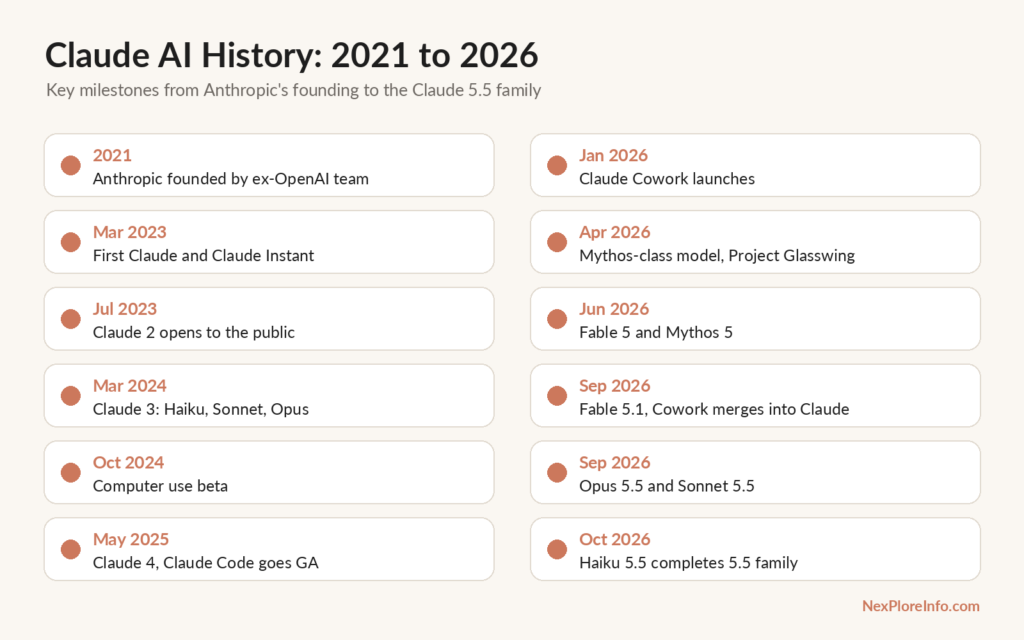
2023: The first Claude
Anthropic introduced Claude more broadly in March 2023, after a closed alpha with partners such as Notion and Quora. Claude 2 arrived in July 2023 and launched with the new public-facing beta website at claude.ai, making direct consumer access much easier.
2024: The three-tier family and computer use
In March 2024, the Claude 3 family introduced the naming system still used today: Haiku (small and fast), Sonnet (balanced) and Opus (most capable). Claude 3.5 Sonnet later became a favorite with developers, and Artifacts let Claude build small apps and documents beside the chat. In October 2024, Anthropic released “computer use” in beta, letting Claude operate a screen, mouse and keyboard.
2025: Claude Code and Claude 4
Claude Code, a coding agent that works directly in a developer’s project, first appeared as an early test version in early 2025. In May 2025, Anthropic launched Claude 4, and Claude Code became generally available. Coding quickly became the area where Claude built its strongest reputation.
2026: Cowork, Mythos, Fable and the 5.5 family
- January 12, 2026: Claude Cowork launched as an early test version, bringing Claude Code style task handling to non-developers.
- April 7, 2026: Anthropic announced its first Mythos-class model and Project Glasswing, giving a small group of trusted organizations access to a very strong model for defensive cybersecurity work only.
- June 9, 2026: Claude Fable 5 and Claude Mythos 5 were released. On June 12, Anthropic suspended access to both to comply with a USA government export control directive. Anthropic said in an official statement that it was complying while disagreeing with the decision. The controls were lifted on June 30, and access returned on July 1, 2026.
- June and July 2026: Claude Sonnet 5 and Claude Opus 5 followed.
- September 1, 2026: Claude Fable 5.1 and Mythos 5.1 launched.
- September 16, 2026: Cowork and chat merged into one Claude.
- September 22 to October 7, 2026: Opus 5.5, Sonnet 5.5 and Haiku 5.5 completed the current 5.5 family.
Why Did Anthropic Merge Claude Cowork Into Claude?
Many readers ask if Anthropic “closed” Cowork. It did not shut the features down. On September 16, 2026, Anthropic announced that Cowork and chat are now one Claude. Anthropic said people found it frustrating to decide where a task belonged, and work did not carry between the two.
Now Claude decides on its own whether a request needs a quick reply or a longer job that keeps running after you close your laptop. Files, projects, connectors and scheduled tasks carried over, Claude Docs and Slides launched in beta, and by default Claude still asks before taking an action. We covered the change in detail in our guide to the Claude Cowork and chat merger.
How Claude AI Works
Claude generates text from patterns learned in training, shaped by human feedback and its constitution. Three ideas explain most of what you see:
- Context window: the amount of information Claude can consider at once. Current plans support up to 1 million tokens, depending on the model. Our context window explainer breaks this down for beginners.
- Effort levels: newer models let you trade speed and cost for deeper thinking, from Low to Max.
- Tools and agents: Claude can search the web, run code, use connected apps and control a browser, which turns it into an AI agent rather than just a chatbot.
Claude’s Main Features and Capabilities
- Chat, web search and memory on web, desktop and mobile.
- Claude Docs, Slides and Design, downloadable as PowerPoint or PDF.
- Artifacts for small apps and interactive pages.
- Claude Code for software development on paid plans.
- Connectors and Skills linking Claude to Gmail, Google Drive, Slack and more.
- Scheduled tasks, such as a weekly report that writes itself.
Claude Opus, Sonnet and Haiku Explained (Plus Fable and Mythos)
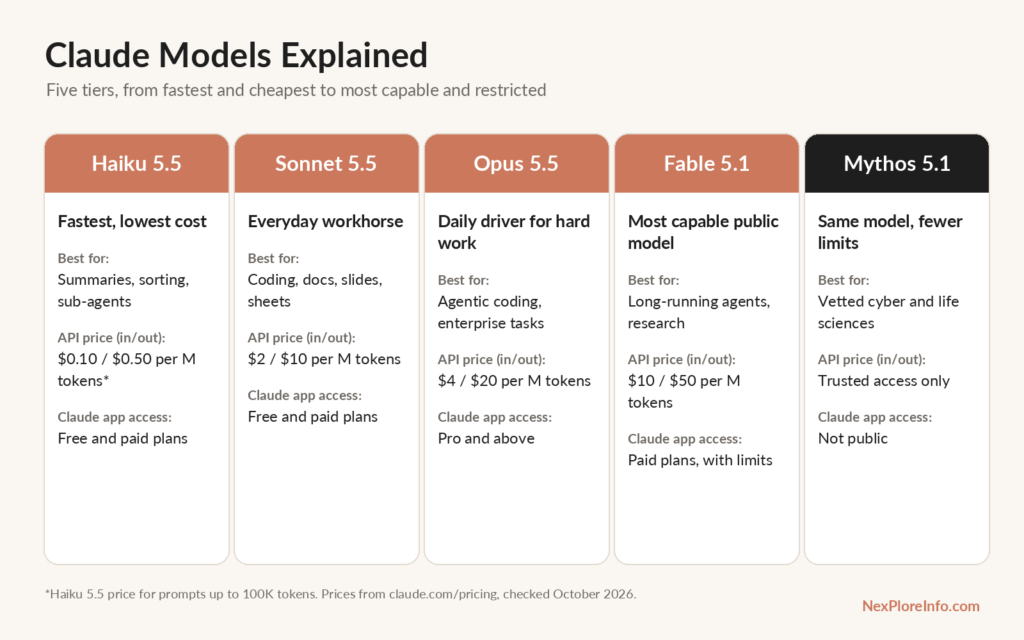
Think of Claude’s models like car trims: same brand, different power and price.
| Model | Best for | API price per 1M tokens (input / output) | Who can use it |
|---|---|---|---|
| Haiku 5.5 | Fast, cheap, high-volume jobs like summaries and sorting | $0.10 / $0.50 | AED 0.37 / AED 1.84 (prompts up to 100K tokens) | Free and paid plans |
| Sonnet 5.5 | Everyday coding, documents, slides and spreadsheets | $2 / $10 | AED 7.35 / AED 36.73 | Free and paid plans |
| Opus 5.5 | Complex agentic coding and enterprise work | $4 / $20 | AED 14.69 / AED 73.45 | Pro and above |
| Fable 5.1 | Long-running agents, research, hardest problems | $10 / $50 | AED 36.73 / AED 183.63 | Paid plans, with limits |
| Mythos 5.1 | Vetted cybersecurity and life sciences work | Trusted access programs only | Not available to the public |
Pricing checked: October 2026, from Anthropic’s official Claude pricing page. AED figures are converted at 3.6725.
How useful is Fable, and what are the restrictions?
Fable is Anthropic’s top publicly available tier, sitting above Opus. Anthropic describes Fable 5.1 and Mythos 5.1 as the same underlying model with different levels of safeguards. In Anthropic’s own testing, Fable 5.1 beat Fable 5 and Opus 5 on several coding and knowledge-work benchmarks. These are company-published results, and independent results may differ.
The restrictions are real, though:
- Plan limits: Fable is not on the Free plan. Pro users pay for it through usage credits, and Max users can spend up to 50% of their weekly limits on it.
- Biology: life sciences research and development questions are routed to Opus models instead.
- Cybersecurity: Fable 5.1 can help find software vulnerabilities, but not build exploits. Penetration testing and exploit generation are redirected to Opus.
- Mythos access: Mythos 5.1 is limited to vetted USA organizations through Anthropic’s trusted access programs.
Why Is Claude Easy to Use?
Claude is designed around a simple chat interface, but the experience now extends beyond basic question-and-answer use. You can upload files, search the web, create documents and slides, work inside projects, connect external apps and hand off longer tasks without switching to a separate product. For beginners, that means many common writing, research and productivity tasks start with the same action: describe what you want in plain language and refine the result in conversation.
The model lineup is also easier to understand when you think in terms of speed and capability: Haiku for fast, low-cost work, Sonnet for balanced everyday tasks, Opus for harder professional work and Fable for the most demanding generally available tasks.
Why Some People Prefer Claude Over ChatGPT
There is no official “best AI,” but independent comparisons point to consistent Claude strengths:
- Coding: Claude Code and Claude models are widely rated among the strongest for large, multi-file projects. See our list of the best AI coding tools for context.
- Writing quality: many writers find Claude’s tone natural and its style-following precise.
- Long documents: a large context window suits contracts and reports.
- One place for big tasks: one conversation can produce a matching report, slides and spreadsheet.
- Published safety approach: Anthropic publishes system cards, safety policies and its constitution, which matters to many businesses.
For a model-level matchup, read our comparison of GPT-6 Astra vs Claude Fable 5.1.
Where ChatGPT May Be a Better Choice
A fair comparison covers the other side too:
- ChatGPT: a broad consumer feature set with built-in image generation, voice tools and a large ecosystem of connected capabilities. For the full background, read our ChatGPT history, features and ownership guide.
- Gemini: the tightest link to Google Search, Gmail, Docs and Android.
- Microsoft Copilot: the natural fit if your company lives inside Windows, Outlook, Teams and Microsoft 365.
- Claude limits: no photo-style image generator, strict safeguards and usage caps heavy users can hit.
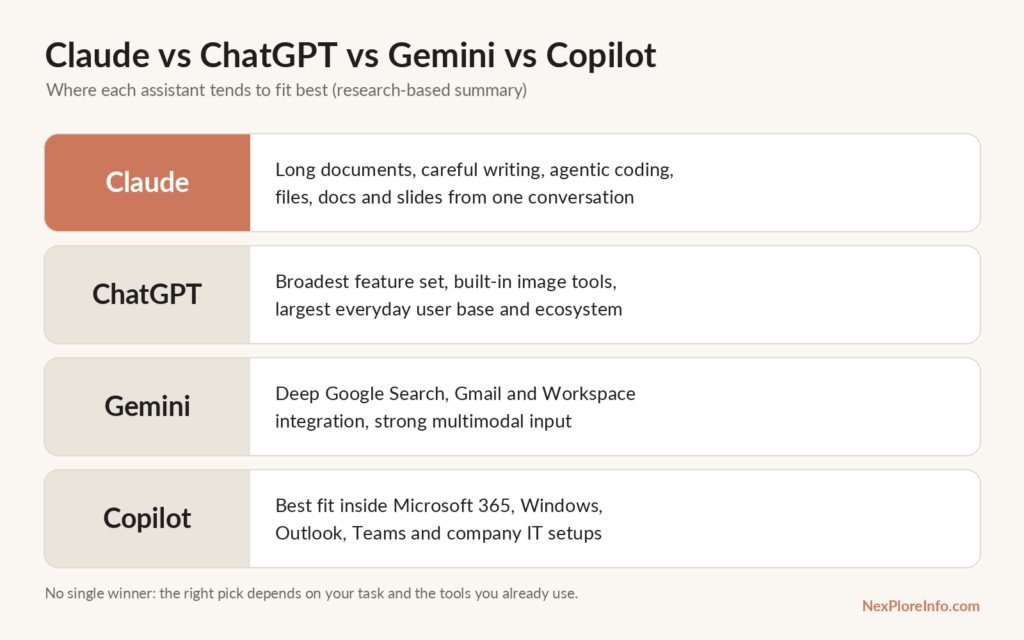
Many power users pay for two and use each where it is strongest.
Claude AI for Writing, Coding, Research and Business
- Writing: blog posts, scripts, captions and emails, edited in Claude Docs.
- Coding: building and debugging software with Claude Code.
- Research: web search plus long-document analysis, with citations you can check. Always verify facts, since all chatbots can hallucinate.
- Business: Team and Enterprise add admin controls and no model training on your content by default.
Claude plans and prices
| Plan | Price (USA and UAE) | Main extras |
|---|---|---|
| Free | $0 | AED 0 | Chat, web search, memory, Docs, Slides, Design |
| Pro | $20 | AED 73 per month ($17 | AED 62 per month billed yearly) | More usage, Claude Code, Opus, Projects, Chrome and Microsoft 365 |
| Max | From $100 | AED 367 per month | 5x or 20x Pro usage, priority access, API credits |
| Team | $25 | AED 92 per seat monthly ($20 | AED 73 yearly) | Admin tools, SSO, shared projects |
| Enterprise | $20 | AED 73 per seat plus usage | Audit logs, SCIM, custom data retention |
Pricing checked: October 2026. Taxes may apply.
Anthropic’s Confirmed Plans and Product Direction
Officially announced items only:
- Enterprise Frontier Safeguards (EFS): a system that lets enterprise customers keep data on their own cloud while still being protected from misuse. Anthropic says it is rolling out in phases starting this fall.
- Merged Claude rollout: after Pro and Max, Team and Free plans follow, with Enterprise admins getting at least 30 days’ notice.
- Wider Mythos access: Anthropic says it is working with the USA government to expand Mythos 5.1 access to more domestic and international partners, and plans to open its life sciences program to more scientists.
- Bringing Fable gains to other models: Anthropic says it is continuing to carry Fable 5.1 improvements into the rest of the model family.
The Future of Claude AI: Opportunities and Challenges
This part is analysis, not a company promise. The direction is from chatbot to coworker: Claude increasingly plans and finishes tasks while you are away. Anthropic is also pushing into science, citing a new high-resolution map of Venus that Fable 5.1 built from old NASA radar data.
The challenges are just as real: government oversight has already paused one model launch, rivals ship new models almost monthly, and keeping more independent agents safe and under human control remains the core problem Anthropic says it was founded to solve.
Claude AI Advantages and Disadvantages
| Advantages | Disadvantages |
|---|---|
| Strong coding and long-task performance | No native photo-style image generation |
| Natural, instruction-following writing | Usage limits can feel tight on Pro |
| Large context window up to 1M tokens | Fable costs extra credits on Pro |
| Docs, Slides, Design and agents in one app | Safeguards sometimes redirect harmless requests |
| Transparent, published safety approach | Fewer consumer integrations than some rivals |
Frequently Asked Questions
Is Claude better than ChatGPT?
It depends on the task. Claude is often preferred for coding, long documents and careful writing, while ChatGPT offers a broader feature set, including built-in image generation.
Is Claude AI free?
Yes. The Free plan includes chat, web search and memory. Paid plans start at $20 | AED 73 per month.
What is the difference between Claude Opus, Sonnet and Haiku?
Haiku is the fastest and cheapest, Sonnet is the balanced everyday model, and Opus is the more powerful option for complex work. Fable sits above Opus.
What happened to Claude Cowork?
On September 16, 2026, Anthropic merged Cowork into the main Claude app. Its features remain; you no longer switch modes.
Can I use Claude in the UAE?
Yes. Both the USA and the UAE are on Anthropic’s list of supported regions.
Conclusion
Claude has grown from a careful 2023 chatbot into one of the most capable AI work assistants available, with a clear lineup from Haiku to Fable and one app for both quick answers and long projects. ChatGPT, Gemini and Copilot each win in their own areas, but if your work leans on writing, coding, research or long documents, Claude is well worth trying, starting with the free plan. For more beginner-friendly AI guides, keep exploring NexPloreInfo.com.












Leave a Comment