
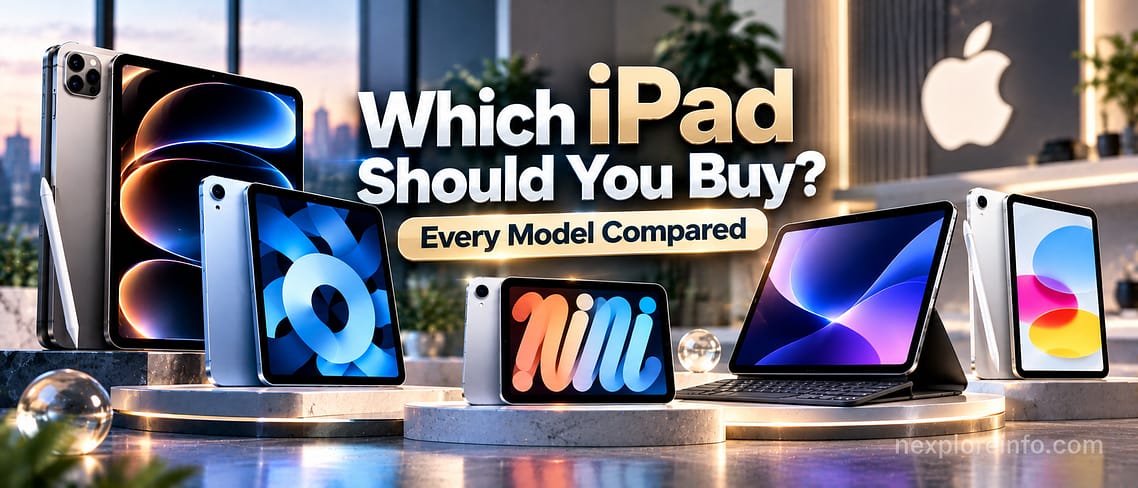
Apple currently sells four different iPads, and picking the right one is not as simple as it used to be. The iPad Pro brings a laptop-class M5 chip and an OLED screen, the iPad Air offers most of that power for less, the base iPad covers the basics at the lowest price, and the iPad mini packs real performance into a pocketable size. If you are wondering which iPad should you buy in 2026, the answer depends on your budget and what you plan to do with it.
Students and casual users are usually best served by the base iPad or the iPad Air. Creators who edit photos and video, or use the Apple Pencil heavily, should look at the Air or Pro. Anyone who wants the fastest tablet Apple makes should go straight to the Pro. This guide breaks down pricing, specs, and independent test results for all four models in the USA and UAE, so you can match the right iPad to your budget.
Buying Guide Summary
- Product: Apple iPad Lineup: iPad, iPad Air, iPad Pro, and iPad mini
- Category: Tablets
- Starting Price: $449 (USA) | AED 1,999 (UAE), for the base iPad
- Availability: Available in the USA and UAE through Apple’s own stores and authorized retailers
- Best For: Students, creators, professionals, and casual users, depending on the model
- Main Strength: A model and price point for nearly every budget, all running the same iPadOS software
- Main Weakness: The lineup can be confusing, and it is easy to overpay for features you will not use
- Guide Type: Research-Based Buying Guide
- Last Verified: September 30, 2026
Pros and Cons of Each iPad
iPad (A16): Pros and Cons
- Pro: Lowest entry price at $449 | AED 1,999, and “more than fast enough” for browsing and most games, per Engadget
- Pro: Strong battery life, measured over 11 hours in Engadget’s looped video test
- Con: No Apple Intelligence support, the only current iPad without it
- Con: Unlaminated LCD screen; only the basic Apple Pencil (USB-C) is supported, not Pencil Pro
iPad Air (M4): Pros and Cons
- Pro: M4 chip with a 39% GPU gain over the previous model, per Engadget; TechRadar called it “the iPad most people should buy”
- Pro: Supports Apple Pencil Pro, the Magic Keyboard, and Apple Intelligence, with 12GB of RAM
- Con: Same LCD panel as before; Engadget said plainly, “it’s time for a better screen,” and there’s no ProMotion
- Con: Real-world battery measured at 7 to 8 hours under heavy use, short of the 10-hour claim
iPad Pro (M5): Pros and Cons
- Pro: Tandem OLED display Engadget called “the nicest display I have ever seen on a portable device,” with ProMotion up to 120Hz
- Pro: Roughly 32% faster GPU and up to 101% better AI-focused GPU benchmarks than the M4, plus Face ID and Thunderbolt/USB4
- Con: Starts well above the Air, and the gap widens once you add the Magic Keyboard
- Con: Battery with the Magic Keyboard attached measured 7 to 8 hours, similar to the cheaper Air
iPad mini (A17 Pro): Pros and Cons
- Pro: Most portable iPad Apple sells at 293 grams, with a 23% multi-core and 31% graphics gain over the last generation, per Macworld
- Pro: Now supports Apple Pencil Pro, and battery life almost exactly matched Apple’s 10-hour claim in Macworld’s testing
- Con: Display is still 60Hz with no ProMotion, and the design is largely unchanged since 2021
- Con: Not compatible with the older 2nd-generation Apple Pencil
Price and Availability in the USA and UAE
All four iPads are sold new in the USA and UAE through Apple’s own stores and authorized retailers, including Amazon and Best Buy in the US, and Sharaf DG, Jumbo, noon, and iSTYLE in the UAE. UAE prices include 5% VAT. Prices below were checked on Apple’s US and UAE stores on September 30, 2026.
iPad (A16), 11-inch, Wi-Fi: 128GB: $449 | AED 1,999. 256GB: $549 | AED 2,399. 512GB: $749 | AED 3,199.
iPad Air (M4), 11-inch, Wi-Fi: 128GB: $749 | AED 2,999. 256GB: $849 | AED 3,399. 512GB: $1,049 | AED 4,199. 1TB: $1,349 | AED 5,399. (The 13-inch Air adds $200 at every tier, starting at $949 | AED 3,999.)
iPad Pro (M5), 11-inch, Wi-Fi: 256GB: $1,199 | AED 4,999. 512GB: $1,399 | AED 5,799. 1TB: $1,799 | AED 7,399. 2TB: $2,299 | AED 9,399. (The 13-inch Pro adds $300 at every tier, starting at $1,499 | AED 6,299.)
iPad mini (A17 Pro), Wi-Fi: 128GB: $599 | AED 2,499. 256GB: $699 | AED 2,899. 512GB: $899 | AED 3,699.
Wi-Fi + Cellular models add roughly $150 to $200 in the USA at every tier; check current Apple UAE listings for cellular pricing.
[AFFILIATE LINK: Apple USA Store] | [AFFILIATE LINK: Apple UAE Store] | [AFFILIATE LINK: Amazon.ae] | [AFFILIATE LINK: Sharaf DG]
Every iPad sold through Apple’s UAE store carries the standard one-year limited warranty, and AppleCare+ is available locally for extended coverage. Specs and storage options are identical between the US and UAE versions.
iPad Pro vs iPad Air vs iPad mini: Key Specs Compared
| Spec | iPad (A16) | iPad Air (M4) | iPad Pro (M5) | iPad mini (A17 Pro) |
|---|---|---|---|---|
| Starting price | $449 | AED 1,999 | $749 | AED 2,999 | $1,199 | AED 4,999 | $599 | AED 2,499 |
| Chip | A16 | M4 (12GB RAM) | M5 (12 to 16GB RAM) | A17 Pro |
| Display | 11″, LCD, no lamination | 11″ or 13″, LCD | 11″ or 13″, Tandem OLED, 120Hz | 8.3″, LCD |
| Biometrics | Touch ID | Touch ID | Face ID | Touch ID |
| Pencil support | Apple Pencil (USB-C) | Apple Pencil Pro | Apple Pencil Pro | Apple Pencil Pro |
| Apple Intelligence | Not supported | Supported | Supported | Supported |
| Weight (Wi-Fi) | 477g | 464g (11″) | 444g (11″) | 293g |
| Connector | USB-C, USB 2.0 speeds | USB-C, USB 3 speeds | Thunderbolt / USB4 | USB-C |
Performance: What Independent Testing Found
The performance gap across this lineup is bigger than the price gap suggests. Engadget’s Geekbench 6 testing found the M5 iPad Pro about 15% faster single-core and 10% faster multi-core than the M4 iPad Air, with GPU performance over 32% higher and AI-focused GPU benchmarks up to 101% better. For most people, that gap only matters for heavy video export, 3D work, or on-device AI image generation.
The iPad Air’s M4 chip is still a substantial step up from the base iPad, with Engadget measuring a 39% GPU gain over the previous Air and smooth performance in demanding games. The base iPad’s A16 chip scored about 20% faster than its predecessor but trailed the Air by roughly 40% in multi-core tasks, mainly noticeable in heavier photo and video editing rather than everyday browsing. The iPad mini’s A17 Pro chip punches above its size too, with Macworld measuring a 23% multi-core and 31% graphics gain over the previous mini.
Display, Design, and Battery Life
The iPad Pro’s Tandem OLED panel supports ProMotion up to 120Hz and 1,600 nits of peak HDR brightness, and Engadget’s reviewer called it the best screen on any portable device they had tested. The iPad Air and base iPad both use standard Liquid Retina LCD panels without ProMotion; Engadget was blunt about the Air’s screen, writing “it’s time for a better screen.” The base iPad’s panel is also unlaminated, which Engadget said creates more glare and a less precise feel with Apple Pencil. The iPad mini’s 8.3-inch display is sharp at 326 ppi but, like the Air, stays at 60Hz.
Apple rates every current iPad at “up to 10 hours” of browsing or video, but real-world results vary. Macworld measured 9 hours 57 minutes on the iPad mini, close to the claim, and Engadget measured over 11 hours on the base iPad in looped video. The Air and Pro told a different story under heavier use, with Engadget reporting 7 to 8 hours on both with the Magic Keyboard attached. Light use gets closer to Apple’s number; productivity work shortens runtime mainly on the Air and Pro.
Apple has reportedly been testing an OLED iPad mini that could arrive as soon as late October 2026, though nothing is official yet, so it’s worth watching if a bigger mini upgrade matters more than buying today.
Apple Pencil, Accessories, and Software
The iPad Pro, iPad Air, and iPad mini all support Apple Pencil Pro, with squeeze gestures, haptic feedback, and Find My. The base iPad only supports the simpler Apple Pencil (USB-C) or the older 1st-generation Pencil with an adapter. The Magic Keyboard is available for the iPad Air and iPad Pro, turning either into a laptop-style setup, though it adds meaningfully to the price. If you are weighing a keyboard-equipped iPad against an actual laptop, our MacBook Neo buying guide and Googlebook buying guide cover two very different laptop alternatives worth comparing first.
All four iPads run the same iPadOS, so app compatibility is identical. The one real software split is Apple Intelligence: the Air, Pro, and mini all support it, while the base iPad does not, something Engadget said many buyers will not mind. Creators who lean on AI tools, including apps covered in our best AI image generators guide, will get more consistent performance from an Air or Pro model.
Best iPad for Students, Creators, and Professionals
- Base iPad: students who mainly need notes, reading, and video calls; families buying a tablet for kids; anyone upgrading from a much older iPad who just wants the essentials.
- iPad Air: most everyday buyers who want real performance without Pro prices; design or video students; anyone pairing it with the Magic Keyboard for lightweight productivity.
- iPad Pro: video editors, photographers, and AI-assisted creative workflows that benefit from the M5 chip and OLED display; anyone using it as a laptop replacement.
- iPad mini: commuters and readers who want a tablet that fits in one hand, or strong performance in the smallest size rather than the biggest screen.
- Consider waiting if you specifically want an OLED iPad mini, given the reported model that may arrive later in 2026.
Alternatives to Consider
Samsung Galaxy Tab S11: the closest Android equivalent to the iPad Air, with Samsung’s DeX desktop-style mode built in and more storage for the price at the base tier, though it has fewer tablet-optimized apps and S Pen support varies by app. Price: $899.99 | AED 2,999 (128GB).
Microsoft Surface Pro (12-inch): a genuine Windows 2-in-1 for buyers who need full desktop software rather than tablet apps, though the keyboard and pen are sold separately and battery life trails Apple’s iPads in most independent tests. Price: $849.99 (USA) | approximately AED 3,699 at UAE retail, per Jumbo Electronics.
Should You Buy an iPad in 2026?
Yes, but the right model depends on what you need it to do. The base iPad is the easiest recommendation for a reliable tablet at the lowest price. The iPad Air is the one most people who want more should actually buy: independent reviewers keep landing on the same conclusion, that it delivers most of the Pro’s usefulness for meaningfully less. The iPad Pro only makes sense once you need its OLED display, extra performance, or Thunderbolt connectivity, since day-to-day use of an Air and a Pro is closer than the price gap implies. The iPad mini is a specialist pick for anyone who values portability over screen size.
If you are unsure, the iPad Air is the safest default. If you know you will push the hardware hard with editing or AI-assisted creative work, the extra cost of the iPad Pro is easier to justify. Students or writers weighing how much AI-assisted work they will realistically do can also check our guide to AI content tools before deciding how much power they need.
FAQs
Which iPad should I buy in 2026?
For most people, the iPad Air (M4) offers the best balance of price and performance. Choose the base iPad if budget is the priority, the iPad Pro if you need the best display and performance, and the iPad mini if portability matters most.
What is the cheapest iPad you can buy right now?
The base iPad (A16) is the cheapest current model, starting at $449 | AED 1,999 for 128GB Wi-Fi.
Is the iPad Air worth it over the base iPad?
For most buyers who do more than basic browsing, yes. Independent testing shows a real performance gap, and the Air adds Apple Pencil Pro support and Apple Intelligence, both missing on the base model.
How much does the iPad Pro cost in the UAE?
The 11-inch iPad Pro (M5) starts at AED 4,999 (256GB Wi-Fi), and the 13-inch starts at AED 6,299, both confirmed on Apple’s UAE store.
Which iPad is best for students?
Most students are well served by the base iPad for notes and reading, or the iPad Air for design, video editing, or heavier multitasking.
What is the real difference between the iPad Pro and iPad Air?
The Pro adds a Tandem OLED display with ProMotion, a faster M5 chip, Face ID, and Thunderbolt. The Air uses a standard LCD screen, Touch ID, and a slower but still capable M4 chip, at a meaningfully lower price.
How we made this guide: This buying guide is based on official specifications, current USA and UAE pricing, and research from trusted independent reviews. NexPloreInfo has not tested these products hands-on.


Leave a Comment