
GPT-6.1 Terra vs Claude Opus 5.5 is the AI matchup a lot of developers and power users are weighing right now. OpenAI shipped Terra on October 26, 2026 as a cheaper, faster model for agents and computer use. Anthropic’s Opus 5.5 has been out since September 22 and still tops most independent leaderboards.
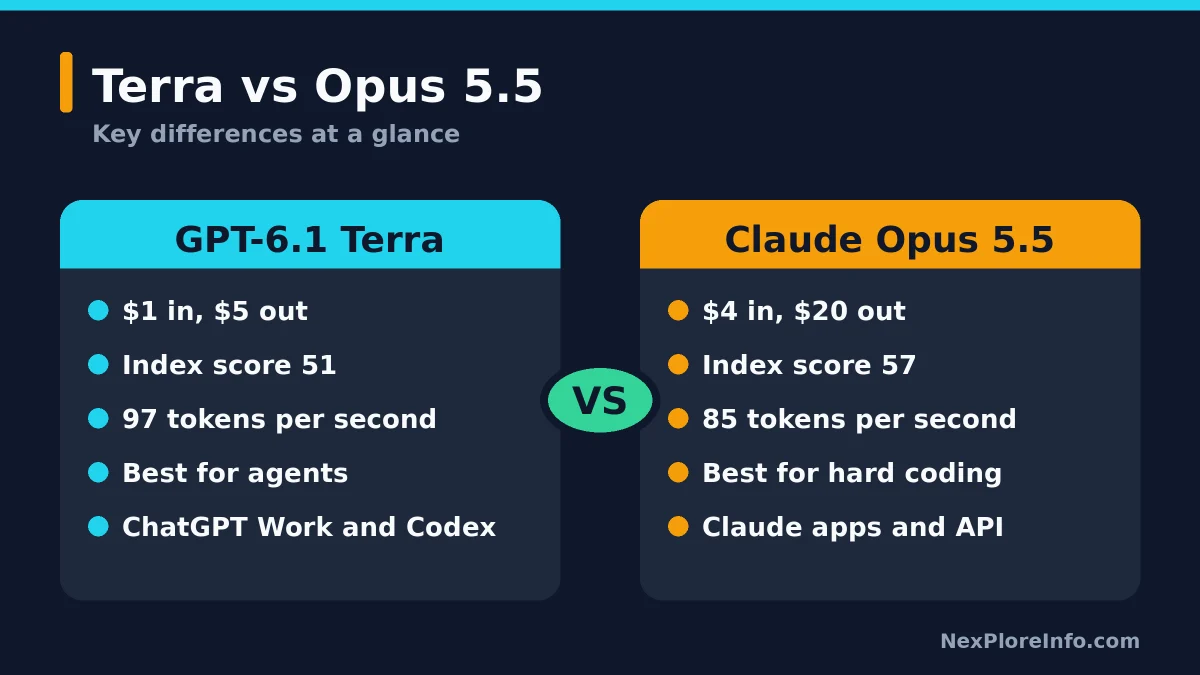
Quick answer: Claude Opus 5.5 is the smarter model overall, scoring 57 to Terra’s 51 on Artificial Analysis’ Intelligence Index, and it’s the safer pick for hard coding and long reasoning. GPT-6.1 Terra costs a quarter as much per token ($1 input and $5 output per million, vs $4 and $20), so it wins on price and on high-volume agent work.
In this article 14 sections
- Quick Verdict
- GPT-6.1 Terra vs Claude Opus 5.5 at a Glance
- Price and Availability in the USA and UAE
- Full Specs Comparison
- Is GPT-6.1 Terra Better Than Claude Opus 5.5 for Coding?
- GPT-6.1 Terra Computer Use and Agent Tasks
- Speed: Which Model Answers Faster?
- Writing, Research and Everyday Answers
- Limits, Access and Privacy
- Value for Money
- Which Should You Buy?
- Alternatives to Consider
- Final Verdict
- FAQs
Quick Verdict
Short version? Pick by the job, not the logo.
- Pick Claude Opus 5.5 if you need the strongest reasoning, tough multi-file coding or long research tasks, and you can live with paying more per task.
- Pick GPT-6.1 Terra if you run lots of agent jobs, screen and form automation or bulk API calls, and cost per task matters more than the last few points of accuracy.
GPT-6.1 Terra vs Claude Opus 5.5 at a Glance
Here’s the side-by-side summary. Prices are standard API rates and monthly plan prices, checked on November 1, 2026.
| Category | GPT-6.1 Terra | Claude Opus 5.5 |
|---|---|---|
| Maker | OpenAI | Anthropic |
| Release date | October 26, 2026 | September 22, 2026 |
| API price (per 1M tokens) | $1 input, $5 output | $4 input, $20 output |
| Cheapest paid plan with access | ChatGPT Plus, $20 | approximately AED 73 a month | Claude Pro, $20 | approximately AED 73 a month |
| Availability | USA and UAE: ChatGPT Work, Codex, OpenAI API | USA and UAE: Claude apps, Claude API, AWS, Google Cloud, Microsoft Foundry |
| Best for | Cheap, fast agents and computer use | Hard coding, deep reasoning, long research |
| Main strength | Cost per task | Top independent scores |
| Main weakness | Not in the regular ChatGPT chat picker | Four times the token price |
| Comparison type | Research-Based Comparison | |
| Prices last verified | November 1, 2026 | |
Price and Availability in the USA and UAE
Both models are available in the USA and UAE today, but you reach them in different ways. Terra lives mostly in OpenAI’s work tools and API, while Opus 5.5 sits right inside the normal Claude app.
GPT-6.1 Terra price per token and plans
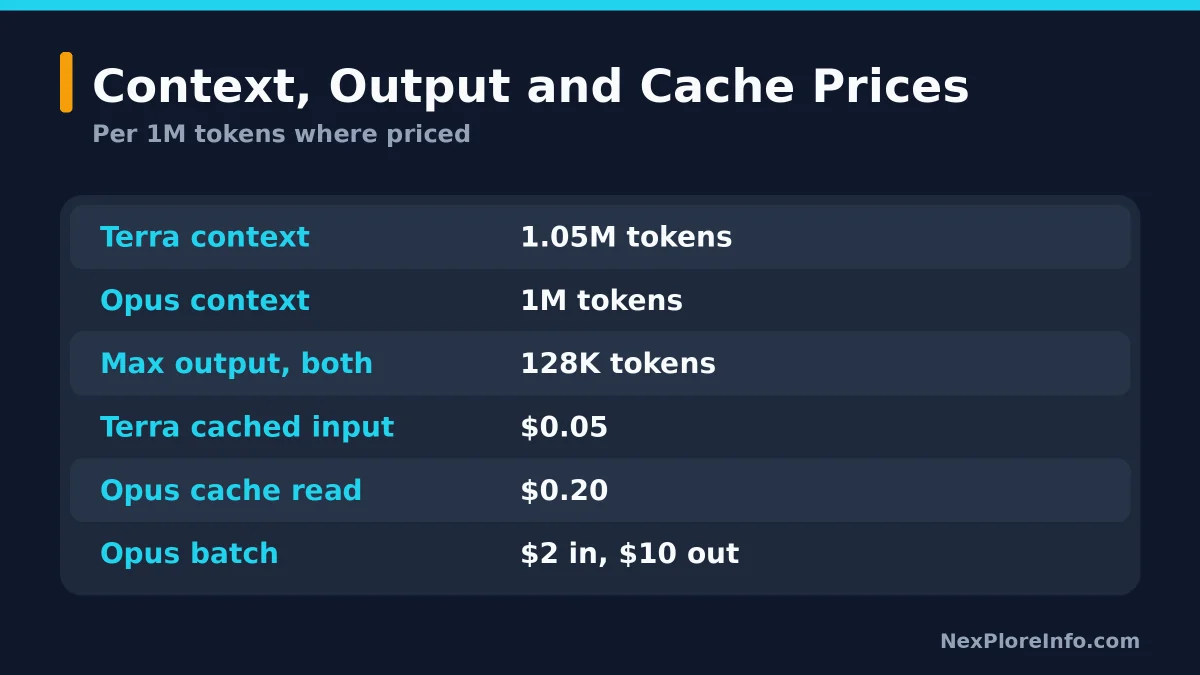
On the API, Terra costs $1 per million input tokens, $0.05 per million cached input tokens and $5 per million output tokens, according to TestingCatalog’s launch coverage. That’s about half what OpenAI charged for GPT-5.6 Terra.
In ChatGPT, you’ll find it in ChatGPT Work and Codex for Plus, Pro, Business, Enterprise and Edu users. It isn’t in the everyday Chat model picker, which trips up a lot of people. ChatGPT Plus is $20 | approximately AED 73 a month, and the Pro tiers run $100 | approximately AED 367 and $200 | approximately AED 735. ChatGPT bills these plans in USD in the UAE, which is why the AED figures are approximate. [AFFILIATE LINK: ChatGPT Plus]
Claude Opus 5.5 price and plans
Anthropic’s pricing page lists Opus 5.5 at $4 per million input tokens and $20 per million output tokens, with cache reads at $0.20. Batch jobs cost half: $2 and $10.
For regular users, Claude Pro is $20 | approximately AED 73 a month, or $17 a month billed yearly. Max is $100 | approximately AED 367 and Ultra is $200 | approximately AED 735. Those plans are billed in USD too. [AFFILIATE LINK: Claude Pro]
Full Specs Comparison
On paper they’re closer than the price gap suggests: same-size context windows, same output cap and the same knowledge cutoff month.
| Spec | GPT-6.1 Terra | Claude Opus 5.5 |
|---|---|---|
| API model ID | gpt-6.1-terra | claude-opus-5-5 |
| Context window | About 1.05M tokens | 1M tokens |
| Max output | 128K tokens | 128K tokens (300K on Batch API beta) |
| Knowledge cutoff | June 2026 | June 2026 |
| Reasoning control | Effort settings up to max | Effort levels low to max, adaptive thinking always on |
| Cached input price | $0.05 per 1M | $0.20 per 1M (read) |
| Intelligence Index (Artificial Analysis) | 51 | 57 |
| Output speed (Artificial Analysis) | 97 tokens per second | 85 tokens per second |
| Where to use it | ChatGPT Work, Codex, API | Claude apps, API, AWS, Google Cloud, Microsoft Foundry |
Not sure what a context window really means for you? Our explainer on how context windows and tokens work breaks it down.
Is GPT-6.1 Terra Better Than Claude Opus 5.5 for Coding?
No, not for the hardest coding work. Opus 5.5 posts the higher scores, and OpenAI itself says its bigger models remain the better pick for complex coding.
Anthropic reports 66.4% for Opus 5.5 on Terminal-Bench 4.0 at xhigh effort, according to Digital Applied’s breakdown of the launch numbers. OpenAI’s own figure for Terra on the same test is 50.3% at max effort. Those are vendor numbers from different setups, so treat the gap as a rough signal, not a final score.
Real-world testing tells a messier story. In The New Stack’s three-task test, both models tied 50 out of 50 on release triage, and Terra scored 48 to Opus’s 43.5 on a data task. On a CI history audit, Opus ran out of output room before giving a final answer. The author is clear that one run each doesn’t prove a general ranking.
Winner: Claude Opus 5.5. Higher benchmark ceiling, and OpenAI points hard coding to its pricier models anyway.
GPT-6.1 Terra Computer Use and Agent Tasks
This is where Terra shines. OpenAI built it for agents that read screens, fill in forms and click through apps, and it does that at a far lower cost per task.
On OpenAI’s Agents’ Last Exam chart, Opus 5.5 scores 63.2% at $8.82 per task while Terra scores 60.0% at $1.01 per task, as Let’s Data Science reported. So Claude still edges it on accuracy, but Terra gets you about 95% of that result for roughly one-ninth of the cost.
OpenAI also says Terra’s error rate on tricky, error-inducing prompts dropped to 4.3% at max effort, down from much higher levels on GPT-5.6 Terra. Opus 5.5 is no slouch here either: Anthropic reports 81.8% on OSWorld 2.0, a desktop-control test.
If you’re new to the idea, our guide to what an AI agent actually does is a good starting point.
Winner: GPT-6.1 Terra. Slightly lower accuracy, but the cost per task is in a different league.
Speed: Which Model Answers Faster?
That depends on what you’re timing. Terra writes text faster once it starts, but at max effort Opus 5.5 starts answering sooner.
Artificial Analysis measures Terra at 97 tokens per second vs 85 for Opus 5.5. But at those high-effort settings, Terra took about 275 seconds before its first token, against roughly 127 seconds for Opus. That’s a lot of thinking time either way.
Across the full job, Terra was quicker in The New Stack’s test: 2,418 seconds total vs 3,962 for Opus. For most people, finishing the whole task sooner beats a fast first word.
Winner: GPT-6.1 Terra. Faster output and quicker end-to-end runs in the testing we found.
Writing, Research and Everyday Answers
For polished writing and deep research, Opus 5.5 is the more dependable pick. Terra is good, but OpenAI pitched it at practical work output, not long-form thinking.
OpenAI says Terra writes more clearly than its last Terra model and handles proposals, technical drawings and forms well. Its Artificial Analysis test also shows it guesses far less on questions it can’t answer, which matters if you’ve been burned by AI hallucinations before.
Opus 5.5 leads Anthropic’s charts on Humanity’s Last Exam with tools (67.7%) and on GDPval-AA, a test of real office tasks. Vals AI’s independent run did find some drops on legal, tax and medical-coding tasks, so it isn’t perfect everywhere.
Winner: Claude Opus 5.5. Stronger reasoning scores, and it’s right there in the normal Claude chat.
Limits, Access and Privacy
Opus 5.5 is easier to reach day to day. Terra is easier on your budget if you’re building something.
Terra not showing up in regular ChatGPT chat is the big catch for casual users. You need ChatGPT Work, Codex or the API. Opus 5.5 is in the Claude app on paid plans, and Anthropic raised five-hour usage limits on Pro, Max and Team plans with this release.
For developers, Opus 5.5 brings some breaking changes. Thinking can’t be turned off and forced tool use is gone, so older code may throw errors. OpenAI published a system card addendum for Terra and says it resists prompt injection better in its tests. Whichever you pick, check your plan’s data settings before you paste in anything sensitive.
Winner: Tie. Claude wins on everyday access, while Terra wins on API cost and simpler migration.
Value for Money
Terra is the clear value pick for anyone paying by the token. Opus 5.5 earns its price only when the extra accuracy saves you rework.
The gap is huge. In The New Stack’s test, the estimated token bill was $25.99 for Terra vs $214.96 for Opus 5.5 on the same three tasks. That’s more than eight times cheaper for scores that were close or better on two of the three jobs.
Subscriptions are a different story. ChatGPT Plus and Claude Pro both cost $20 | approximately AED 73 a month, so a single user isn’t saving money either way. The value question really only bites when you’re running agents at scale.
Which Should You Buy?
Match the model to the work. Here’s how that plays out for different people:
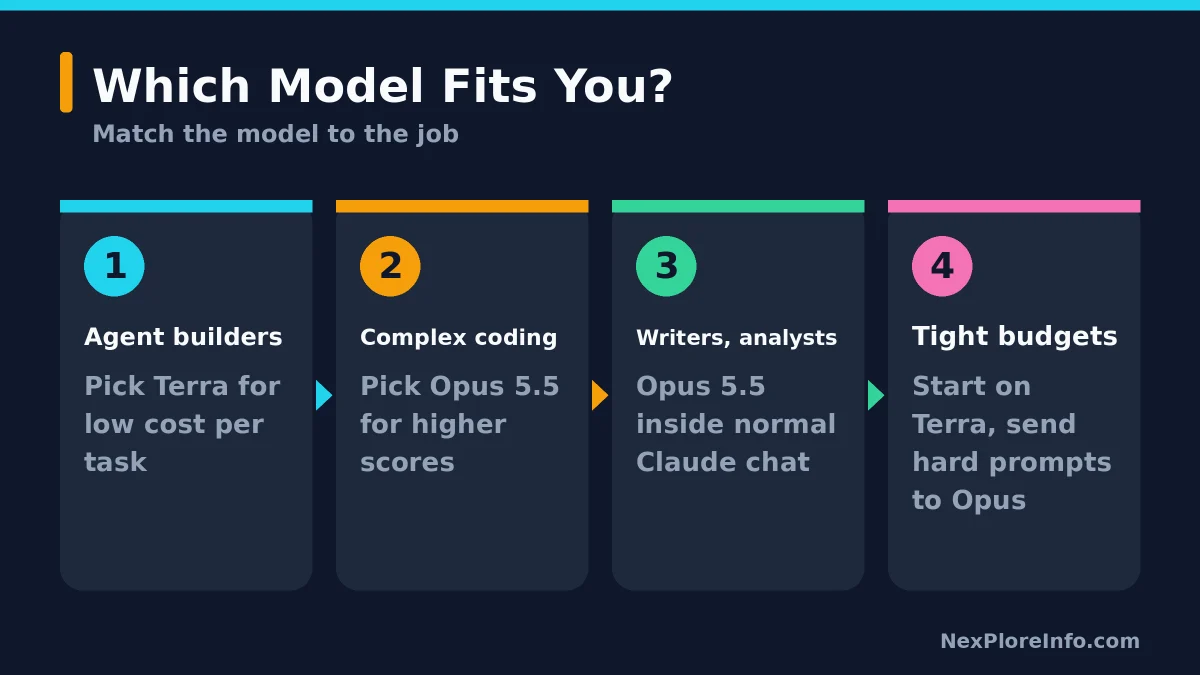
- Developers building agents: GPT-6.1 Terra. Cost per task is just too good to ignore.
- Engineers on complex codebases: Claude Opus 5.5. It has the higher coding ceiling. Our list of the best AI coding tools covers the apps that use it.
- Writers, analysts and researchers: Claude Opus 5.5, for the stronger reasoning and easy chat access.
- Operations teams automating forms and screens: GPT-6.1 Terra.
- Students and casual users: Neither is essential. A $20 | approximately AED 73 plan from either company covers you, and Claude Pro gets you Opus 5.5 inside normal chat.
- Startups on a tight budget: Start with Terra, then send the hardest prompts to Opus 5.5.
Alternatives to Consider
Two other models deserve a quick look before you commit.
- GPT-6 Astra: OpenAI’s bigger model for tougher coding, at higher cost per token. See our GPT-6 Astra vs Claude Fable 5.1 comparison.
- Gemini 4 Argon: Google’s rival model for developers. Our Gemini 4 Argon API guide has prices and access details.
Final Verdict
If you only want one model and accuracy matters most, choose Claude Opus 5.5. It scores higher in independent testing, it’s easy to use in the Claude app, and it handles the hardest coding and reasoning better.
If you’re paying by the token, GPT-6.1 Terra is the smarter buy. It lands close to Opus on agent and computer-use tasks for a fraction of the cost, and in at least one real test it finished faster too. Plenty of teams will end up using both: Terra for the bulk work, and Opus for the tricky stuff. Want to know more about Anthropic’s model family first? Read our guide on what Claude AI is and how its plans work.
FAQs
Is GPT-6.1 Terra better than Claude Opus 5.5?
Not overall. Claude Opus 5.5 scores 57 to Terra’s 51 on Artificial Analysis’ Intelligence Index and leads on hard coding benchmarks. GPT-6.1 Terra is better value, though, costing a quarter as much per token and far less per agent task.
How much does GPT-6.1 Terra cost per token?
GPT-6.1 Terra costs $1 per million input tokens, $0.05 per million cached input tokens and $5 per million output tokens on the OpenAI API. Claude Opus 5.5 costs $4 per million input tokens and $20 per million output tokens.
Can I use GPT-6.1 Terra in regular ChatGPT?
Not in the standard Chat model picker. GPT-6.1 Terra is available in ChatGPT Work and Codex for Plus, Pro, Business, Enterprise and Edu plans, and through the OpenAI API with the model ID gpt-6.1-terra.
What is the Claude Opus 5.5 context window?
Claude Opus 5.5 has a 1 million token context window and can write up to 128,000 tokens in one reply. GPT-6.1 Terra is similar, with about 1.05 million tokens of context and the same 128,000 token output cap.
How much do ChatGPT Plus and Claude Pro cost in the UAE?
Both cost $20 a month, which is approximately AED 73. Each is billed in USD in the UAE, so the AED amount moves slightly with your card’s exchange rate. Claude Pro drops to $17 a month if you pay yearly.





Leave a Comment