
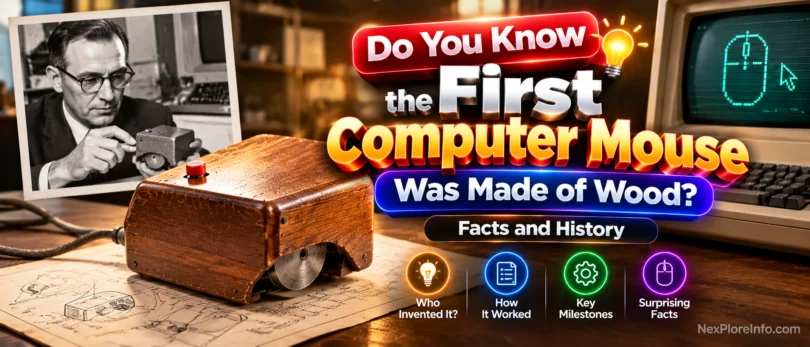
Quick answer: The first computer mouse was a hand-sized block of carved wood with two metal wheels and a single button. Bill English built it in fall 1964 at Stanford Research Institute for Douglas Engelbart, and Engelbart’s patent for it (number 3,541,541) was granted in 1970.
You probably clicked a mouse (or a trackpad that copies one) a few dozen times before lunch today and never wondered where the thing came from. The real story is stranger than you’d guess. It has a wooden box, a stage in San Francisco, and a name that nobody can say who picked.
In this article 12 sections
- First Computer Mouse: The Key Facts at a Glance
- Who Invented the Computer Mouse?
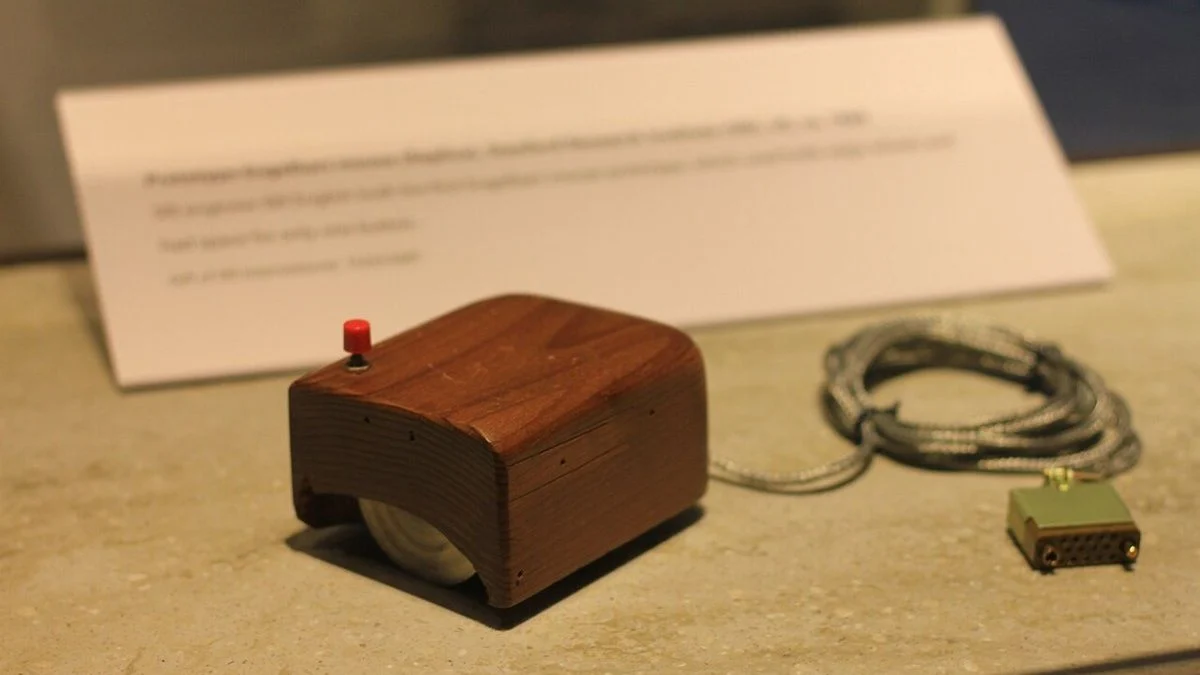
- What Did the First Computer Mouse Look Like?
- How Did the First Computer Mouse Work?
- Why Was the First Mouse Made of Wood?
- Why Is It Called a Mouse?
- Why Did the Mouse Beat the Joystick and Light Pen?
- The 1968 Demo That Showed the Mouse to the World
- From Wooden Block to Ball Mouse: Xerox PARC and Apple
- How the Scroll Wheel and Optical Mouse Came Along
- Did Engelbart Make Money From the Mouse?
- FAQs
First Computer Mouse: The Key Facts at a Glance
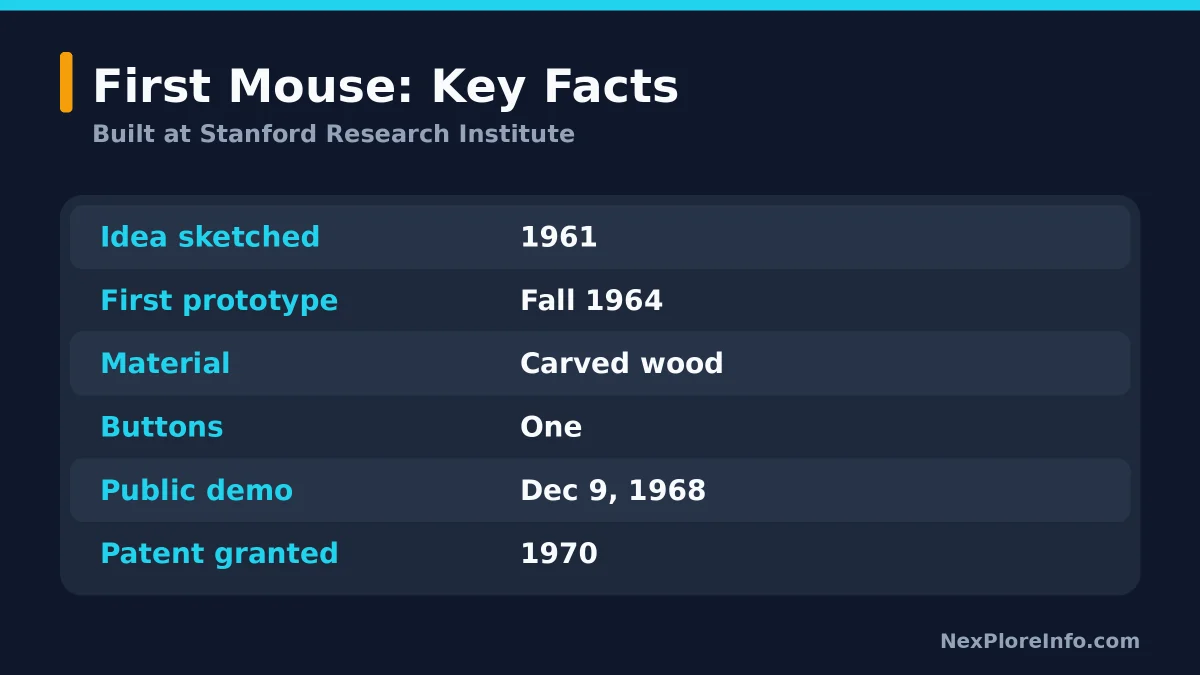
The short version: one researcher, one engineer, one block of wood and about six years between the first prototype and the patent. Here are the numbers, all taken from the Doug Engelbart Institute, the National Inventors Hall of Fame and the Smithsonian.
| Detail | Verified fact |
|---|---|
| Idea first sketched | 1961, during a conference session on computer graphics |
| First prototype built | Fall 1964, by engineer Bill English at Stanford Research Institute (SRI) |
| Materials | Carved wooden block with two perpendicular metal wheels |
| Buttons on the first model | One (the team tried up to five and settled on three) |
| Patent | US 3,541,541, “X-Y position indicator for a display system,” filed 1967, granted 1970 |
| First public demo | December 9, 1968, at Brooks Hall in San Francisco |
| Inventor’s honor | Douglas Engelbart was inducted into the National Inventors Hall of Fame in 1998 |
| Where the original is today | Original donated by SRI International to the Computer History Museum in 2024 |
Who Invented the Computer Mouse?
Douglas Engelbart gets the credit, and he earned it, but the honest answer has two names in it. Engelbart was the researcher at SRI who pushed the idea. Bill English, his lead engineer, was the one who actually built it.
Engelbart didn’t take a straight road to Silicon Valley. He was born on January 30, 1925, near Portland, Oregon, and served in the U.S. Navy as an electronics technician during World War II. After a degree from Oregon State University he worked at NASA’s Ames Research Laboratory, then earned a Ph.D. at Berkeley, according to the National Inventors Hall of Fame. At SRI he built a system called NLS (oN-Line System), and his project became the second host on ARPANET, the network that grew into the internet.
The idea behind the mouse goes back to 1961, when he was sitting in a conference session on computer graphics, as the Doug Engelbart Institute tells it. Three years later the first working prototype existed. That’s the part people skip: it wasn’t a flash of genius over a weekend. It took years of thinking about how a person should point at things on a screen.
What Did the First Computer Mouse Look Like?
It looked like a small wooden box. English carved a block of wood to fit the hand, put two small metal wheels underneath and added one button on top, plus a cord trailing out the back.
Nothing about it resembles the sleek, lightweight mice on our desks now. It was chunky, it had no ball and no light sensor, and it sat on a table like a tiny wooden car. But the basic layout (hold it, slide it, click it) is exactly what we still do every day.
How Did the First Computer Mouse Work?
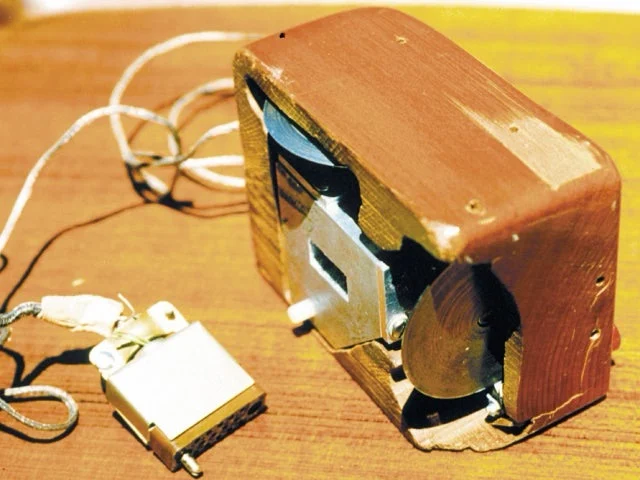
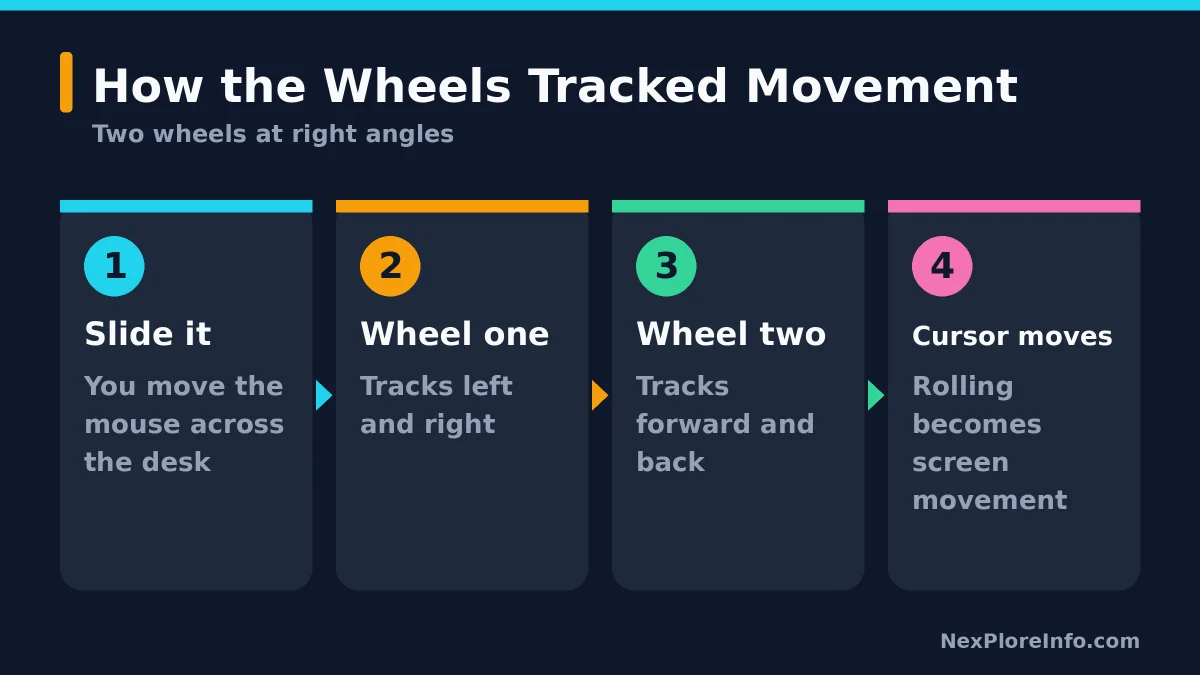
It used two wheels set at right angles to each other, and each wheel tracked movement along one direction. As you slid the mouse across a tabletop the wheels rolled, and the computer turned that rolling into cursor movement on screen.
The Doug Engelbart Institute describes one wheel turning horizontally and the other vertically. That pairing is the reason the patent is titled “X-Y position indicator for a display system.” One wheel handled left and right, the other handled forward and back, and between them the cursor could go anywhere.
It was a clever trick for the time. No ball, no optics, just two wheels and a lot of patience.
Why Was the First Mouse Made of Wood?
Wood was the fastest way to get a hand-sized shell. This was a research lab prototype, not a product waiting for a factory, so a carved block with wheels and a switch did the job.
That wooden original survived. In 2024, SRI International donated it to the Computer History Museum. The Smithsonian has documented and exhibited mouse-related artifacts, but older accounts of a Smithsonian loan should not be mistaken for the current location of the original.
Why Is It Called a Mouse?
Nobody knows for sure. The cord trailing out the back looks a lot like a tail, which is the obvious explanation, but the Doug Engelbart Institute says no one remembers who first used the name. Engelbart himself said he was surprised it stuck.
It started as a nickname inside the lab. A better, more serious name would probably have come along if anyone had been planning a product launch. Nobody was, and so “mouse” stayed.
Why Did the Mouse Beat the Joystick and Light Pen?
It simply did the job better. The SRI team compared roughly six pointing devices for speed and accuracy, including a knee-operated device, DEC’s Grafacon, a joystick and a light pen, with a tracking ball and a pivoting slider also in the mix. The mouse won every category, with faster selection and fewer errors, and a 1967 paper called it the most accurate and efficient option.
Think about the knee-operated one for a second. Somebody seriously built a way to move a cursor with your leg. Then the humble wooden box with wheels beat it. The mouse didn’t win because it was trendy, it won a head-to-head comparison.
It also wasn’t the only ball-and-roller idea in the air. The German company Telefunken published a ball-based pointing device it called Rollkugelsteuerung on October 2, 1968, according to Wikipedia’s entry on the computer mouse. That one began life as a trackball for radar flight-control desks. It’s a good reminder that “first” often depends on how you define the device. SRI’s wheel-driven mouse was built in 1964, and it’s the one that got the patent and the stage.
The 1968 Demo That Showed the Mouse to the World
The mouse reached the public on December 9, 1968, in a 90-minute session now known as the “Mother of All Demos.” It was part of the ACM/IEEE Fall Joint Computer Conference, and Engelbart presented on stage at Brooks Hall in San Francisco while the NLS computer ran about 30 miles away at SRI in Menlo Park. Video and a leased phone line connected the two.
Look at what else was on that stage. The audience saw overlapping windows, hypertext links, copy and paste, drag and drop and two people editing the same document from different places. That’s most of what we call “normal computing” now, shown a decade before most people owned a personal computer. The Doug Engelbart Institute says the audience was over a thousand people, while the Smithsonian notes Brooks Hall seats 2,000.
Engelbart and Don Andrews explained the mouse and a chord keyset over the video link. The mouse got a few minutes of fame in a demo that covered half the future of computing.
From Wooden Block to Ball Mouse: Xerox PARC and Apple
In the early 1970s the mouse moved from SRI to Xerox PARC, along with some of Engelbart’s team. Bill English, by then at PARC, built a ball mouse in 1972, and in 1981 the Xerox 8010 Star shipped with a mouse. The Engelbart Institute adds that the mouse wasn’t invented at PARC, because PARC didn’t exist until 1970.
Apple was next. Apple arranged a visit to PARC in 1979 to see the experimental technology, and then it had a problem. The three-button Xerox mouse cost about US$400, and Apple needed one around US$25, as Wikipedia’s page on Apple pointing devices puts it. Apple hired Hovey-Kelley Design (later IDEO), which built hundreds of prototypes and ran focus groups for the Lisa mouse. The Lisa shipped with a steel-ball mouse in 1983, and the Macintosh 128K followed with a single-button design in 1984.
Microsoft entered the same year the Lisa arrived. The Microsoft Mouse came out in 1983, and from there the mouse stopped being a lab curiosity and became something you bought at a store.
How the Scroll Wheel and Optical Mouse Came Along
The scroll wheel arrived in the mid-1990s. Microsoft announced the IntelliMouse on July 22, 1996, started shipping it in November 1996 and priced it at $85 at retail, according to How-To Geek. The idea came from Eric Michelman, a group program manager for Excel, who wanted a faster way to zoom in and out of spreadsheets. He built a prototype with a PC joystick, and the hardware team’s first reaction was lukewarm.
The wheel also doubled as a third button you could click. Inside the company, the Office team argued about whether it should scroll text in Word or zoom data in Excel. Scrolling won, and holding Ctrl while turning the wheel became the zoom shortcut. Yes, the thing you use to scroll a web page every day started as a spreadsheet idea.
That IntelliMouse still used a traditional ball. Optical sensing came with the IntelliMouse Explorer in 1999, and the mouse lost its rolling ball for good.
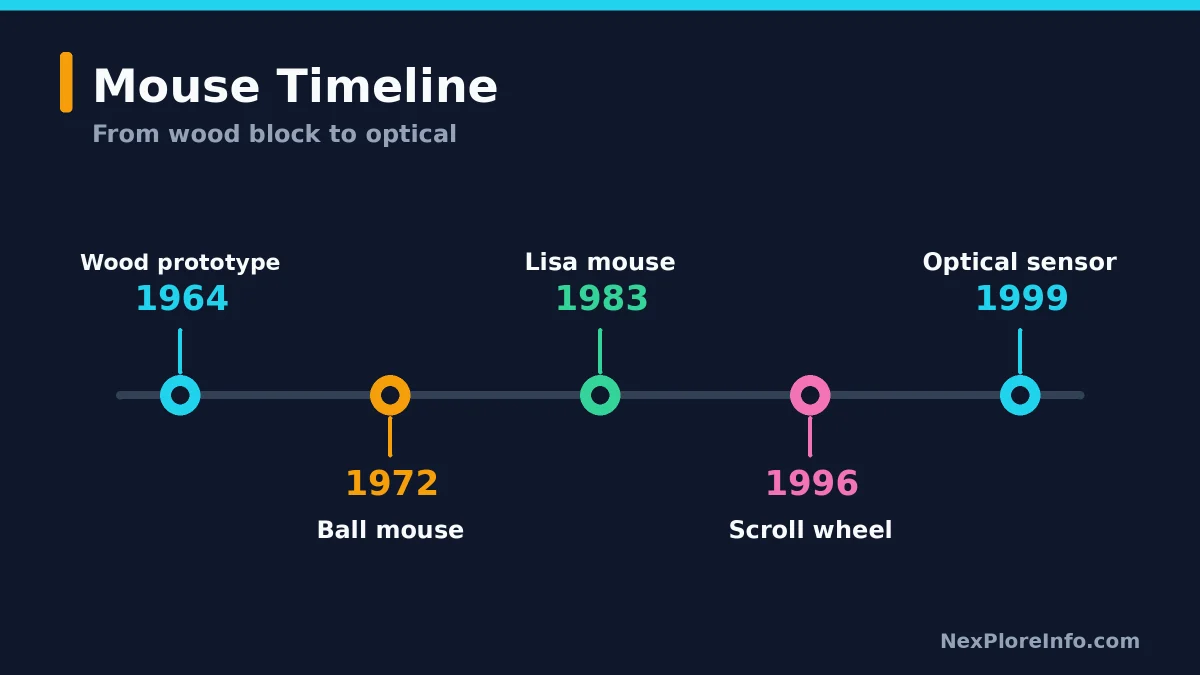
Computer Mouse Timeline: Key Dates
Here’s the whole run on one page, using the dates above.
| Year | Milestone | Who |
|---|---|---|
| 1961 | Idea first appears during a conference session on computer graphics | Douglas Engelbart |
| 1964 | First wooden prototype built | Bill English, SRI |
| 1968 | Public demo of the mouse (December 9) | Engelbart and SRI team |
| 1970 | US patent 3,541,541 granted | SRI |
| 1972 | Ball mouse built at Xerox PARC | Bill English |
| 1981 | Xerox 8010 Star ships with a mouse | Xerox |
| 1983 | Apple Lisa and Microsoft Mouse arrive | Apple, Microsoft |
| 1984 | Macintosh 128K with a one-button mouse | Apple |
| 1996 | IntelliMouse with scroll wheel, $85 | Microsoft |
| 1999 | IntelliMouse Explorer, optical sensor | Microsoft |
Did Engelbart Make Money From the Mouse?
No. Engelbart never received royalties for it, because SRI, his employer, held the patent. According to the Wikipedia entry, the patent also ran out before the mouse became common on personal computers.
He did say SRI licensed the idea to Apple “for something like US$40,000,” which is a tiny number next to what mice ended up being worth. He later worked at Tymshare, founded the Bootstrap Institute in 1989 and was honored with the National Inventors Hall of Fame induction in 1998. Engelbart died in July 2013.
If you like this kind of origin story, our posts on the first digital camera, the first smartphone and the first iPhone follow a similar pattern: a clunky prototype first, a mainstream product much later.
And if all this has you looking at your own desk, we’ve put together lists of the best budget gaming mouse picks and the best budget wireless mouse for work. Quite a step up from a wooden block.
FAQs
Was the first computer mouse really made of wood?
Yes. The 1964 prototype built by Bill English had a carved wooden shell with two metal wheels and one button. A surviving example is displayed in the Smithsonian’s Places of Invention exhibition on loan from SRI International.
Who invented the computer mouse and when?
Douglas Engelbart invented it at Stanford Research Institute, and Bill English built the first prototype in fall 1964. Engelbart’s patent, US 3,541,541, was granted in 1970.
Why is a computer mouse called a mouse?
The exact origin of the name is unknown. The cord resembled a tail, but the Doug Engelbart Institute says no one recalls who started calling it a mouse. It was a lab nickname that stuck.
How many buttons did the first computer mouse have?
The first prototype had one button. The SRI team experimented with up to five buttons and settled on three, because, as Engelbart put it, that was all they could fit.
When was the computer mouse first shown to the public?
It was first shown publicly on December 9, 1968, at Engelbart’s “Mother of All Demos” in San Francisco. The 90-minute session also introduced hypertext, windows and remote collaborative editing.
Did Douglas Engelbart get paid for inventing the mouse?
No royalties. SRI owned the patent, and it expired before the mouse became widespread on personal computers. Engelbart said SRI licensed it to Apple for something like US$40,000.
Image credits: Photo: Michael Hicks from Saint Paul, MN, USA, Wikimedia Commons, CC BY 2.0.





Leave a Comment