
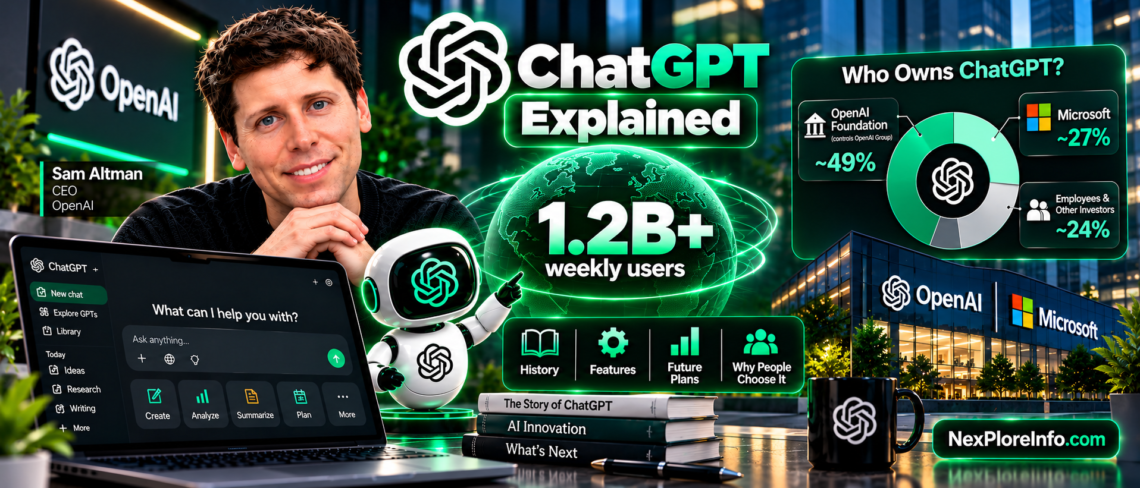
ChatGPT is an AI assistant made by OpenAI that understands plain language and can write, explain, code, search the web, analyze files, create images and talk with you by voice. It launched on November 30, 2022, and grew into one of the most widely used AI apps in the world, with OpenAI reporting 1.2 billion weekly users in October 2026. This guide explains what ChatGPT is, who owns it, how it works, why people find it so easy to use, and where it beats or trails Claude, Gemini and Microsoft Copilot.
Whether you are a complete beginner or deciding between AI assistants, you will finish with a clear picture of ChatGPT’s history, plans and confirmed direction.
What Is ChatGPT? A Quick Explanation
ChatGPT is a chatbot app built on top of OpenAI’s GPT family of AI models. You type or speak a request in normal words, and it replies the way a knowledgeable helper would. You can ask follow-up questions, change your mind, or ask it to try again.
People use ChatGPT to:
- Draft and polish emails, essays, captions and reports
- Learn new topics with simple explanations
- Write and fix code
- Search the web and summarize what they find
- Read PDFs, spreadsheets and photos
- Create images and plan daily tasks
It is available on the web, on iPhone and Android, and as desktop apps, in both the USA and the UAE.
What Does ChatGPT Stand For?
ChatGPT combines “Chat” with GPT, which stands for Generative Pre-trained Transformer. “Generative” means it creates new output, “pre-trained” means the model learns from large datasets before you use it, and “Transformer” refers to the neural-network architecture behind the GPT family.
Who Created ChatGPT and Who Owns It?
ChatGPT was created by OpenAI, an AI research company founded in December 2015 in San Francisco. Its founding group included Sam Altman (now CEO), Greg Brockman (now President), Ilya Sutskever, Wojciech Zaremba, John Schulman and Elon Musk, among others. Musk later left the board and is no longer involved.
OpenAI vs ChatGPT vs GPT: what is the difference?
- OpenAI is the company.
- GPT (Generative Pre-trained Transformer) is the family of AI models OpenAI builds, such as GPT-5.6 and GPT-6.
- ChatGPT is the app you use, which runs on those models.
Who owns ChatGPT today?
No single person owns ChatGPT. After a 2025 restructuring, the business sits inside OpenAI Group PBC, a public benefit corporation. It is controlled by the nonprofit OpenAI Foundation, which holds a large stake. OpenAI says Microsoft holds roughly 27% of OpenAI Group on an as-converted diluted basis, while current and former employees and other investors hold the remaining 47%. See OpenAI’s official structure page. Sam Altman leads the company as CEO, but he is not its owner.
The History of ChatGPT: From 2022 to 2026
2022 to 2023: a surprise hit
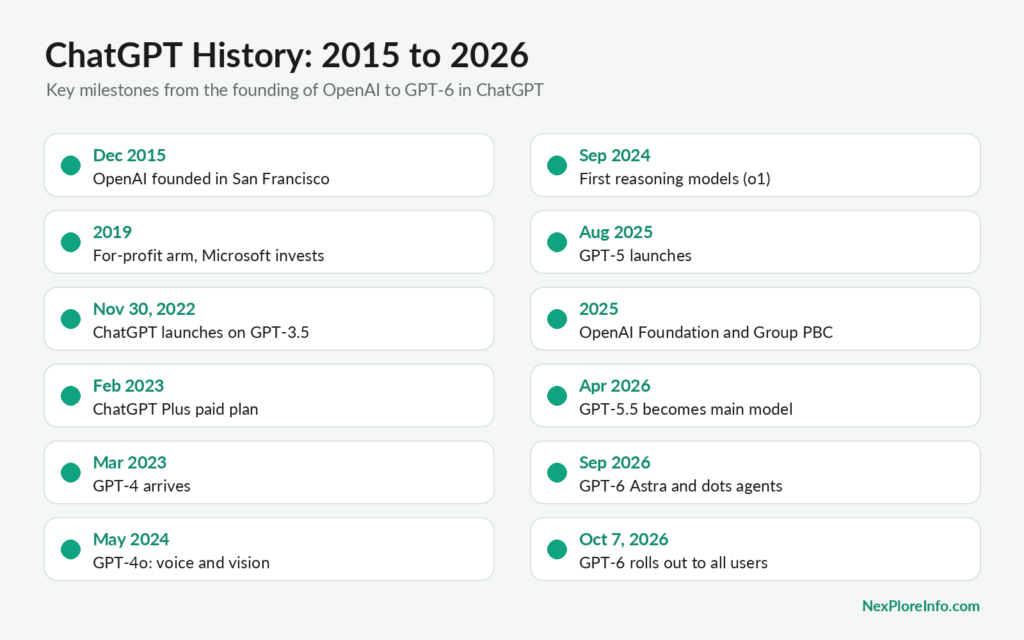
Before ChatGPT, OpenAI spent years on research. In 2019 it created a for-profit arm, and Microsoft invested $1 billion, starting a long partnership that later grew much larger. OpenAI released ChatGPT as a free research demo on November 30, 2022, running on a GPT-3.5 model. It spread faster than almost any consumer app before it. OpenAI added the paid ChatGPT Plus plan in February 2023, and GPT-4 arrived in March 2023 with much stronger reasoning.
2024: voice, vision and reasoning
In May 2024, GPT-4o brought faster responses, natural voice conversations and image understanding, and opened many features to free users. In September 2024, OpenAI introduced “reasoning” models that think step by step before answering, starting with o1. ChatGPT search followed later that year.
2025: GPT-5 and a new company structure
GPT-5 launched in August 2025 and combined fast replies with deeper reasoning in one system. In the same year, OpenAI completed its move to the Foundation and public benefit corporation structure.
2026: GPT-5.5, GPT-6 and agents
- April 2026: GPT-5.5 became ChatGPT’s main model, followed by GPT-5.6 in July.
- September 3, 2026: OpenAI launched GPT-6 Astra, its most capable model, first for selected business customers. We covered it in our GPT-6 Astra explainer.
- September 29, 2026: At DevDay, OpenAI introduced “dots,” always-on agents that work toward goals you set, plus a $500 Pro tier.
- October 7, 2026: GPT-6 began rolling out to everyone in ChatGPT, with GPT-6 Sol for paid plans and GPT-6 Luna for Free and Go.
How Does ChatGPT Work?
ChatGPT runs on a large language model (LLM): an AI system trained on huge amounts of text so it learns how words, facts and ideas connect. When you send a prompt, the model predicts the most useful response one small piece of text at a time.
Three steps shape the experience:
- Training: the model learns language patterns from large datasets.
- Fine-tuning: people rate and correct answers so the model becomes more helpful and safer.
- Reasoning and tools: newer models can think through a problem, search the web, run code or open files before replying.
Because it predicts likely text rather than looking up a fixed database, ChatGPT can sound confident while being wrong. This is called a hallucination, explained in our guide to AI hallucinations. Always check important facts, figures and citations.
ChatGPT’s Main Features and Capabilities
- Writing and editing: drafts, rewrites, translations and tone changes.
- Coding: explaining, writing and debugging code, plus Codex for bigger software tasks on paid plans.
- Research and web search: live answers with sources, and deep research for longer reports.
- Images: it can read photos and screenshots and create new images from text.
- Voice: hands-free spoken conversations on mobile and desktop.
- Files and data: upload PDFs, spreadsheets and documents for summaries and charts.
- Personalization: memory, custom instructions, projects, custom GPTs and connected apps.
- Intelligent UI: with GPT-6, answers can include charts, buttons, forms and small tools.
ChatGPT free vs paid plans
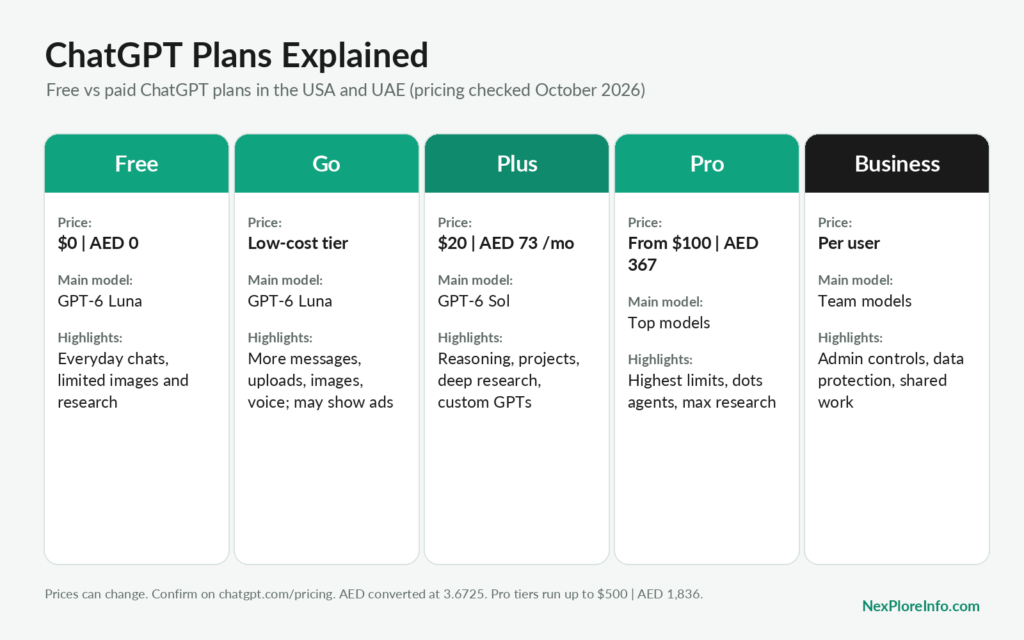
| Plan | Price (USA and UAE) | Best for |
|---|---|---|
| Free | $0 | AED 0 | Everyday chats; GPT-5.6 Luna remains the default while GPT-6 Luna rolls out, with separate limits for tools such as images, files and research |
| Go | Low-cost tier, price varies by region | More messages, uploads, images and voice; may include ads |
| Plus | $20 | AED 73 per month | GPT-6 Sol as the rollout expands, plus GPT-5.6 Sol options, advanced reasoning, projects and deep research |
| Pro | From $100 | AED 367 per month (tiers up to $500 | AED 1,836) | Heavy users who need the highest limits and agents |
| Business and Enterprise | Per user, monthly or yearly | Teams that need admin controls and data protection |
Pricing checked: October 2026. Exact amounts can change, so confirm on OpenAI’s official pricing page. AED converted at 3.6725.
Why Is ChatGPT So Popular and Easy to Use?
- You just talk to it. There are no menus or commands to learn, so beginners get results on day one.
- It remembers the conversation. You can say “make it shorter” or “now in Arabic” without repeating yourself.
- It does many jobs in one place. Writing, homework help, coding, images and planning all live in a single app.
- A useful free plan. Millions of people try it at no cost before deciding to upgrade.
- First-mover habit. As the app that started the AI chatbot boom, it became the default name many people reach for, much like “Google it.”
ChatGPT vs Claude: Which Is Better for Different Tasks?
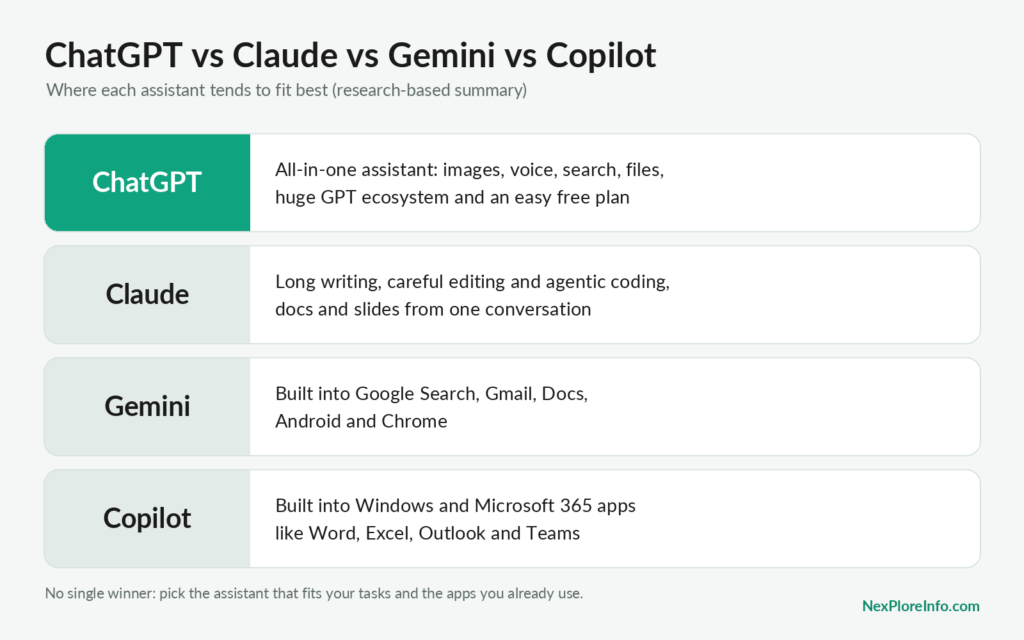
Neither wins everything. Here is a research-based summary of common strengths:
- Writing: both are strong. Many writers find Claude’s tone more natural, while ChatGPT is quick and flexible across formats.
- Coding: Claude Code is widely rated for large codebases, while ChatGPT’s Codex is closely tied to the ChatGPT app and plans. See our best AI coding tools guide.
- Research: both offer web search and deep research reports.
- Long documents: both handle very long files; limits vary by model and plan.
- Images and voice: ChatGPT has a clear edge with built-in image generation and a mature voice mode.
For a head-to-head on the top models, read GPT-6 Astra vs Claude Fable 5.1.
ChatGPT vs Google Gemini
Gemini’s biggest advantage is Google itself: it is built into Search, Gmail, Docs, Android and Chrome, which makes it convenient if you already live in Google’s world. ChatGPT is usually the more complete standalone assistant, with a larger plugin ecosystem, custom GPTs and the new Intelligent UI. If most of your work happens in Google Workspace, Gemini may save time. If you want one app for everything, ChatGPT is often the simpler choice.
ChatGPT vs Microsoft Copilot
Microsoft Copilot is Microsoft’s assistant inside Windows, Edge and Microsoft 365 apps like Word, Excel, Outlook and Teams. It is different from GitHub Copilot, which is a coding assistant for developers. Copilot has long used OpenAI models alongside others, so answers can feel similar, but the focus differs. Copilot shines when it can see your company’s emails, files and meetings. ChatGPT is broader for personal use, creative work and learning.
What Advantages Does ChatGPT Have Over Other AI Assistants?
- A very large user base and ecosystem, with OpenAI reporting 1.2 billion weekly users in October 2026, plus extensive tutorials, prompts and shared GPTs.
- Built-in image creation and strong voice in the same app.
- A wide plan range, from free to $500 | AED 1,836 per month.
- Interactive answers through Intelligent UI, and agents through dots on higher plans.
- Sign in with ChatGPT, which lets paid users carry their plan into partner tools.
Competitors may still be the better pick: Claude for long-form writing and agentic coding, Gemini for Google users, and Copilot for Microsoft-based offices.
Best Ways to Use ChatGPT for Everyday Work
- Content writing: “Write five Instagram captions for a coffee shop launch in a friendly tone.”
- Learning: “Explain compound interest like I’m 12, then quiz me with three questions.”
- Coding: “Find the bug in this Python function and explain the fix.”
- Business emails: “Turn these notes into a polite follow-up email to a client.”
- Research: “Summarize this 40-page PDF into key points and action items.”
- Planning: “Make a 7-day meal plan and a shopping list for a family of four.”
OpenAI’s Confirmed Plans and Product Direction
These items come from OpenAI’s own announcements:
- More interactive answers: OpenAI says it wants ChatGPT to build more task-specific interfaces, and admits GPT-6’s design judgment still needs work.
- GPT-6 Astra across paid plans: OpenAI said Astra will come to Plus, Pro, Business and Enterprise users.
- Agents: dots are rolling out, with more controls over what agents may do announced as coming soon.
- Team workspaces: ChatGPT Space brings people, ChatGPT and agents into one shared space for paid business plans.
OpenAI has not given dates for every item, so treat undated features as announced, not available.
The Future of ChatGPT: Opportunities and Challenges
This section is analysis, not a company promise. ChatGPT is moving from answering questions toward doing work: running agents, building small tools on demand and working across your apps. Personalization through memory will likely grow too.
The challenges are real. Accuracy still matters, privacy questions grow as ChatGPT connects to more data, and ads on lower-cost plans raise tracking concerns covered in our guide to turning off ChatGPT ad tracking. Energy use is another debate, explored in how much electricity one ChatGPT question uses.
ChatGPT Advantages and Disadvantages
| Advantages | Disadvantages |
|---|---|
| Very easy for beginners | Can give confident but wrong answers |
| Images, voice, files and search in one app | Best models and limits need paid plans |
| Generous free plan | Ads may appear on lower-cost tiers |
| Huge ecosystem of GPTs and plugins | Privacy settings need attention |
| Fast pace of improvements | Frequent model changes can confuse users |
Frequently Asked Questions
What is ChatGPT used for?
Writing, learning, coding, research, summarizing files, creating images and everyday planning.
Who invented ChatGPT?
OpenAI built ChatGPT and released it on November 30, 2022. OpenAI was co-founded by Sam Altman, Greg Brockman, Ilya Sutskever and others in 2015.
Who owns ChatGPT?
OpenAI Group PBC runs ChatGPT. It is controlled by the nonprofit OpenAI Foundation, with Microsoft holding about 27%.
Is ChatGPT free?
Yes. The Free plan includes everyday text chats and access to core tools with limits. OpenAI currently lists GPT-5.6 Luna as the default for Free and Go while GPT-6 Luna is rolling out. Plus costs $20 | AED 73 per month.
Is ChatGPT easy for beginners?
Yes. You type or speak in normal language, and you can ask follow-up questions until the answer fits.
Is ChatGPT better than Claude?
It depends on the task. ChatGPT leads on images, voice and ecosystem, while Claude is often preferred for long writing and complex coding.
Which is better, ChatGPT or Gemini?
Gemini suits people who use Google apps all day. ChatGPT is usually the stronger all-in-one standalone assistant.
What is the difference between ChatGPT and Copilot?
ChatGPT is OpenAI’s general assistant. Microsoft Copilot is built into Windows and Microsoft 365 for work tasks, and GitHub Copilot is for coding.
Can ChatGPT make mistakes?
Yes. It can misstate facts or invent sources, so verify anything important.
What is the future of ChatGPT?
OpenAI’s confirmed direction points to more agents, interactive answers and deeper personalization, though it has not dated every feature.
Conclusion
ChatGPT went from a 2022 research demo to an everyday assistant used by over a billion people each week, powered today by GPT-6. Its biggest strengths are ease of use, breadth and a strong free plan. Students, creators, small business owners and beginners are likely to benefit most. Start with the free plan, try it on a real task from your week, and upgrade only if you keep hitting its limits. For more simple AI guides, keep exploring NexPloreInfo.com.












Leave a Comment