
What are AI hallucinations? They are answers from a chatbot that sound confident and fluent but are false, invented or unsupported. If you have ever asked ChatGPT, Claude or Gemini for a source and received a link that does not exist, you have seen one. This guide is for everyday users in the USA and UAE who use AI for study, work or content and want to know why it happens, how to spot it and what to do about it.
By the end you will have a plain-language explanation, real documented examples, a seven-step checklist and prompts that lower the risk of made-up answers.
Quick Answer: What Is an AI Hallucination?
OpenAI defines hallucinations as “plausible but false statements generated by language models.” IBM describes them as outputs that seem credible but are false, irrelevant or invented, and says they can be reduced but not fully eliminated.
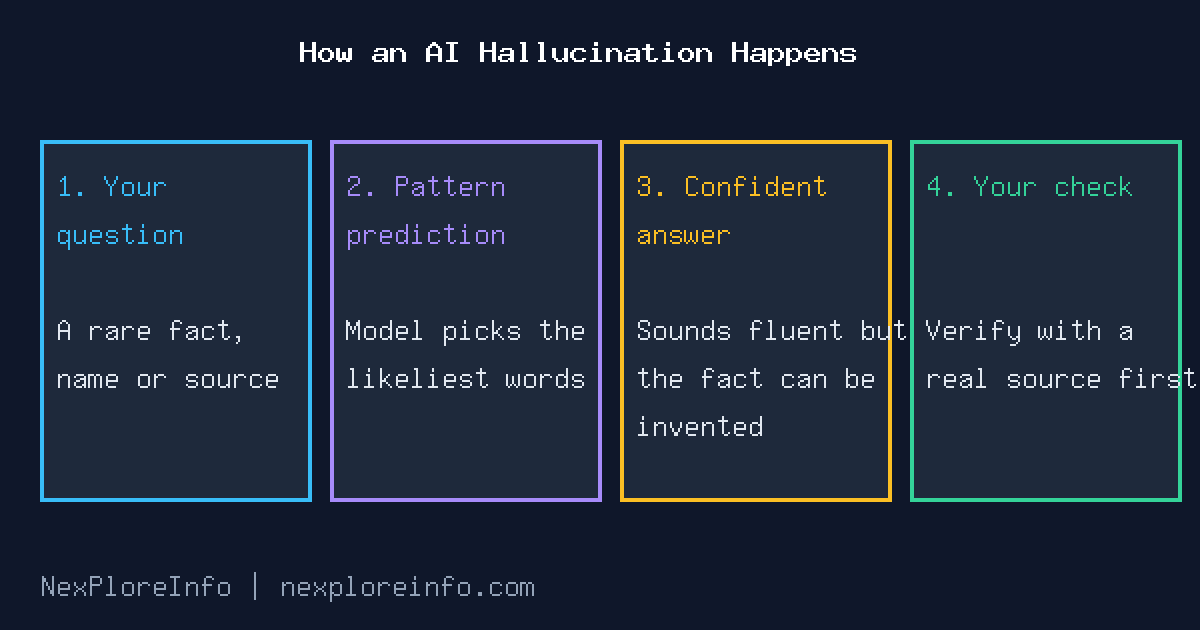
In short: a hallucination does not require intent. The model generates a plausible response from learned patterns, and sometimes that response contains false, invented or unsupported information.
Why Do AI Chatbots Hallucinate?
There is no single cause. The main reasons documented by AI labs and technology companies are below.
1. Models predict words, not facts
A language model learns by predicting the next word across huge amounts of text. OpenAI explains that regular patterns such as spelling improve with scale, but arbitrary low-frequency facts, like a private person’s birthday, cannot be worked out from patterns alone, so errors appear.
2. Training rewards guessing
OpenAI argues that standard training and testing reward guessing over admitting uncertainty, much like a multiple-choice exam with no penalty for wrong answers. In the figures OpenAI cites from the GPT-5 system card on the SimpleQA test, o4-mini scored slightly higher accuracy (24% vs 22%) than gpt-5-thinking-mini but had a far higher error rate (75% vs 26%), because the other model declined to answer more often.
3. The “I know this name” signal misfires
Anthropic’s interpretability research found that Claude’s default behavior is to decline when it lacks information. When a “known entity” signal switches on for a name the model only vaguely recognizes, it suppresses that default and the model can produce a plausible but untrue answer.
4. Flawed data and weak grounding
Google Cloud notes that incomplete or biased training data and a lack of grounding in real-world facts can lead to outputs that look right but are wrong, including links to web pages that do not exist.
AI Hallucination vs Outdated Information vs a Simple Mistake
Not every wrong AI answer is a hallucination. The cause matters:
- Hallucination: the model invents or states unsupported information, such as a fake study, quotation or URL.
- Outdated information: the answer may once have been correct but no longer reflects the latest price, policy, product or event.
- Reasoning mistake: the model has the right facts but makes an error in logic, arithmetic or interpretation.
- Prompt or context error: the model misunderstands the instruction or loses access to an earlier detail in a long conversation.
That last case is why context management matters. Our guide to what a context window in AI is explains how active context, token limits and long chats can affect what a model can reliably use.
AI Hallucination Examples That Really Happened
These cases are documented by court records and reputable outlets, not invented for effect.
- Fake court cases (2023): In Mata v. Avianca, lawyers filed a brief with cases found through ChatGPT that did not exist. On June 22, 2023, a federal judge in the Southern District of New York fined the attorneys and their firm $5,000 | AED 18,375 after they kept defending the fake opinions.
- Glue on pizza: IBM cites a Google AI Overview that suggested adding nontoxic glue to pizza sauce, drawing on a 2013 joke post on Reddit, as reported by the BBC.
- Invented links and sources: Google Cloud lists fabricated web page links as a common form of hallucination.
Types of AI Hallucinations to Watch For
| Type | What it looks like | Typical risk |
|---|---|---|
| Invented facts | Wrong dates, statistics or biographies stated with confidence | Misinformation in homework, posts and reports |
| Fake sources | Book titles, studies, quotes or URLs that do not exist | Credibility loss, legal trouble |
| Added details | A summary that includes points missing from the original text | Misleading summaries |
| Wrong reasoning | Math or logic steps that look neat but contain an error | Bad decisions, wrong calculations |
How to Spot AI Hallucinations: A 7-Step Checklist
Use this checklist before you trust, publish or submit anything an AI wrote.
- Look for precision without a source. Exact numbers, dates and quotes with no link deserve a check.
- Click every link. If the page is missing or does not say what the chatbot claims, treat the claim as unverified.
- Search the exact name. Search for the person, study or case title in quotation marks. No results is a red flag.
- Confirm with an official page. For prices, rules and product features, open the company’s own page.
- Ask the same question twice. Different answers to a factual question signal guessing.
- Ask for the evidence. Request the source and the exact passage, then check that passage yourself.
- Run a second tool. Compare a second chatbot or a search engine, and see our guide to AI content detectors for how limited automatic checks can be.
How to Stop ChatGPT, Claude and Gemini From Hallucinating
You cannot switch hallucinations off, but you can lower the odds. IBM lists structured prompting, retrieval-augmented generation (RAG) and human checks among its prevention methods.
Use web search and sources
Turn on web search or source-grounded mode when you need current facts. This can reduce hallucinations because the model has fresh evidence to work from, but it does not guarantee accuracy. An AI can still misread a source, cite the wrong passage, combine sources incorrectly or draw an unsupported conclusion.
In Gemini, when sources are available a Sources button appears with the links behind a response, and if there is no button, Gemini did not provide links for that answer.
Give the model the material
Retrieval-augmented generation (RAG) means the AI answers from documents you supply instead of memory. Tools like NotebookLM follow this idea by working from your uploaded sources.
Write prompts that allow “I don’t know”
IBM recommends guardrails such as telling the model to say so when it is unsure. Here is a prompt you can adapt:
Answer only from the text I paste below. If the answer is not in the text, reply “Not in the source.” Quote the sentence you used for each claim.
For more on structuring requests, see our guide on writing AI prompts with a clear formula.
Add a human check for high-stakes work
IBM advises human approval for outputs such as legal, medical or regulatory content. The 2023 court case shows why. A person must own the final answer.
Can Web Search Stop AI Hallucinations?
No. Web search can lower the risk of factual hallucinations, especially for recent information, but it cannot make every answer automatically correct. A model can still misunderstand a page, overlook context, cite an irrelevant source or produce a conclusion that the source does not support.
The safest workflow is to use web-connected AI as a research assistant, then open the cited source and verify the exact claim yourself. For prices, laws, product specifications, health information and other high-stakes facts, prefer the original official source rather than a secondary summary.
Can AI Hallucinations Be Fixed?
They can be reduced, not erased. OpenAI says newer models hallucinate less on many evaluations, but false or unsupported answers still occur. The practical goal is therefore to reduce confident guessing, improve grounding and make uncertainty more explicit rather than assuming any model is error-free.
Do AI Hallucinations Matter for AI Agents?
Yes. An assistant that takes actions can repeat a wrong fact across many steps. Read what an AI agent is and the risks involved, and keep a person approving any action that costs money or sends messages. Students should also see our AI tools guide for students and teachers for safe study habits.
Hallucination vs Mistake vs Bias
A hallucination is invented or unsupported content. A mistake can be a plain error, such as a wrong calculation. Bias is a systematic skew in how information is represented or generated. They can overlap, but they are not the same failure mode, so the best fix depends on what went wrong.
Frequently Asked Questions
What are AI hallucinations in simple words?
They are confident-sounding answers from an AI that are false or invented, such as a fake book title or a case that never existed.
Why do AI chatbots make things up?
Chatbots predict likely words from patterns in training data. Training that rewards guessing, rare facts and weak grounding all push them toward a fluent answer instead of “I don’t know.”
Do AI chatbots lie?
No, lying needs intent. A hallucination is a false output from a system built to predict text, but the effect on the reader can be the same, so verify.
How do I know if ChatGPT is hallucinating?
Check sources, click links, search exact names and compare with an official page. Unsupported precision is the biggest warning sign.
Which AI hallucinates the least?
No tool is free of it. Results vary by model, task and test, so use the checklist above with whichever assistant you choose.
Can I use AI for school or work safely?
Yes, as a first draft and idea partner. Verify facts, cite real sources and keep a human responsible for the final version.
For more AI explainers and tutorials, browse the AI section on NexPloreInfo.












Leave a Comment