

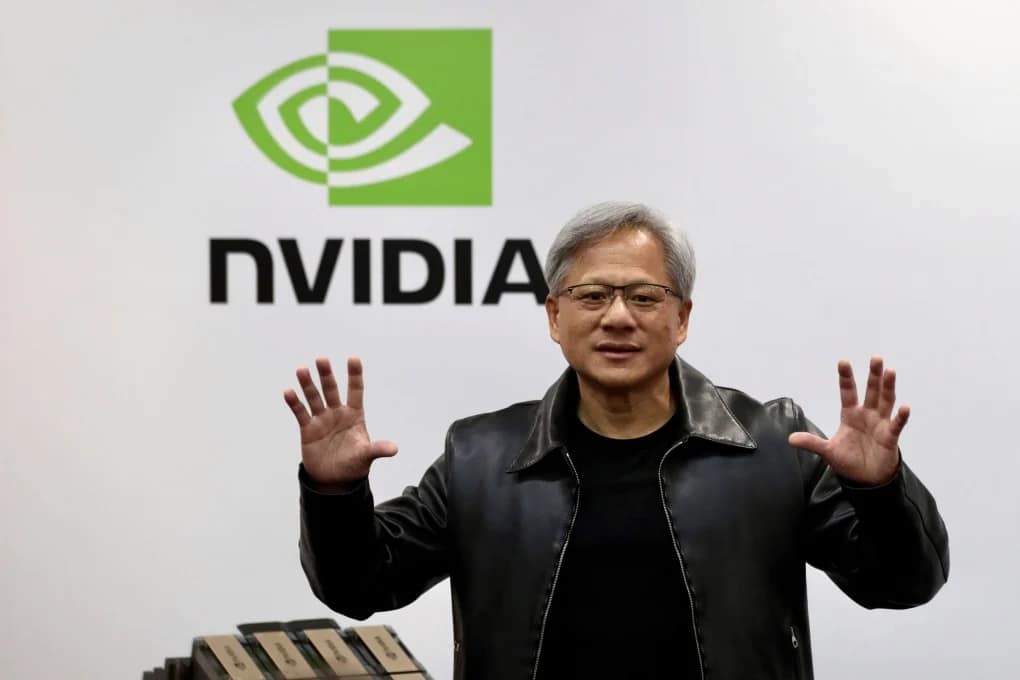
As of September 16, 2026, Nvidia carries a market value of roughly $5.17 trillion, according to data from stockanalysis.com. That makes it the most valuable public company on earth, and the first company in history to ever close above the $5 trillion mark, a milestone it reached on October 29, 2025. For a company that now sits at the center of the entire AI boom, its origin story looks almost nothing like the trillion dollar business it became. Nvidia’s rise is closely tied to the wider AI infrastructure buildout happening across the industry, including the kind of expansion covered in our report on Microsoft’s data center capacity plans. Here are the facts behind how Nvidia got there, and why its climb is stranger than most people realize.
A $600 Napkin Sketch at a Denny’s Booth
Nvidia was founded on April 5, 1993, by three engineers: Jensen Huang, Chris Malachowsky, and Curtis Priem. The meeting where they planned the company did not happen in a boardroom or a garage. It happened over pancakes and coffee at a Denny’s in East San Jose, California, where the trio reportedly sketched out their business plan on napkins.
The company’s initial paperwork cost just $600 to file. Sequoia Capital later became one of Nvidia’s earliest venture backers, an investment that would go on to become one of the most lucrative bets in Silicon Valley history. Today, there is a booth at that same Denny’s location commemorating the meeting, and Huang has returned to it publicly more than once as the company hit new milestones.
Why It’s Called “Nvidia”
The name Nvidia was not picked at random, as Yahoo Finance explains. The founders wanted a word connected to “video,” since the company’s original focus was graphics chips, and they landed on something close to invidia, the Latin word for envy. The idea was that Nvidia’s products should be good enough to make competitors jealous. More than three decades later, with the company controlling the vast majority of the market for AI training chips, that early ambition has more or less played out.
The Dishwasher Who Returned to a Different Denny’s
One detail often gets simplified online: that Jensen Huang worked as a dishwasher at the very same Denny’s where Nvidia was founded. According to Fortune’s reporting, that is not quite accurate. Huang did work as a dishwasher and busboy at a Denny’s as a teenager, starting around age 15, while he was living in the Pacific Northwest near Portland, Oregon. The Denny’s where Nvidia was actually founded years later, in East San Jose, was a different location entirely. Huang has spoken fondly about his time washing dishes, saying the diner environment felt unpressured and, in his words, “the perfect incubator,” which may be part of why he chose a Denny’s booth again when it came time to start a company. The two Denny’s stories are real, but they are two different restaurants in two different states, separated by years.
Six Months to Live: The $5 Million Deal That Saved Nvidia
Nvidia’s early years were far closer to failure than most of its history is remembered today. In the mid 1990s, Sega contracted Nvidia to build the graphics chip for its upcoming Dreamcast console. Nvidia spent more than a year developing that chip, known as NV2, using a texture mapping approach that turned out to be the wrong technical bet compared to the triangle based rendering rivals were using.
Jensen Huang eventually concluded the chip would not be competitive enough to ship. That left Nvidia in what Huang later described as a no win position: finishing the contract would leave the company hopelessly behind on technology, but walking away would drain what little cash it had left. “Either way, we would be out of business,” Huang has said.
According to an account of the deal, Sega America’s then chief executive, Shoichiro Irimajiri, chose to pay Nvidia $5 million anyway, even though the company had not delivered a usable chip. That payment, all the capital Nvidia had at the time, is credited with keeping the company alive for roughly six more months while it regrouped. Sega later sold its Nvidia stock for about $15 million, a $10 million profit at the time, though holding onto those shares would have made the sale worth billions today.
From Graphics Cards to the Engine of the AI Boom
Nvidia spent its first two decades primarily as a maker of graphics cards for gaming PCs under its GeForce brand. The turning point came from a bet few outside the company saw coming: investing heavily in CUDA, a software platform launched in 2006 that let Nvidia’s chips be used for general purpose computing, not just rendering graphics. That decision positioned Nvidia’s hardware as the default engine for the machine learning boom more than a decade later, once researchers realized GPUs were far better suited to training AI models than traditional processors.
The scale of that shift shows up clearly in Nvidia’s own numbers. For its full fiscal year 2026, Nvidia reported total revenue of $215.9 billion, up 65 percent year over year. Its data center business, the segment that sells AI training and inference chips to companies building AI systems, brought in $193.7 billion for the year, up 68 percent. In just its fourth quarter of fiscal 2026 alone, data center revenue hit a record $62.3 billion, up 75 percent from the same quarter a year earlier, according to Nvidia’s own earnings release.
Nvidia’s Trillion Dollar Climb
Nvidia’s stock has moved through market cap milestones at a pace that has no real precedent among public companies.
| Milestone | Approximate Date |
|---|---|
| $1 trillion market cap | Mid 2023 |
| $2 trillion market cap | February 2024 |
| $3 trillion market cap | June 2024 |
| $4 trillion market cap | July 9, 2025 |
| $5 trillion market cap | October 29, 2025 |
Each jump of roughly a trillion dollars happened faster than the one before it, a pace that reflects how quickly investors have priced in demand for AI infrastructure since the launch of tools like ChatGPT in late 2022. Nvidia is not the only company riding that wave to a historic valuation either, even privately held Anthropic has reportedly been in talks for a valuation near $2 trillion, as we covered in our piece on Anthropic’s potential IPO.
Quick Facts Recap
- Nvidia was founded April 5, 1993, at a Denny’s in East San Jose, California.
- The founders paid $600 to incorporate the company.
- The name Nvidia comes from invidia, the Latin word for envy.
- Jensen Huang worked as a Denny’s dishwasher as a teenager, but at a different location years before Nvidia was founded.
- A $5 million payment from Sega in the mid 1990s is credited with saving Nvidia from running out of money after a failed game console chip project.
- Nvidia became the first public company to close above $5 trillion in market value on October 29, 2025.
- Nvidia’s fiscal year 2026 revenue reached $215.9 billion, up 65 percent from the prior year.
FAQs
Is Nvidia really the first company ever worth $5 trillion?
Yes. Nvidia became the first publicly traded company to close above a $5 trillion market capitalization on October 29, 2025, according to reporting from outlets including CNBC, TechCrunch, and CBS News at the time.
Did Sega actually save Nvidia from bankruptcy?
Sega America’s $5 million payment in the mid 1990s, made even though Nvidia had not delivered a usable graphics chip for the Dreamcast console, is widely credited by Jensen Huang himself as keeping the company operating during a period when it was nearly out of cash.
What does the name Nvidia mean?
It is derived from invidia, the Latin word for envy, reflecting the founders’ goal of building products that would make competitors jealous.
Was Jensen Huang a dishwasher at the same Denny’s where Nvidia was founded?
No. He worked as a dishwasher and busboy at a Denny’s near Portland, Oregon as a teenager. Nvidia was founded years later at a different Denny’s location in East San Jose, California.


Leave a Comment