

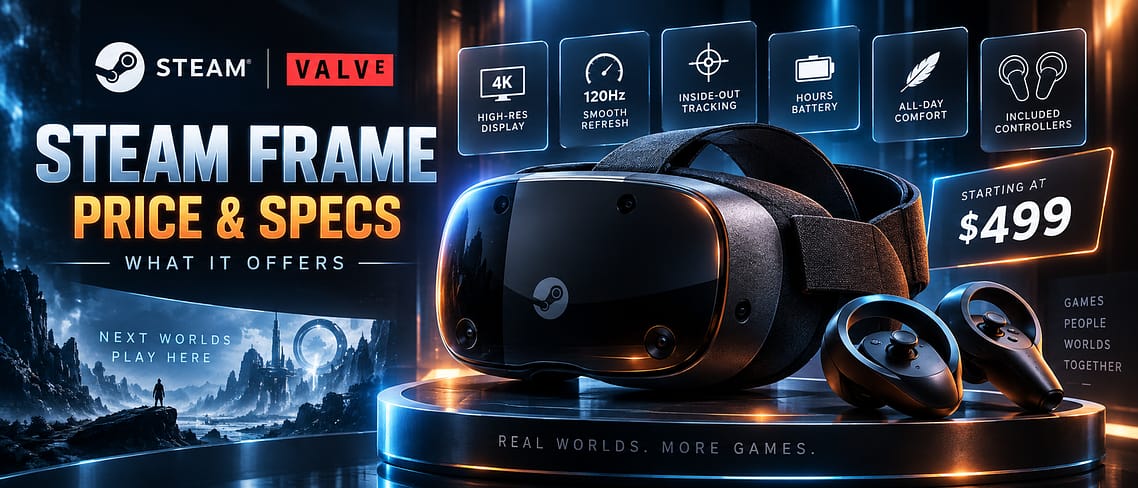
Valve officially launched the Steam Frame, its first standalone VR headset, on September 14, 2026. The company confirmed pricing starting at $1,059, opened a lottery-style reservation window that closed three days later, and began sending purchase invitations on September 18. It is Valve’s biggest hardware push since the Steam Deck, and it lands as Meta’s Quest headsets continue to dominate the consumer VR market at a much lower price. If you have been wondering what the Steam Frame actually is, what it costs, and whether you need a gaming PC to use it, here is what Valve has confirmed so far.
Quick Summary
- Valve launched the Steam Frame on September 14, 2026, priced at $1,059 for 256GB or $1,299 for 1TB.
- It works two ways: standalone, running SteamOS on a mobile chip, or streamed wirelessly from a gaming PC.
- Valve used a randomized reservation lottery instead of open preorders, so not everyone who wanted one could buy it right away.
- The headset uses a Snapdragon 8 Gen 3 chip, dual 2160×2160 displays, and a new “foveated streaming” trick to make wireless PC streaming look sharper.
- Both kits include Steam Frame Controllers, a Wi-Fi 6E adapter for streaming, and a copy of Half-Life: Alyx.
What Was Announced?
Valve confirmed that the Steam Frame is real, priced, and shipping, ending years of leaks and rumors about a Valve-made VR headset. Instead of a normal preorder page, Valve reused the reservation system it built for the Steam Machine: customers had until September 17 at 10 a.m. Pacific time to request a unit, and Valve then randomly selected buyers and sent purchase invitations starting September 18. Anyone not selected was placed on a waitlist for a later batch.
The headset is sold in two storage configurations, and both include the same core hardware and accessories.
Key Specifications
| Feature | Steam Frame |
|---|---|
| Chip | Qualcomm Snapdragon 8 Gen 3 (4nm, ARM64) |
| RAM | 16GB LPDDR5X, unified |
| Storage | 256GB or 1TB UFS, plus a microSD slot compatible with Steam Deck cards |
| Display | Dual 2160×2160 LCD panels, one per eye |
| Refresh rate | 72Hz to 144Hz (144Hz marked experimental by Valve) |
| Field of view | Roughly 110 degrees horizontal by 110 degrees vertical |
| Weight | 185g for the front visor, about 440g complete with strap and battery |
| Battery | 21.6Wh Li-ion, mounted in the rear strap and replaceable |
| Tracking | Inside-out, using four monochrome fisheye cameras plus infrared eye tracking |
| Connectivity | Wi-Fi 7, Bluetooth 5.4, a Gen 4 PCIe expansion port, and a bundled Wi-Fi 6E adapter for PC streaming |
| Controllers | Ringless design with 18 infrared LEDs each, gamepad-style buttons, and roughly 40 hours of runtime per AA battery |
| Price | $1,059 (256GB) or $1,299 (1TB) |
Valve has not published an official battery-life estimate for the headset itself, only for the controllers.
What’s Actually New?
The headset’s biggest technical idea is what Valve calls foveated streaming. Steam Frame engineer Jeff Leinbaugh explained it this way in an interview with Tom’s Hardware: “The part that you’re looking at is using about 10 times as much bandwidth and encoding bit rate as it actually is for the entire image, because we just squished it all into that part that follows where your eyes go.” In plain terms, the headset tracks where your eyes are pointed and sends a much sharper video signal to that exact spot, while cutting quality in the parts of the image you are not directly looking at. Because wireless VR streaming is usually limited by how much video data a network connection can carry, this lets Valve send a sharper-looking picture over a normal home Wi-Fi setup without needing dramatically more bandwidth.
The second notable change is that the Steam Frame does not require a PC at all for basic use. It runs SteamOS 3 on its own mobile chip, using compatibility layers called Proton and FEX to run PC games, and Valve says more than 100 titles are already certified to run standalone. A gaming PC is only required if you want to stream your full Steam library wirelessly, which is where the bundled Wi-Fi 6E adapter and foveated streaming come in.
Performance Claims
Valve’s “10x foveated streaming” figure is a company claim about how much more bandwidth is devoted to the area you are looking at compared to the rest of the frame, not an independently measured benchmark of image quality or latency. Early reviewers, including Road to VR and PC Gamer, have published hands-on impressions of image quality and comfort, but NexPloreInfo has not tested a unit directly, and broader independent testing of battery life, tracking accuracy, and long-session comfort is still limited because of how few people received a unit in this first reservation wave.
Price
- 256GB kit: $1,059 (also listed at €1,049, £889, and regional equivalents in Canada, Australia, and Poland)
- 1TB kit: $1,299
- Replacement power supply: $29, sold separately
- Optional Ergonomic Accessories Kit: $59
- Optional Replacement Kit: $49
Both kits include the headset, a pair of Steam Frame Controllers, the Wi-Fi 6E streaming adapter, and a copy of Half-Life: Alyx.
Availability
Valve is not selling the Steam Frame through a normal storefront right now. The reservation window closed on September 17, and Valve has been sending purchase invitations in batches starting September 18. If you were not selected, you were placed on a waitlist, and Valve has not published a firm date for when the next open buying window will happen. Pricing has been confirmed for the US, Canada, the UK, the EU, Australia, and Poland, which suggests a fairly wide initial regional rollout, though exact country-by-country availability has not been fully detailed by Valve.
How It Compares
The most obvious comparison is Meta’s Quest 3, which starts well under $1,059 and has a much larger existing game library built specifically for standalone VR. The Steam Frame’s pitch is different: it leans on Valve’s existing PC game library through streaming and standalone compatibility layers, rather than asking developers to build native mobile-VR versions of their games. That makes the Steam Frame more of a PC gaming accessory that happens to also work alone, while the Quest 3 is built mobile-first. The Steam Frame’s higher price also reflects pricier internals, including 16GB of RAM and a newer Snapdragon chip, plus the included controllers and PC streaming hardware that Meta’s base Quest 3 bundle does not include.
For readers weighing other gaming hardware purchases this season, our ROG Xbox Ally X review covers a very different, handheld take on PC gaming, and our Wi-Fi 8 explainer has more background on the wireless standards behind headsets like this one.
Who This Is For
The Steam Frame is aimed squarely at existing PC gamers who already own a capable gaming PC and want to play their existing Steam library untethered, rather than newcomers looking for the cheapest way to try VR for the first time. Valve’s own engineers have described treating it like a companion to a PC rather than a standalone gaming console. If you do not already have a gaming PC to stream from, you are mostly limited to the roughly 100-plus certified standalone titles for now, which makes the value proposition weaker at this price. If you are deciding between upgrading your gaming setup or buying a headset like this, our guide to the best gaming laptops and our PS5 Update 26.06 guide cover other paths into PC and console gaming worth weighing first.
What We Still Don’t Know
Valve has not published an official battery-life figure for real-world use, and independent testing on that front is still thin. It is also unclear when, or if, Valve will move to a normal open-purchase model instead of the reservation lottery, how large future production batches will be, and how the standalone game library will grow over time. Long-term comfort during extended sessions and how well the foveated streaming system holds up on typical home Wi-Fi setups (rather than the dedicated adapter Valve bundles in) are also still open questions that will likely be answered as more independent reviews come in over the next few weeks.
Frequently Asked Questions
How much does the Steam Frame cost?
The 256GB model costs $1,059, and the 1TB model costs $1,299. Both prices include the headset, controllers, and a Wi-Fi 6E streaming adapter.
Do I need a gaming PC to use the Steam Frame?
No. It can run over 100 certified games standalone using SteamOS. A gaming PC is only needed if you want to wirelessly stream your entire Steam library to the headset.
What is foveated streaming?
It is a technique that sends much sharper video to the exact spot your eyes are looking at, while lowering quality in your peripheral vision, so wireless streaming can look sharper without needing more network bandwidth.
Can I buy a Steam Frame right now?
Not through a normal storefront. Valve used a reservation lottery that closed September 17, and invitations to buy are going out in batches. Anyone not selected is on a waitlist.
How does the Steam Frame compare to the Meta Quest 3?
The Quest 3 is cheaper and has a bigger native standalone game library. The Steam Frame is pricier but is built to lean on an existing PC game library through streaming, plus its own smaller but growing standalone catalog.
What games work on the Steam Frame without a PC?
Valve says more than 100 titles are certified for standalone play using Proton and FEX compatibility layers, with more expected to be added over time.


Leave a Comment