
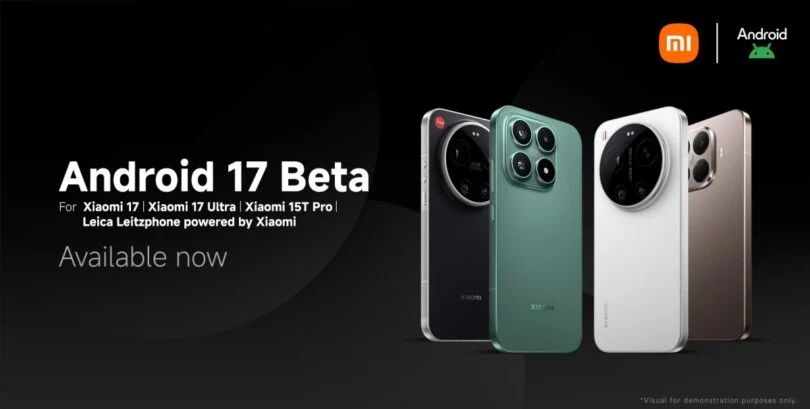
Quick answer: Xiaomi phones get Android 17 in two steps. HyperOS 3.3 moves your phone to Android 17 with almost no visible changes, and it is already available for the Xiaomi 17 and Xiaomi 17 Ultra in Global and European markets. HyperOS 4, also built on Android 17, is the big redesign. Xiaomi’s official stable schedule in China starts on October 15, 2026, with the Xiaomi 17 series first, and global testing is already running through the Mi Pilot program.
This guide explains the difference between Android 17, HyperOS 3.3 and HyperOS 4, which Xiaomi, Redmi and POCO phones have them, how to check and install the update step by step, and what to do if the update does not show up on your phone.
In this article 13 sections
- Android 17 vs HyperOS 3.3 vs HyperOS 4: What Is the Difference?
- Which Xiaomi Phones Have Android 17 Now?
- What Is New in HyperOS 4
- What Android 17 Means for Your Apps
- HyperOS 4 Official Rollout Schedule in China
- HyperOS 4 in the USA and UAE
- Will My Xiaomi, Redmi or POCO Phone Get HyperOS 4?
- How to Check for and Install the Update
- Update Not Showing? Try These Fixes
- Should You Join the Mi Pilot Beta?
- Before You Update: Quick Checklist
- Buying a New Phone? Pick One With Long Updates
- Frequently Asked Questions
Android 17 vs HyperOS 3.3 vs HyperOS 4: What Is the Difference?
| Name | What it is | What you notice |
|---|---|---|
| Android 17 | Google’s base operating system | Shown on the About phone page |
| HyperOS 3.3 | Xiaomi’s first Android 17 build | Almost no visible change; stability fixes and a newer security patch |
| HyperOS 4 | Xiaomi’s major redesign on Android 17 | New Soft Light Glass design, new animations and system changes |
Xiaomi does not ship plain Android. HyperOS is its own software layer, and Xiaomi decides which Android features to add and when. That is why the version number on your phone can say Android 17 while the phone looks the same as before. Xiaomi also skipped HyperOS 3.2 and went straight from HyperOS 3.1 to 3.3 when it moved to Android 17.
Which Xiaomi Phones Have Android 17 Now?
Xiaomi was the first phone maker after Google to release a stable Android 17 build. It started rolling out HyperOS 3.3 in mid-July 2026:
- Xiaomi 17: full public rollout in Global and European regions, about a 7.5GB download.
- Xiaomi 17 Ultra: full public rollout in Global and European regions, about a 9.5GB download.
- Xiaomi 15T Pro: released first to testers in the Mi Pilot program, then more widely.
The changelog for HyperOS 3.3 lists stability improvements and the June 2026 security patch. Several headline Android 17 features, such as app bubbles and screen recording reactions, are not included yet. Think of HyperOS 3.3 as the foundation for HyperOS 4, not a feature update.
What Is New in HyperOS 4
HyperOS 4 is where the real changes are. The main ones Xiaomi has shown in testing are:
- Soft Light Glass UI: a new design language with translucent layers and frosted glass effects across menus, notifications and the Control Center.
- System code rewritten in Rust: Xiaomi has rewritten core parts of the system in the Rust programming language, which is designed to prevent many memory-related security bugs.
- The Android 17 base: newer security patches and the Android 17 platform for apps.
For everyday users, the new look is the most obvious change. For security, the Rust rewrite is the most important one, because memory bugs are one of the most common causes of serious Android vulnerabilities.
What Android 17 Means for Your Apps
Even without big visual changes, moving to Android 17 matters. According to Google’s Android 17 developer page, the release focuses on AI-powered app experiences, an adaptive-first approach that helps apps work better on foldables and tablets, a new contact picker, and stricter rules for background audio.
Here is what that means in practice:
- Better privacy when sharing contacts: the new contact picker lets you share only the contacts an app needs, instead of your whole address book.
- Apps that fit your screen: Android 17 ignores many app limits on orientation and resizing, which helps on foldables such as the Xiaomi MIX Flip 2 and on tablets.
- Fewer surprises from background audio: apps have tighter limits on playing audio in the background.
- Newer security patches: staying on a supported Android version is the best protection against new security threats, especially for banking and payment apps.
If an app such as WhatsApp, Instagram, a banking app or Careem behaves oddly after the update, check the Google Play Store for an update to that app first. Developers usually release fixes within days of a major Android update.
HyperOS 4 Official Rollout Schedule in China
Xiaomi has published an official stable rollout schedule for China. China usually goes first, with Global and European versions following in phased batches.
| Batch | Phones (selected) |
|---|---|
| From October 15, 2026 | Xiaomi 17 Ultra, Xiaomi 17 Pro Max, Xiaomi 17 Pro, Xiaomi 17, REDMI K90 series |
| By October 31, 2026 | Xiaomi 17T Pro, Xiaomi 17T, REDMI Turbo 5 series |
| By November 15, 2026 | Xiaomi 15 Ultra, Xiaomi 15 Pro, Xiaomi 15, Xiaomi MIX Flip 2, REDMI K80 series |
| By November 30, 2026 | REDMI Note 17 Pro, REDMI Note 17, REDMI Note 15 Pro+, REDMI Note 15 Pro, REDMI Note 15 |
Schedule as reported by The Tech Outlook. Some models listed are sold only in China. POCO phones usually follow their Redmi equivalents.
HyperOS 4 in the USA and UAE
Xiaomi has not published a stable global date yet, but global testing is already underway. On September 21, 2026, Xiaomi expanded HyperOS 4 testing in Global and European markets to the Xiaomi 15, Xiaomi 15 Ultra, Xiaomi 17T and Xiaomi 17T Pro through Mi Pilot.
- In the UAE: Xiaomi phones sold officially in the UAE use global software, so they follow the global schedule after China.
- In the USA: Xiaomi does not officially sell its phones in the USA. If you imported a global model, it follows the same global schedule. Chinese models follow the China schedule but may lack Google services.
Will My Xiaomi, Redmi or POCO Phone Get HyperOS 4?
Reports from testing show that HyperOS 4 is only going to phones that also get Android 17. If your phone is staying on Android 16, it will probably stay on HyperOS 3. Here is how to check:
- Find your exact model in Settings > About phone.
- Check Xiaomi’s update policy for your model on the Xiaomi website for your region. It lists how long each phone gets OS and security updates.
- Compare with the schedule above. If your phone, or its Redmi equivalent for POCO models, is listed, it is very likely eligible.
As a rule, phones launched in the last two years from the Xiaomi number series and the Redmi K and Note Pro lines are the most likely to get it. Older budget models are the least likely.
How to Check for and Install the Update
- Back up your phone to Xiaomi Cloud or Google One, including photos, messages and app data.
- Charge to at least 50% and connect to Wi-Fi, since updates can be close to 10GB.
- Free up storage. Keep at least 15GB free so the update can download and install.
- Open Settings and tap About phone.
- Tap the HyperOS version box, then tap Check for updates.
- If an update is available, tap Download, then Install when it finishes. The phone restarts automatically.
Rollouts are staged, so the update can take days or weeks to appear even when your model is listed. Checking again every few days is enough.
Update Not Showing? Try These Fixes
- Wait for the staged rollout. Xiaomi releases updates to a small group first, then expands.
- Check your region. Global, European, Indian and Chinese versions get updates at different times.
- Sign in to your Mi Account. Some builds, especially test builds, need a signed-in Mi Account.
- Keep the bootloader locked. Phones with an unlocked bootloader may not receive official over-the-air updates.
- Restart the phone and check again on Wi-Fi.
Should You Join the Mi Pilot Beta?
Mi Pilot is Xiaomi’s early testing program for global phones. It lets you try HyperOS 4 before the stable release, but test builds can have bugs, battery drain or app problems. Xiaomi requires a linked Mi Account and a locked bootloader to receive these builds.
Join only if you have a backup phone or you are comfortable with occasional problems. If you use your phone for work, banking or content creation every day, wait for the stable release. For most people in the USA and UAE, the stable version will arrive soon enough. If you do join and run into problems, you can leave the program from the same Mi Pilot page, but going back to a stable build may require a full reset, so keep your backup up to date.
Before You Update: Quick Checklist
- Back up WhatsApp chats separately from inside WhatsApp, since they are not always included in a full phone backup.
- Note your important app logins and make sure two-factor authentication works on another device or with backup codes.
- Update your apps from the Google Play Store first, to reduce compatibility problems after the update.
- Do not interrupt the installation or turn the phone off while it is updating.
Buying a New Phone? Pick One With Long Updates
If your phone is not getting Android 17, it may be time to upgrade. Look for phones with a clear, long update promise. Our guide to phone and smartwatch OS updates explains how each brand compares. Xiaomi fans can look at our POCO F9 Ultra price and specs guide, while Samsung’s Galaxy S26 series and the Google Pixel 11 Pro both promise seven years of updates. On a budget, see our best camera phones under $600 | AED 2,200.
Frequently Asked Questions
Which Xiaomi phones have Android 17?
The Xiaomi 17 and Xiaomi 17 Ultra got Android 17 first in Global and European markets through HyperOS 3.3, with the Xiaomi 15T Pro following through Mi Pilot. More phones get Android 17 with HyperOS 4.
Is HyperOS 3.3 the same as HyperOS 4?
No. HyperOS 3.3 moves your phone to Android 17 with almost no new features. HyperOS 4 is the major redesign built on Android 17.
When does HyperOS 4 start rolling out?
Xiaomi’s official stable rollout in China starts on October 15, 2026, with the Xiaomi 17 series. Global testing is running through Mi Pilot, and Xiaomi has not yet published a global date.
Did Xiaomi skip HyperOS 3.2?
Yes. Xiaomi paired Android 17 with HyperOS 3.3 and skipped version 3.2.
Will my Android 16 Xiaomi phone get HyperOS 4?
Probably not. Testing shows HyperOS 4 is going only to phones that also get Android 17.
How big is the Android 17 update for Xiaomi?
About 7.5GB on the Xiaomi 17 and about 9.5GB on the Xiaomi 17 Ultra, so use Wi-Fi and keep plenty of free storage.
Do POCO phones get HyperOS 4?
POCO phones usually receive updates around the same time as their Redmi equivalents, as long as they are still within Xiaomi’s update period.
Image credits: Photo: 茅野ふたば / Wikimedia Commons, CC BY-SA 4.0





Leave a Comment