
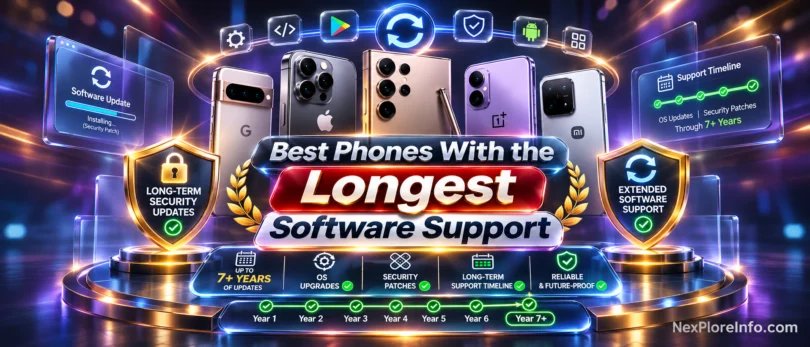
Ever wonder how long your phone will actually keep getting updates before it quietly turns into a security risk? That question matters more than any camera spec, and it’s exactly why the phones with the longest software support are worth seeking out, since once a phone stops getting Android or iOS patches, the apps you trust with your banking and personal data get a lot less safe. It also shapes resale value, how comfortable the phone feels to keep using, and honestly, how much e-waste piles up when a perfectly good phone gets cut off from updates way too early.
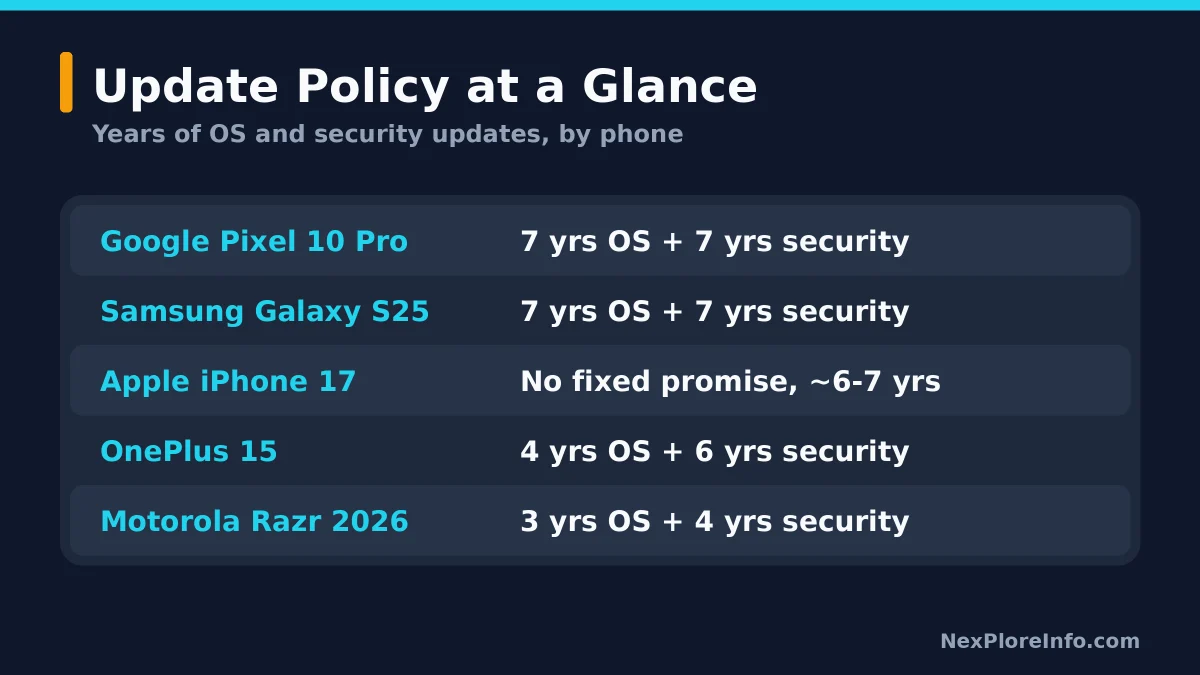
Quick answer: Google’s Pixel 10 Pro and Samsung’s Galaxy S25 currently lead the pack, both promising seven years of OS and security updates, and both priced between $799 and $999 in the USA (AED 3,030 to AED 3,199 in the UAE). Apple doesn’t publish a fixed number, but the iPhone’s real-world record sits around six to seven years. OnePlus and Motorola trail well behind, and that matters if you’re the type who keeps a phone for the long haul.
In this article 11 sections
- The Phones With the Longest Software Support: Quick Comparison
- How Many Years of Updates Does Google Give the Pixel 10 Pro?
- Does the Samsung Galaxy S25 Match Google’s Seven-Year Promise?
- How Long Does Apple Actually Support the iPhone 17?
- What About OnePlus and the OnePlus 15?
- Why Does the Motorola Razr 2026 Fall Behind?
- Which Phone Should You Buy for Long-Term Use?
- Why Software Support Years Actually Matter
- How to Check How Many Updates Your Own Phone Has Left
- Things to Know Before You Buy
- FAQs
The Phones With the Longest Software Support: Quick Comparison
Here’s how the numbers stack up before we get into the details. Prices below were checked on November 3, 2026, and can shift with promotions.
| Phone | Major OS Updates | Security Updates | USA Price | UAE Price |
|---|---|---|---|---|
| Google Pixel 10 Pro | 7 years | 7 years | $999 | around AED 3,030 |
| Samsung Galaxy S25 | 7 years | 7 years | $799 | AED 3,199 |
| Apple iPhone 17 | No fixed promise, ~6 to 7 years in practice | Bundled with OS updates | $799 | AED 3,099 |
| OnePlus 15 | 4 years | 6 years | $900 | around AED 3,650 |
| Motorola Razr 2026 | 3 years | 4 years | $800 | around AED 3,170 |
How Many Years of Updates Does Google Give the Pixel 10 Pro?
Seven. Google promises seven full years of Android OS upgrades and seven years of security patches on the Pixel 10 Pro, which is the longest guaranteed commitment of any phone sold in the USA or UAE right now. That policy has held for every Pixel since the Pixel 8 launched back in 2023, and so far, Google has actually kept its word.
In practical terms, a Pixel 10 Pro bought today should keep getting the yearly Android version bump, Google’s “feature drop” updates, and monthly security patches through roughly 2032. If you’re someone who runs a phone until it genuinely wears out instead of swapping every two years, that’s about the strongest safety net you can buy. You can check the official policy for yourself on Google’s Pixel support page.
Does the Samsung Galaxy S25 Match Google’s Seven-Year Promise?
Yes, it does. Samsung now matches Google at seven years of OS updates and seven years of security patches on the Galaxy S25 line, a policy it extended in 2025 to cover its flagship S series, its foldables, and a handful of mid-range models too. That’s a big leap from the four years Samsung was offering as recently as the Galaxy S20 generation.
Samsung has gone a step further and published the exact end dates for individual models right on its own support pages, including the official Samsung UAE support page covering its foldables. Trying to decide between a Galaxy S25 and our Galaxy S26 Ultra buying guide? Both generations sit on the same seven-year policy, so really, it comes down to price and features rather than longevity.
How Long Does Apple Actually Support the iPhone 17?
Apple has never put a guaranteed number in writing, which is a bit odd for a company that loves to brag about specs. What it does have, though, is a strong track record. The iPhone SE (2nd generation), which launched way back in April 2020, is still sitting on the official iOS 26 compatibility list. Do the math and that works out to roughly five and a half to six years of major OS updates, and a few older iPhone generations have stretched close to seven before finally losing support.
Going by that history, an iPhone 17 bought today should reasonably get iOS updates well into the early 2030s, even without anything official in writing. If price-to-performance matters more to you than the brand on your phone, our iPhone 17 Pro Max price and buying breakdown covers how the bigger iPhone compares to this base model.
What About OnePlus and the OnePlus 15?
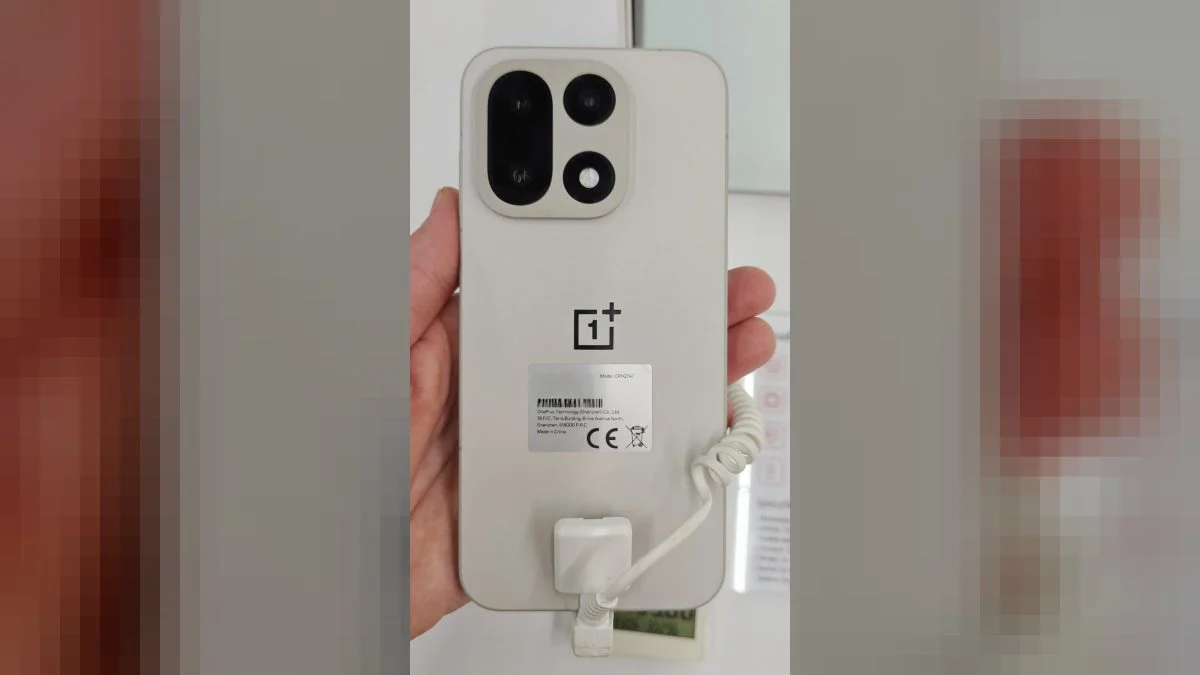
OnePlus promises four years of major Android OS upgrades and six years of security patches under its current flagship policy, and that covers the OnePlus 15. It’s a real improvement over the two or three years OnePlus used to offer a few generations back, and the brand locked in that same four-year OS commitment for its previous flagship series too.
Four years of OS updates still falls short of what Google or Samsung offer, but six years of security patches at least keeps the phone reasonably safe to use even after new Android versions stop arriving. Want the full hardware rundown? Our OnePlus 15 price and specs guide covers the rest.
Why Does the Motorola Razr 2026 Fall Behind?
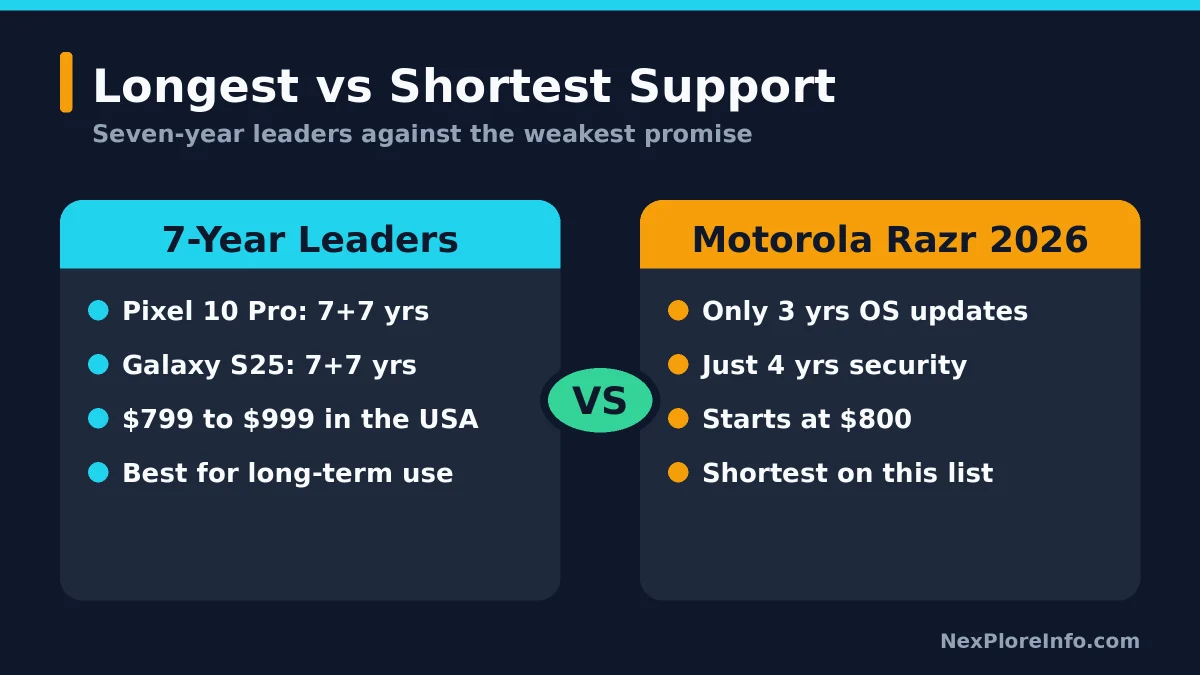
The Motorola Razr 2026, Razr+ 2026 and Razr Ultra 2026 each get three major Android OS updates and four years of security patches, which is the shortest window on this entire list. Motorola’s own support site lists that four-year security figure directly, and independent reporting has since confirmed it after some early confusion over the exact numbers.
That’s a letdown for a flip phone starting at $800 in the USA and around AED 3,170 in the UAE, roughly the same price bracket as the Galaxy S25. If software longevity matters to you, the Razr’s folding design and pocketable size come at a real cost in update years.
Which Phone Should You Buy for Long-Term Use?
If holding onto the same phone for five years or more is the goal, the Pixel 10 Pro and Galaxy S25 are the only two here with a written seven-year guarantee covering both the OS and security side. Between the two, the Galaxy S25 is cheaper at launch and benefits from Samsung’s wider accessory and carrier support, while the Pixel 10 Pro leans on Google’s camera processing and a cleaner Android experience.
If you’re already in Apple’s ecosystem, you probably don’t need to lose much sleep either. The iPhone’s real-world update history is close enough to Samsung’s and Google’s official numbers that switching platforms just for software longevity usually isn’t worth the hassle. OnePlus makes a decent middle ground for buyers chasing performance and fast charging who are fine replacing the phone within four or five years. The Motorola Razr 2026, though, is the one to think twice about if a long software life matters to you. The folding display and compact design are genuinely impressive, but the update promise is easily the weakest of the bunch.
Why Software Support Years Actually Matter
A phone that’s lost security updates still works, technically, but it gets a little riskier every month that passes without a patch. Banking apps, payment wallets, and even some app stores will eventually refuse to run on an outdated OS version, and unpatched security flaws are exactly what scammers and malware go looking for first.
Longer support windows also change the math on when to upgrade. A Pixel or Galaxy phone bought today could realistically get handed down to a family member in three or four years and still pull patches for several more years after that, which is a very different picture from a phone that loses support in year three. There’s an environmental upside too: keeping a phone in service for seven or eight years instead of three means one less device ending up in a recycling bin or a drawer somewhere.
How to Check How Many Updates Your Own Phone Has Left
You don’t have to dig through old press releases to figure this out for a phone you already own. Here’s the fast way to check, on either platform.
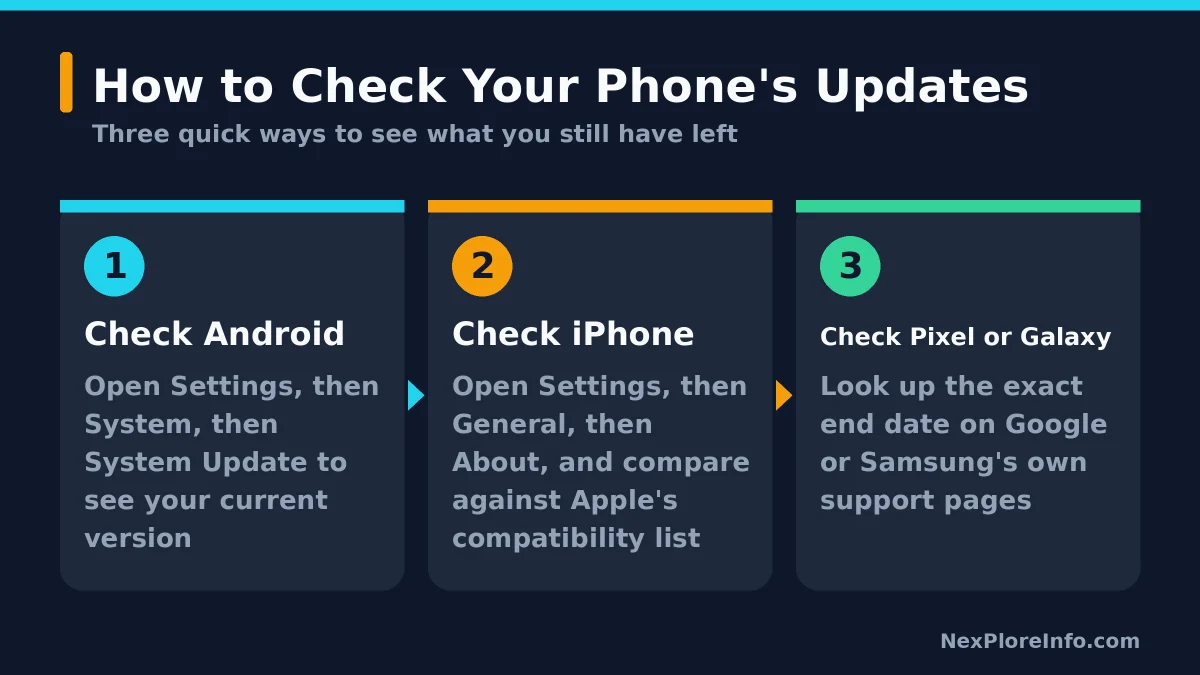
- On Android: open Settings, then System, then System Update (the wording shifts slightly depending on the brand). This usually shows your current Android version and sometimes the end-of-support date too.
- On iPhone: open Settings, then General, then About, and check which iOS version is installed. Apple doesn’t post an end date anywhere, so comparing your model against the current compatibility list on Apple’s own support page, linked above, is the most reliable way to see where you stand.
- For Samsung and Google specifically: both companies publish a searchable list of exact update end dates by model name, which is worth bookmarking well before your next upgrade.
Things to Know Before You Buy
- Security-only updates still count for something. A phone getting security patches without new Android or iOS versions is still safer to bank and shop on than one getting nothing at all.
- Carrier-locked phones in the USA can lag weeks or even months behind the unlocked update schedule, so keep that in mind if you’re buying through a carrier plan.
- In the UAE, grey-market or imported units don’t always get updates on the same schedule as phones bought through authorized retailers, so paying a bit more at an official store is usually worth it for the long run.
- Update policies can change for whatever phone comes next in a lineup. The figures above apply to the specific models named here, not necessarily to the next phone a brand puts out.
FAQs
Which phone brand gives the most years of software updates right now?
Google and Samsung are tied for the longest written commitment at the moment, both promising seven years of major OS updates and seven years of security patches on their current flagship lines, including the Pixel 10 Pro and the Galaxy S25.
Does Apple guarantee a fixed number of years of iOS updates?
No, it doesn’t. Apple has never published an official number, but its real-world record is solid, with some iPhone models pulling major iOS updates for six to seven years after launch.
Is four years of Android updates on the OnePlus 15 enough?
That depends on how long you plan on keeping the phone. Four years of major OS updates plus six years of security patches works fine for most people who upgrade every three to four years, but it comes up short for anyone planning to hang onto the phone for five years or longer.
Why does the Motoroola Razr 2026 only get three years of OS updates?
Motorola has historically offered shorter software support than Google, Samsung or Apple, and the 2026 Razr lineup keeps that pattern going with three major Android updates and four years of security patches, confirmed right on Motorola’s own support site.
Do security updates stop the moment OS updates end?
Not usually. Most manufacturers, OnePlus and Motorola included, keep issuing security-only patches for a year or two after the last major OS update, which is why the security figures above run longer than the OS update figures.
Does a longer software support window affect resale value?
Generally, yes. Phones with longer official update promises, like Pixel and Galaxy models, tend to hold their resale value better over time simply because buyers know the phone will keep working safely for longer.
Image credits: Phone photography sourced via Wikimedia Commons under CC BY-SA and CC0 licenses, credited individually where used.




Leave a Comment