
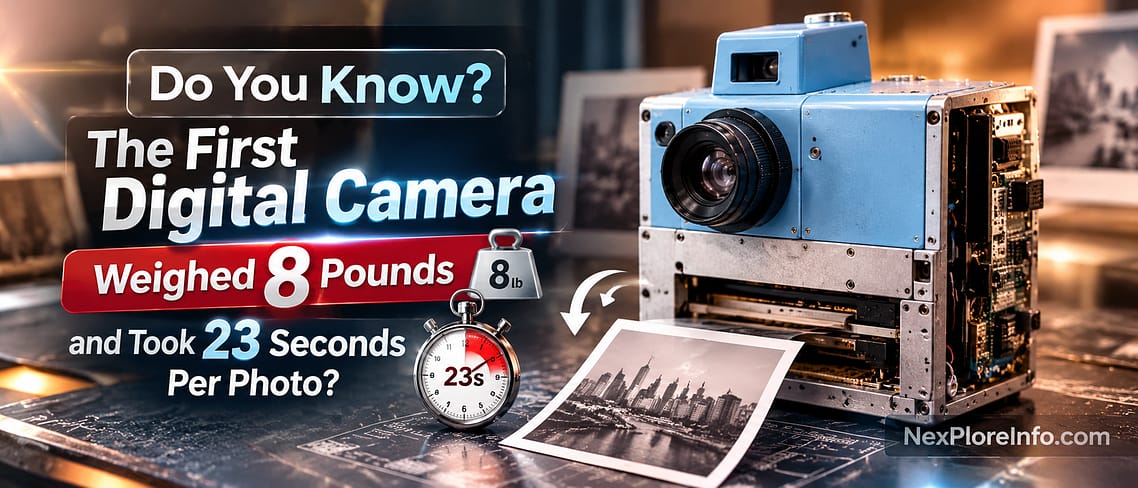
Quick answer: The first handheld digital camera was built by Kodak engineer Steven Sasson in December 1975. Kodak’s 1975 prototype is widely recognized as the first self-contained handheld digital camera, created in Rochester, New York. It weighed about 8 pounds, captured a black and white image of just 0.01 megapixels (100 x 100 pixels), saved it to a cassette tape in about 23 seconds, and needed a separate TV to display the result. Kodak owned the idea, then hesitated to sell it. Here is the full story, with the numbers that matter.
Who Built the First Digital Camera and When?
Steven Sasson, a young engineer at Eastman Kodak in Rochester, New York, started testing the imaging performance of charge-coupled device (CCD) sensors in 1974. By December 1975 he had a working, self-contained prototype, with help from Gareth Lloyd. The IEEE-backed Engineering and Technology History Wiki recognizes it as the “First Hand-Held Solid-State Still Camera, 1975”, and a plaque was dedicated at Kodak’s Rochester site on April 26, 2022.
The patent followed later. US Patent 4,131,919, titled “Electronic still camera”, was filed on May 20, 1977.
First Digital Camera Specs: How Many Megapixels Did It Have?
The prototype looks almost comically limited next to a modern phone. This table is NexPloreInfo’s own compilation of the figures documented by the sources linked in this article.
| Specification | Kodak prototype (1975) |
|---|---|
| Inventor | Steven Sasson (with Gareth Lloyd) |
| Weight | About 8 pounds (roughly 3.6 kg) |
| Sensor | Fairchild CCD, 100 x 100 pixels |
| Resolution | 0.01 megapixels, black and white |
| Storage | Digital cassette tape |
| Time to record one image | About 23 seconds |
| Time to read it back for display | About 23 more seconds, shown on a TV |
What Was Inside the First Digital Camera?
Sasson has described building it from parts that were already lying around. In his account to PetaPixel, the lens came from a used parts bin on the Super 8 movie camera production line. The rest was a portable cassette recorder, 16 nickel-cadmium batteries, a CCD sensor, an analog-to-digital converter adapted from a voltmeter, and several circuit boards.
That recipe is the surprising part. There was no single breakthrough component. The invention was the idea of capturing light as digital data, storing it as numbers, and turning it back into a picture later.
Why Did the First Digital Camera Take So Long to Show a Photo?
Two slow steps added up. Writing one frame to the cassette took about 23 seconds. Reading it back and displaying it on a television took roughly another 23. A photo you could not review on the camera itself, and that took close to a minute to appear, sounds unusable today. But Sasson was not trying to build a product. He was proving that an image could be captured without film at all.
Did Kodak Really Hide Its Own Invention?
This is the part most people have heard in simplified form. According to Fstoppers’ retelling of Sasson’s story, Kodak management declined to commercialize a more refined 1989 version he built with Robert Hills, fearing it would cut into film sales. Film, chemicals and paper were the core of Kodak’s profits.
To be fair, the real picture is more nuanced than “Kodak ignored digital.” Kodak did later sell digital cameras and held many digital imaging patents. But the company moved slowly away from film, and it filed for Chapter 11 bankruptcy protection in January 2012. Sasson himself later received the US National Medal of Technology and Innovation.
Fact check note: Many articles claim Kodak’s reaction to the prototype was “that’s cute, but don’t tell anyone.” It is a popular quote in retellings, but we did not find it in the primary sources above, so we have not treated it as verified.
How Far Have Camera Sensors Come Since 1975?
The 1975 camera had 10,000 pixels. Many flagship phones now carry 200MP main sensors, which is 200,000,000 pixels, about 20,000 times more. We covered one of those cameras in our Honor Magic9 price and specs article. If you want a camera phone that fits your budget today, see our best camera phones under $600 | AED 2,200 guide.
The camera also reminds us that “firsts” depend on definitions. This was the first handheld, self-contained, solid-state still camera. Digital imaging itself involved many people and organizations. For another first with a debated definition, read our piece on the first smartphone, the 1994 IBM Simon.
Key Findings
- The first handheld digital camera was completed in December 1975 by Steven Sasson at Kodak.
- It weighed about 8 pounds and recorded 0.01 megapixel black and white images.
- Each image took about 23 seconds to record and 23 more to display on a TV.
- It was assembled from off-the-shelf parts, including a Super 8 movie camera lens.
- Kodak later declined to commercialize a 1989 version and filed for bankruptcy protection in 2012.
FAQs
When was the first digital camera invented?
The first self-contained handheld digital camera was completed by Kodak engineer Steven Sasson in December 1975.
What did the first digital camera use to store photos?
It stored digital image data on a magnetic cassette tape rather than film or a memory card.
Who invented the first digital camera?
Steven Sasson, an engineer at Eastman Kodak, built the first handheld digital camera prototype in December 1975, with help from Gareth Lloyd.
How many megapixels did the first digital camera have?
It had 0.01 megapixels, a 100 x 100 pixel sensor, and captured black and white images only.
How much did the first digital camera weigh?
About 8 pounds, roughly the size of a toaster.
Why did Kodak not sell the first digital camera?
Kodak management feared digital photography would hurt its profitable film business, and did not commercialize Sasson’s refined 1989 camera.
Was the first digital camera really invented by Kodak?
Kodak’s Sasson built the first self-contained handheld digital still camera. Digital imaging itself drew on work by many engineers and companies, including the CCD sensor maker Fairchild.
Facts verified as of October 4, 2026.


Leave a Comment